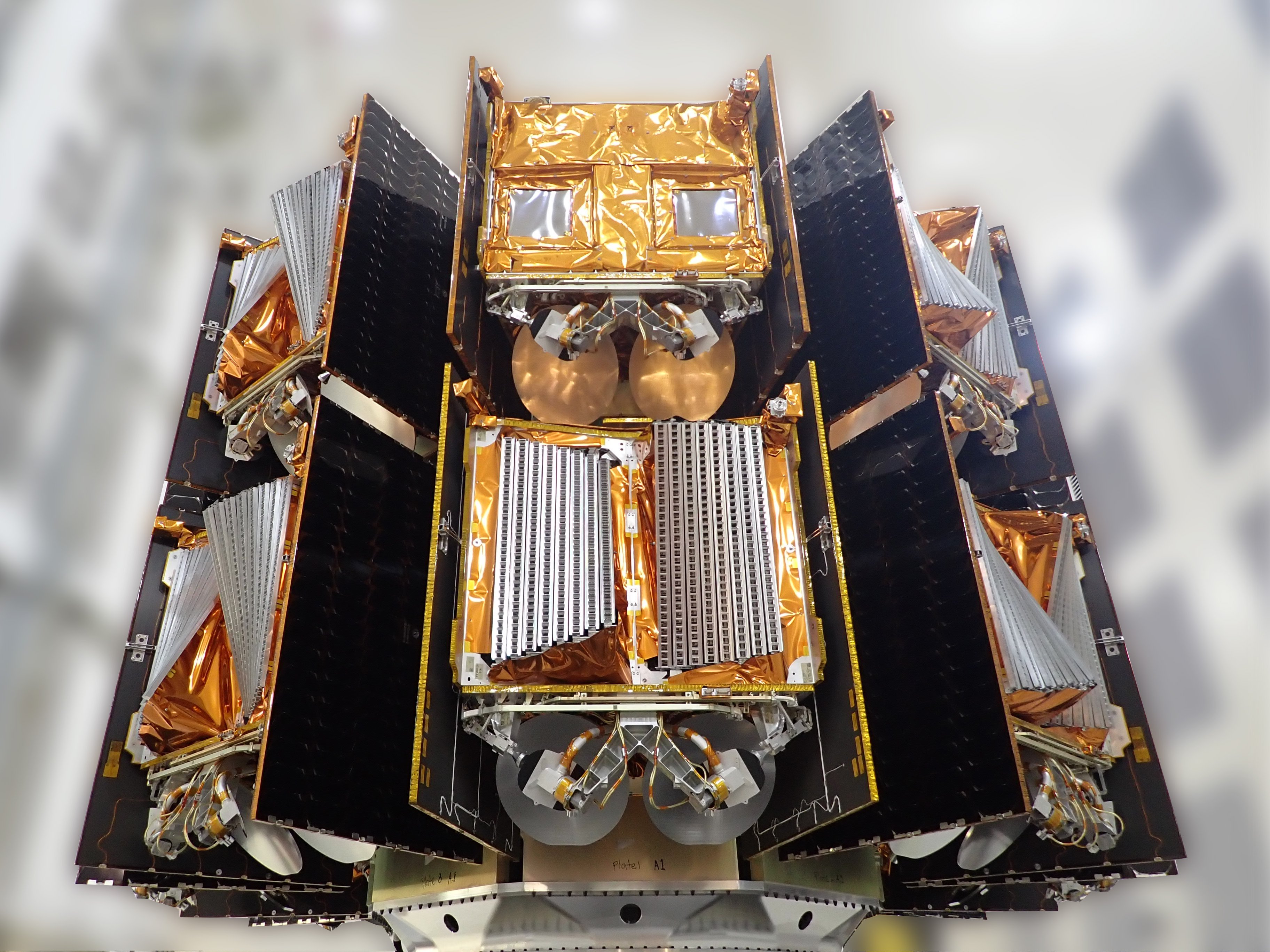
SpaceX launched Eutelsat’s latest geostationary satellite March 30 on a trip due to take around half a year to a geostationary orbit slot over Africa and Eurasia. A Falcon 9 rocket carrying the roughly 5,000-kilogram Eutelsat 36D lifted off 5:52 p.m. Eastern from Launch Complex 39A at Kennedy Space Center, Florida, and placed the satellite into a geostationary transfer orbit 34 minutes later. Eutelsat 36D is based on the all-electric Airbus Eurostar Neo platform and equipped with 70 physical Ku-band transponders for providing TV and government connectivity services from 36 degrees East. The satellite has a steerable antenna and is set to replace French fleet operator Eutelsat’s aging Eutelsat 36B satellite. Eva Berneke, Eutelsat’s CEO, said Eutelsat 36D is on track to start commercial services in the second half of 2024, after reaching position and completing health checks. The satellite would be co-located with Ekspress-AMU1, also known as Eutelsat 36C, which Russia’s RSCC operates. Ekspress-AMU1 is one of the satellites Eutelsat leases capacity from to have been caught up in sanctions amid Russia’s war in Ukraine.
SpaceX launched a geostationary satellite for Eutelsat in its 30th mission so far this year. Credit: SpaceX
Reuse anniversary
The rocket’s first stage landed as planned on a droneship in the Atlantic Ocean post-launch, marking the 273rd time SpaceX has returned a Falcon 9 booster for reuse.
SpaceX launched its first reused Falcon 9 booster for a customer seven years earlier in a mission for SES of Luxembourg March 30, 2017.
The Eutelsat 36D launch also marked SpaceX’s 30th mission this year.
But less than four hours later, SpaceX launched a batch of satellites for its Starlink low Earth orbit (LEO) broadband constellation from a nearby pad at the Cape.
SpaceX had planned to launch another set of Starlink satellites March 30 from Vandenberg, California, but scrubbed this mission because of poor weather.
Alongside 35 geostationary satellites, Eutelsat operates a network of more than 600 LEO satellites after buying OneWeb last year.
The company expects to have completed 90% of the ground network OneWeb needs for full global services by the end of June.
According to Eutelsat, multi-orbit capabilities will give it an edge over Starlink and other single-orbit constellations by offering enterprise and government customers extra network redundancy and flexibility.
Intuitive Machines and SpaceX have confirmed plans to launch the IM-1 lunar lander mission as soon as Feb. 14, pending a fueling test on the pad later this week. In a Feb. 5 statement, Intuitive Machines announced it was targeting a launch of its lander in a “multi-day window” that opens Feb. 14. Liftoff of the Falcon 9 from Kennedy Space Center’s Launch Complex 39A is scheduled for 12:57 a.m. Eastern that day. The announcement came hours after a SpaceX official, speaking at a briefing about the upcoming launch of NASA’s PACE Earth science mission on another Falcon 9, confirmed that Feb. 14 date, which had been widely known in the industry but which neither NASA nor Intuitive Machines would disclose at a Jan. 31 briefing about the agency’s payloads on the lander. “Our Intuitive Machines launch is targeting Feb. 14, Valentine’s Day,” said Julianna Scheiman, director of civil satellite missions at SpaceX, at the Feb. 5 briefing. “We’re tracking well to a Feb. 14 launch.” One final milestone before that launch is a fueling test, or wet dress rehearsal, scheduled for Feb. 7. That is important for IM-1 since the lander needs to be loaded with liquid oxygen and methane propellants while on the launch pad shortly before launch, a procedure that required modifications to the infrastructure at LC-39A. “We’ll be performing essentially a tanking test, or wet dress rehearsal, for that spacecraft on Feb. 7,” she said, to confirm that the spacecraft can be fueled on the pad.
Intuitive Machines says its IM-1 lunar lander mission is scheduled for launch as soon as Feb. 14, with a tanking test scheduled for Feb. 7. Credit: SpaceX
While Intuitive Machines said in its statement that it had a multi-day window, Scheiman said the mission had a three-day window, with launch opportunities Feb. 14 through 16. Intuitive Machines previously stated that a launch any day in that window would set up a landing attempt on Feb. 22.
The 675-kilogram lander, called Odysseus by the company, is carrying six payloads for NASA through a Commercial Lunar Payload Services (CLPS) award valued at $118 million. It is also carrying six commercial payloads, ranging from sportswear company Columbia to artist Jeff Koons. The commercial payloads also include Eaglecam, a camera developed by students at Embry-Riddle Aeronautical University that will eject from the lander during its final descent to the surface to attempt to photograph the landing.
If IM-1 is successful, it will be the first private mission to land softly on the moon after three previous failed attempts. The Beresheet lander by Israel’s SpaceIL crashed during its descent to the lunar surface in 2019, and the HAKUTO-R M1 lander from Japanese company ispace crashed attempting a landing in April 2023. Astrobotic’s Peregrine lunar lander suffered a propellant leak hours after its Jan. 8 launch that prevented the spacecraft from attempting a lunar landing.
A Cygnus cargo spacecraft is set to launch on a Falcon 9 rocket for the first time, a combination that required more changes to the rocket than to the spacecraft. NASA announced at a Jan. 26 briefing that it was targeting Jan. 30 at 12:07 p.m. Eastern for the launch of the NG-20 cargo mission from Cape Canaveral’s Space Launch Complex 40. That is a one-day slip from previous plans, which the agency said was to “accommodate launch pad readiness.” If Cygnus launches that day, it will arrive at the International Space Station early Feb. 1. The launch marks the first time Northrop Grumman’s Cygnus cargo spacecraft has flown on Falcon 9. All previous launches of Cygnus have been on Northrop’s own Antares launch vehicle with the exception of two missions that launched on United Launch Alliance’s Atlas 5 after an Antares launch failure in 2014. Northrop plans to launch at least three Cygnus missions on Falcon 9 rockets as it works with Firefly Aerospace on a new version of the Antares, replacing the Ukrainian-built first stage powered by Russian engines with a stage developed by Firefly using its own engines. That vehicle, the Antares 330, is slated to begin launches as soon as mid-2025. The shift to the Falcon 9 has been relatively smooth for Northrop. “We didn’t really have to make any modifications to the Cygnus,” said Cyrus Dhalla, vice president and general manager of tactical space systems at Northrop Grumman, during the briefing. The company did make minor changes to the cargo loading process, which he attributed to doing it in a new facility with different equipment.
The NG-20 Cygnus cargo spacecraft being encapsulated for launch on a Falcon 9. Credit: SpaceX
The shift in launch vehicles doesn’t alter the capabilities of the Cygnus, he added. The NG-20 mission will carry a little more than 3,700 kilograms of cargo, the capacity of the current version of the vehicle.
SpaceX, though, did have to make changes to accommodate Cygnus, specifically its ability for “late load” of cargo within 24 hours of launch. The Antares has a “pop top” opening at the top of the rocket’s payload fairing, allowing access to the Cygnus inside for cargo loading after the spacecraft has been encapsulated.
To provide a similar late load capability for Falcon 9 launches of Cygnus, SpaceX created what Bill Gerstenmaier, vice president of build and flight reliability at SpaceX, called a “gigadoor” in the fairing of the Falcon 9. That is a door 1.5 by 1.2 meters in the side of the fairing that can be opened to provide environmentally controlled access to the Cygnus inside.
“This will be the first time we’ve done that,” he said, as SpaceX’s own Dragon spacecraft launches without a fairing. “It’s taken a lot of modifications on our part to get this hardware ready to go fly.” He added that putting the door in the payload fairing does not affect SpaceX’s ability to recover and reuse it.
“We really appreciate how SpaceX has worked with us to accommodate the flow of cargo and integration, and we’ve been able to reuse a lot of our procedures,” Dhalla said.
Besides the development of the payload fairing door for Cygnus launches, SpaceX has been testing modifications to its transporter erector at Launch Complex 39A, enabling it to load liquid methane and oxygen propellants. That is required for the upcoming launch of the IM-1 lunar lander by Intuitive Machines, which will be fueled on the pad, inside the payload fairing, shortly before launch.
Gerstenmaier said SpaceX was doing testing of that equipment to ensure it is ready for the IM-1 launch, currently projected for mid-February. “That work is pretty much on track,” he said. “It’s a lot of interesting integration but, as you see even with this Northrop Grumman 20 mission, we at SpaceX like to do innovative and creative things.”
SpaceX Chief Executive Elon Musk says a propellant dump caused the destruction of the Starship upper stage on a November test flight, giving him confidence that the vehicle can reach orbit on its next launch. On that Nov. 18 launch, the Starship upper stage, or ship, was nearing the end of its burn to place it on a long suborbital trajectory when contact was lost. Hosts of the SpaceX webcast said it appeared the automated flight termination system was activated, but did not give a reason why, and the company provided few details since. At a recent event at SpaceX’s Starbase test site in Boca Chica, Texas, video of which SpaceX posted on social media Jan. 12, Musk said the failure was linked to venting liquid oxygen propellant near the end of the burn. That venting, he said, was needed only because the vehicle was not carrying any payload. “Flight 2 actually almost made it to orbit,” he said. “If it had a payload, it would have made it to orbit because the reason that it actually didn’t quite make it to orbit was we vented the liquid oxygen, and the liquid oxygen ultimately led to a fire and an explosion.” That venting, he said, would have been unnecessary if the ship had a payload, presumably because it would have been consumed by the Raptor engines on the vehicle in order to reach orbit. He didn’t elaborate on how the venting triggered the fire, or discuss the explosion of the Super Heavy stage shortly after stage separation.
The Starship upper stage separates from the Super Heavy booster on a November 2023 launch. Credit: SpaceX
Musk said that failure mode gave him confidence for the next Starship test flight. “I think we’ve got a really good shot of reaching orbit with Flight 3,” he said.
That third flight is currently projected for February, SpaceX’s Jessica Jensen during a Jan. 9 NASA briefing, pending receipt of an updated launch license from the Federal Aviation Administration. Musk described a more ambitious flight plan for the mission with additional tests of Starship.
“We want to get to orbit and we want to do an in-space engine burn from the header tank” at the top of the vehicle, he said. Doing so would “prove that we can
A NASA spacecraft is finally on its way to a metallic main belt asteroid after a successful Falcon Heavy launch Oct. 13. The SpaceX Falcon Heavy rocket lifted off from the Kennedy Space Center in Florida at 10:19 a.m. Eastern. Its payload, NASA’s Psyche spacecraft, separated from the upper stage 62 minutes after liftoff. The launch was the eighth for the Falcon Heavy but the first by that rocket for NASA. In a statement, NASA said controllers established two-way communications with the spacecraft at 11:50 a.m. Eastern, confirming the spacecraft was in good condition as it goes through initial post-launch commissioning. Psyche is a Discovery-class planetary science mission whose destination is an object in the main asteroid belt also called Psyche. That asteroid is made primarily of metal and could be the core of a larger object whose outer layers were stripped away. On its way to the asteroid, the Psyche spacecraft will conduct a technology demonstration. The Deep Space Optical Communications payload on the spacecraft will test the ability of lasers to provide high-bandwidth communications at interplanetary distances. The launch took place more than a week into a three-week launch period. In late September NASA delayed the launch, once scheduled for Oct. 5, by a week after a review found concerns with the operating temperature of cold-gas thrusters used to maneuver the spacecraft. Engineers had to revise the operating parameters of the thrusters to avoid overheating.
A SpaceX Falcon Heavy lifts off Oct. 13 carrying NASA's Psyche spacecraft. Credit: Jordan Sirokie
“There would have been a potential risk of overheating the thrusters and damaging them” if the parameters were not changed, Henry Stone, Psyche project manager at the Jet Propulsion Laboratory, said at an Oct. 11 briefing. “It was a serious issue that we had to deal with.”
The changes involve a “select subset of parameters” to the thrusters, he said, but did not elaborate on the changes. Those changes, he said, will not affect Psyche’s operations once at the asteroid. “The changes affected some of the timeline margins that we already had, but we’ll conduct the same operations when we get to the body.”
NASA rescheduled the launch for Oct. 12, but postponed it another day because of poor weather. The launch period ran through Oct. 25, with instantaneous launch windows each day. Earlier problems
Psyche was originally scheduled to launch in August 2022. Delays in testing the flight software, though, forced NASA to skip launch opportunities in August and October 2022. An independent review found that those testing delays were symptoms of broader institutional issues at JPL.
While the problems with both Psyche and JPL have been corrected, they affected several NASA science missions. The 14-month launch delay pushed back the spacecraft’s arrival at the asteroid from 2026 to August 2029. The mission’s cost also increased 20% from $1 billion to $1.2 billion.
Psyche’s delay also affected Janus, an asteroid smallsat mission that was to fly as a secondary payload on the launch. The delay meant that Janus could not fly its original mission to go by two pairs of binary asteroids, and the mission could not find suitable alternative targets with its revised trajectory. NASA announced in July it was canceling Janus and putting the completed spacecraft in storage.
The institutional issues at JPL uncovered in the independent review of Psyche’s delays led NASA to delay the next Discovery-class mission under development at JPL, the Venus Emissivity, Radio science, InSAR, Topography, And Spectroscopy, or VERITAS. That mission, selected in 2021 for launch in 2028, is now scheduled for launch no earlier than 2031.
The Psyche delay and budget increase added stress to the overall NASA planetary science program already dealing with challenges like Mars Sample Return. In the agency’s fiscal year 2024 budget request, NASA said it was postponing a heliophysics mission, the Geospace Dynamics Constellation, citing “high budgetary requirements” from other programs.
The Psyche spacecraft will arrive at the asteroid of the same name in 2029. Credit: NASA/JPL-Caltech/ASU
“A new kind of world”
NASA, and scientists involved with Psyche, said the mission is worth the wait and the additional cost. The spacecraft will spend 26 months orbiting at Psyche in four different orbits, studying the largest solar system body made primarily of metal.
“This will be our first time visiting a world that has a metal surface,” said Lindy Elkins-Tanton, Psyche principal investigator at Arizona State University, at a pre-launch briefing.
A key goal of the mission is to determine Psyche’s origins, said Ben Weiss, Psyche deputy principal investigator at the Massachusetts Institute of Technology. “We have two leading ideas about how Psyche formed,” he said, either as the core of a planetesimal that failed to become a planet, or as a primordial body enriched in metal for some reason.
“We are going to go into orbit around Psyche and measure its various properties at lower and lower altitudes,” he said. The spacecraft is equipped with a camera, gamma-ray and neutron spectrometer and magnetometer.
“It’s primary exploration of a new kind of world,” said Elkins-Tanton. “There aren’t that many completely unexplored types of worlds in our solar system to go see, so that is what is so exciting about this.”
A Falcon 9 launched a multinational crew to the International Space Station Aug. 26 after a one-day delay to check the spacecraft’s life support system. The SpaceX Falcon 9 lifted off from Launch Complex 39A at the Kennedy Space Center at 3:27 a.m. Eastern on the Crew-7 mission for NASA. The Crew Dragon spacecraft Endurance separated from the Falcon 9’s upper stage a little more than 12 minutes later. Endurance, with its crew of four, is scheduled to dock with the zenith port on the Harmony module of the ISS at 8:39 a.m. Eastern Aug. 27. That will kick off a roughly six-month stay on the station. The launch was scheduled for Aug. 25 but postponed several hours before the scheduled liftoff. NASA said that engineers needed more time to review a component of the Crew Dragon’s life support system, known as ECLSS. NASA did not initially state what that component was but later said it was valves in an air supply system. Steve Stich, NASA commercial crew program manager, said at the post-launch briefing that after discovering corroded valves in the propulsion system of a cargo Dragon in June, SpaceX “out of an abundance of caution” decided to review all valves on the spacecraft, including for life support and propulsion. The review was designed to check the “force margin,” or the ability of the valve to open and close. “It took a little bit more time to get through the ECLSS valves,” he said, which led to the one-day slip. “We said, let’s stand down for 24 hours and make sure we understand it before we go fly.” That review confirmed that the valves were working properly and required no changes.
A Falcon 9 lifts off from the Kennedy Space Center Aug. 26 on the Crew-7 mission to the ISS. Credit: NASA/Joel Kowsky
During the launch countdown, controllers reported a sensor issue that was cleared shortly before liftoff. At the post-launch briefing, officials said that sensors had detected trace amounts of nitrogen tetroxide, or NTO, from the Crew Dragon spacecraft that indicated a possible propellant leak. NTO is one of the two hypergolic propellants used by the spacecraft’s thrusters.
Benji Reed, senior director of the human spaceflight program at SpaceX, said at the post-launch briefing that the levels of NTO detected were about 0.25 parts per million. Three engineers independently calculated what level of leak could cause that reading and all three came to the same conclusion. “The good news was that the number that we came up with was well within the range of what you might normally see.”
That assessment, though, came down to the wire. “We were working the problem and we cleared it within the last two minutes of the count,” he said.
Crew-7 is the first commercial crew flight to carry people from four different agencies. The mission is commanded by NASA astronaut Jasmin Moghbeli on her first flight to space. European Space Agency astronaut Andreas Mogensen is the pilot; he made a 10-day trip to the station on a Soyuz spacecraft in 2015. Satoshi Furukawa of the Japanese space agency JAXA and Roscosmos cosmonaut Konstantin Borisov are mission specialists. Furukawa flew a long-duration mission to the ISS in 2011 while Borisov is on his first trip to space.
That multinational lineup was simply how the crew assignments worked out, said Joel Montalbano, NASA ISS program manager, at a preflight briefing Aug. 21. “The way the timing worked out for this one with our integrated crew agreement that we have with Roscosmos, it was time for these other folks to fly,” he said.
Stich said at that briefing that another milestone for Crew-7 is having a non-NASA astronaut, Mogensen, be a Crew Dragon pilot for the first time. “It’s a very big deal for us,” he said then.
Such multinational crews will not always be the case. The next Crew Dragon mission to the ISS, Crew-8 launching in early 2024, will have three NASA astronauts and one Roscosmos cosmonaut.
The arrival of Crew-7 will allow NASA to begin preparations for the return of the Crew-6 mission, which has been on the station for nearly six months. Montalbano said at the post-launch briefing that the agency was planning a five-day handover between Crew-6 and Crew-7 before Crew-6 departs on the Crew Dragon spacecraft Endeavour. That timing, though, will depend on weather at splashdown locations off the Florida coast, which could be affected by the expected formation of a tropical storm in the Gulf of Mexico in the next several days.
SpaceX launched EchoStar’s more than nine metric ton Jupiter-3 spacecraft July 28 and successfully dropped off the world’s heaviest commercial communications satellite in geosynchronous transfer orbit. The Maxar Technologies-built satellite lifted off on a dedicated Falcon Heavy at 11:04 p.m. Eastern from Kennedy Space Center, Florida, separating from the rocket about three and a half hours later. Both Falcon Heavy side boosters landed at nearby Cape Canaveral Space Force Station just over seven minutes after launch for reuse. They had supported two earlier Falcon Heavy missions, both for the U.S. Space Force: USSF-44 in November and USSF-67 early this year. The mission was delayed from July 26 to allow more time for vehicle checkouts after an abort was called with about a minute remaining in the countdown for reasons SpaceX did not detail. EchoStar’s Hughes Networks Systems subsidiary, which is set to provide Jupiter-3’s broadband services, confirmed the satellite has started sending and receiving its first signals post-launch, and that engineers had deployed its solar arrays. Jupiter-3 is set to double the capacity of the operator’s Jupiter fleet with an additional 500 gigabits per second, after reaching its 95 degrees west orbital slot and completing health checks the operator expects to wrap up in the fourth quarter. The broadband services would address rising demand over the Americas, where it has been losing subscribers as capacity constraints weigh on the business.
EchoStar's colossal Jupiter-3 satellite launches on a Falcon Heavy July 28. Credit: SpaceX
EchoStar recently said Hughes broadband subscribers are using about 15% more bandwidth on average year-on-year amid intensifying competition in the market, including from SpaceX’s Starlink broadband constellation.
Jupiter-3 enables the company “to start growing again in our key markets where we’ve been hesitant to add new customers because of the capacity limitations,” EchoStar chief operating officer Paul Gaske said, “and it also allows us the opportunity to improve plans for our existing customers.”
He said the company has a number of “pinch points” to address but its constraints are highest in the United States, where it intends to put the largest chunk of Jupiter-3’s capacity to work.
Heavyweight champions
EchoStar ordered Jupiter-3 (also called EchoStar-24) in 2017 from Space Systems Loral before it rebranded as Maxar Technologies, and had initially planned to launch it in 2021 before the pandemic led to production issues at Maxar and other satellite manufacturers.
Maxar said Jupiter-3, at about the size of a standard school bus when antennas and solar panels stowed and with a wingspan of a Boeing 737 when fully deployed, is the largest spacecraft it has ever made.
Jupiter-3 unseats Telesat’s Telstar-19 Vantage that launched in 2018 on a SpaceX Falcon 9 as the largest commercial communications satellite ever deployed.
Maxar-built Telstar-19 Vantage had a launch mass of roughly seven metric tons.
SpaceX launched a technology demonstration satellite for OneWeb’s second-generation broadband constellation May 20, along with spares for the British firm’s current low Earth orbit (LEO) network and another that U.S.-based Iridium Communications operates. A Falcon 9 rocket carrying a total 21 spacecraft lifted off 9:16 a.m. Eastern amid heavy fog at Vandenberg Space Force Base in California on a polar trajectory to the south. All five Iridium spares were deployed an hour later, followed by 16 OneWeb satellites that separated in pairs. The rocket’s first-stage booster successfully landed on a droneship in the Atlantic Ocean for reuse following its eleventh flight. OneWeb and Iridium separately confirmed contact with all their satellites following the mission, which was postponed by a day for reasons SpaceX did not disclose. OneWeb now has 633 first-generation satellites in LEO, although it only needs 588 to provide global coverage, with the rest serving as in-orbit backups. The satellites that pushed OneWeb passed the 588-satellite mark launched March 25 and the company recently said it is on track to launch global commercial services by January. The satellites were built by prime contractor Airbus OneWeb Satellites, a Florida-based joint venture the operator shares with Airbus. Iridium picked Europe’s Thales Alenia Space as prime contractor for its Iridium NEXT connectivity constellation that comprises 66 operational satellites in LEO. SpaceX launched all these satellites between 2017 and 2019, in addition to nine in-orbit spares. The May 20 mission launched five of the six spare satellites Iridium had been keeping in storage for at least four years. Iridium has not detailed any plans to deploy its final ground spare.
JoeySat and a spare OneWeb Gen 1 satellite successfully separated from the Falcon 9 rocket around one hour and 23 minutes after lift-off. Credit: SpaceX webcast
OneWeb’s Gen2
One of the satellites launched for OneWeb, JoeySat, is designed to test capabilities for a second-generation constellation the company has said could start deployments as soon as 2025.
One of several new technologies on JoeySat is the capability to remotely direct beams and signal strength, according to OneWeb, enabling the satellite to increase capacity at higher usage areas in response to spikes in demand.
Israel-based SatixFy built JoeySat’s payload, supported by funds from the European Space Agency and UK Space Agency, for assembly by Airbus OneWeb Satellites.
JoeySat uses the same satellite platform as OneWeb’s 150-kilogram Gen 1 spacecraft.
French geostationary fleet operator Eutelsat, which is seeking regulatory approvals to buy OneWeb, said May 11 that the Gen 2 satellites would be bulkier than Gen 1 and able to provide three to five times more capacity.
The companies also expect only to need a constellation of around 300 Gen 2 satellites, partly because they could leverage Eutelsat’s network in geostationary orbit over high-demand areas.
Eutelsat and OneWeb have not yet picked a manufacturer for the Gen 2 satellites.
SpaceX launched a second pair of O3b mPower satellites April 28 for SES, which is now just one launch away from bringing its next-generation broadband constellation in medium Earth orbit (MEO) online. The satellites lifted off at 6:12 p.m. Eastern on a Falcon 9 from Cape Canaveral Space Force Station, Florida, after clearing threats of poor weather that delayed a SpaceX Falcon Heavy launch at the Cape yesterday. The Falcon 9’s first-stage booster, which had previously supported a crewed flight to the International Space Station, also successfully landed on a drone ship in the Atlantic Ocean shortly following the launch for reuse. SES confirmed it successfully made contact with both satellites post-launch. It will now take several more months for the two satellites to independently reach their final positions in MEO by using their onboard all-electric propulsion. The first pair of O3b mPower satellites that SpaceX launched Dec. 16 have since reached their target positions, according to SES, although they still need to complete health checks before entering service. There are 11 Boeing-built satellites in the initial O3b mPower system, all with SpaceX launch contracts, but SES said it needs just six to start providing services that promise 10 times more throughput than its current MEO constellation. SpaceX is slated to launch another pair of satellites before the end of June, which would keep SES on track to begin commercial O3b mPower services in the third quarter of this year. Each O3b mPower satellite is designed to scale from tens of megabits per second of throughput to multiple gigabits per second, roughly 10 times more than its first generation of 20 O3b satellites in MEO.
A SpaceX Falcon 9 launched the third and fourth satellites for SES' O3b mPower broadband network April 28. Credit: SES / SpaceX
Customers that have signed up for O3b mPower so far include cloud provider Microsoft, cruise operator Princess Cruises, and telcos Claro Brasil, Vodafone Cook Islands, CNT Ecuador, and Orange of France.
The government of Luxembourg, where SES is based, announced plans in February to acquire capacity from O3b mPower in a 10-year deal valued at 195 million euros ($215 million), subject to parliamentary approval.
Weather forecasts had at one point projected just a 20% chance of good conditions for SpaceX’s April 28 O3b mPower launch.
SpaceX was due to make another attempt at launching ViaSat-3 with a Falcon Heavy from a nearby launchpad at NASA’s Kennedy Space Center at 8:26 p.m. Eastern April 28, at the end of a 57-minute window, but aborted the launch at T-minus 59 seconds for reasons it did not disclose.
SpaceX said its next launch opportunity for this mission is April 29 at 8:26 p.m. Eastern. The mission also includes two rideshare payloads: a communications cubesat from Washington-based Gravity Space and the first broadband satellite built by Astranis of California.
SpaceX successfully launched Intelsat’s IS-40e communications satellite April 7, which will help the operator meet growing demand for connectivity on planes while also carrying its first hosted payload for NASA. The satellite deployed solar arrays and is receiving and sending signals in geosynchronous transfer orbit following its 12:30 a.m. Eastern launch, its manufacturer Maxar Technologies confirmed. The first stage booster of the Falcon 9 rocket that lifted IS-40e off from Cape Canaveral Space Force Station, Florida, also successfully landed on a drone ship for later reuse. It will take three weeks for the satellite to use onboard chemical propulsion to reach its final orbital slot at 91 degrees West over North America, Jean-Luc Froeliger, Intelsat’s senior vice president of space systems, told SpaceNews in an interview. “This is a big satellite with a lot of connectivity,” Froeliger said, and it will likely take another three weeks to check out all its systems to begin operations by the end of May. Equipped with Ku- and Ka-band capacity, the satellite weighed around six metric tons at launch and is designed to have roughly eight kilowatts of power. IS-40e also carries NASA’s Tropospheric Emissions: Monitoring of Pollution (TEMPO) hosted payload, touted to be the first instrument to monitor air pollution across North America from geostationary orbit. While Intelsat’s satellites have carried hosted payloads for other government agencies, including the Federal Aviation Administration, Froeliger said this is the first time it has secured such a deal with NASA.
SpaceX launched Intelsat’s IS-40e high throughput satellite with a Falcon 9 April 7 from Cape Canaveral Space Force Station, Florida. Credit: SpaceX
Hosting payloads on commercial satellites enables government agencies to avoid the cost of building dedicated spacecraft, while also helping the operator fund its expenses.
However, these arrangements are often fraught with logistical and other challenges.
IS-40e’s primarily mission is to provide connectivity for planes, boats, and land vehicles on the move over North America, with a particular focus on serving the commercial aviation market.
Other applications include cellular backhaul and rapid response connectivity missions for natural disasters.
“This is our first real high throughput satellite over North America,” Froeliger said.
IS-40e’s ultimate location along the equator would make Baton Rouge, Louisiana, the closest city in the United States to the satellite.
IS-40e satellite will operate from a geostationary orbit 91° West above the equator, making it Intelsat’s “first real high throughput satellite over North America.” Intelsat previously had the IS-29e satellite at 50° West but that satellite was declared a total loss in 2019 after suffering a fuel leak. Credit: SpaceNews graphic
Intelsat previously covered a narrower swath of the United States with the Boeing-built IS-29e at 50 degrees West, but that satellite was declared a total loss in 2019 after suffering a fuel leak.
Intelsat has been busy securing deals with other satellite operators in the region in its search for more capacity to serve the mobility market, including Spain-based Hispasat and Eutelsat of France.“Third-party satellites are nice when you don’t have your own solution, or if your own solution is late,” Froeliger said, “but having your own solution is the way to go.”
Intelsat has one last satellite to launch this year: Galaxy 37, the final spacecraft in the operator’s strategy to be eligible for nearly $5 billion in C-band spectrum clearing proceeds.
SpaceX is slated to launch Galaxy 37 this summer. In addition to C-band, the satellite has a Ku-band payload for meeting high-speed broadband needs over North America.
SpaceX launched the last two satellites March 17 that SES needs to claim C-band spectrum clearing proceeds worth nearly $4 billion in total. The operator said it has successfully made contact with SES-18 and SES-19 after they were dropped off in geosynchronous transfer orbit by a Falcon 9, which lifted off 7:38 p.m. Eastern from Cape Canaveral Space Force Station, Florida. The rocket’s first-stage booster also successfully landed on SpaceX’s droneship in the Atlantic Ocean for reuse following its sixth flight. Earlier in the day, a Falcon 9 launching from Vandenberg Space Force Base, California, deployed 52 satellites in low Earth orbit for SpaceX’s Starlink broadband constellation. SES said SES-18 and SES-19, built by Northrop Grumman, are due to start services in June after using onboard hydrazine-fueled propulsion to reach their geostationary orbital slots. SES-18 is set to replace the operator’s aging SES-3 satellite at 103 degrees west. SES-19 is heading to 135 degrees west to join the SES-22 satellite that SpaceX launched last year. SES-22 was the first to launch of six satellites SES ordered to help migrate broadcast customers into a narrower swath of C-band so more frequencies can be used for terrestrial 5G services in the United States. United Launch Alliance launched two other satellites for the operator’s C-band clearing strategy in October on an Atlas 5 rocket: SES-20 and SES-21. The sixth C-band satellite SES ordered under this plan is being used as a ground spare.
A Falcon 9 launches the last two satellites in SES' C-band spectrum clearing plan March 17. Credit: SpaceX
All costs related to the C-band clearing are eligible for reimbursement, using proceeds the Federal Communications Commission raised in 2021 from auctioning off the frequencies to wireless operators.
SES also stands to get $3.97 billion in total incentive payments from the FCC if it can move customers and filter antennas on the ground in time for clearing the frequencies by Dec. 5.
The operator said its C-band clearing activities are currently running ahead of schedule.
Intelsat also holds a sizable chunk of C-band in the United States and has ordered seven satellites for its clearing plan, with none serving as ground spares.
SpaceX is slated to launch Intelsat-37, the final satellite left to launch in this spectrum-clearing strategy, on a dedicated Falcon 9 in June.
Intelsat is in line to get $4.9 billion in total proceeds if it can meet the FCC’s deadline in December, although SES is challenging its share of this windfall.
SES and Intelsat have already unlocked more than $2 billion in combined proceeds by hitting the FCC’s initial incentive payment milestone in 2021.
A SpaceX Crew Dragon spacecraft splashed down off the Florida coast March 11, returning four people from the International Space Station after more than five months in space. The Crew Dragon spacecraft Endurance splashed down at the primary landing location west of Tampa, Florida, at 9:02 p.m. Eastern. The splashdown took place nearly 19 hours after the spacecraft undocked from the station. The splashdown marked the end of the 157-day Crew-5 mission that started with an Oct. 5 launch on a Falcon 9. NASA astronaut Nicole Mann commanded the mission, with fellow NASA astronaut Josh Cassada serving as pilot. JAXA astronaut Koichi Wakata and Roscosmos cosmonaut Anna Kikina were mission specialists on Crew-5. Endruance departed the station eight days after the arrival of another Crew Dragon, Endeavour, on the Crew-6 mission. It delivered to the station NASA astronauts Stephen Bowen and Woody Hoburg, Emirati astronaut Sultan Alneyadi and Roscosmos cosmonaut Andrey Fedyaev. They will remain on the station for about six months, when they are relieved by the Crew-7 mission, which will also use the Endurance spacecraft. SpaceX will conduct two commercial Crew Dragon missions before Crew-7. The Ax-2 mission for Axiom Space is tentatively scheduled for May, going to the ISS for about 10 days. It will feature former NASA astronaut Peggy Whitson as commander and John Shoffner, a customer, as pilot along with Saudi astronauts Rayyanah Barnawi and Ali Alqarni. Polaris Dawn, a Crew Dragon mission that is part of billionaire Jared Isaacman’s Polaris Program of private astronaut missions, is expected to launch in the summer, Isaacman said Feb. 23. Isaacman will command the mission with Scott “Kidd” Poteet as pilot and SpaceX employees Sarah Gillis and Anna Menon as mission specialists. The five-day mission will not dock with the ISS but instead conduct other tasks, including the first spacewalk from a Crew Dragon.
Upcoming missions
NASA and SpaceX will now turn their attention to the next Dragon cargo mission, SpX-27. That mission, carrying more than 2,700 kilograms of cargo, is scheduled to launch March 14 at 8:30 p.m. Eastern from the Kennedy Space Center.
The next crewed mission to the station is scheduled to be the first crewed test flight of Boeing’s CST-100 Starliner vehicle, with two NASA astronauts on board. At a post-splashdown briefing, Steve Stich, NASA commercial crew program manager, said that mission, the Crew Flight Test (CFT), was scheduled for no earlier than the end of April.
“We really need to step back here in March and take a look at where we’re at and then determine what the next steps are,” he said, noting work was ongoing to complete certification work and final software testing.
The uncrewed Soyuz MS-22 spacecraft is scheduled to undock from the station March 28. That spacecraft, which brought two Russian cosmonauts and one American astronaut to the station in September, suffered a damaged radiator in December that caused it to lose coolant. Roscosmos launched a new, uncrewed Soyuz spacecraft, Soyuz MS-23, in February to replace Soyuz MS-22.
Joel Montalbano, NASA ISS program manager, said at the briefing that while the damaged radiator does not return to Earth, controllers will collect data on the temperature and humidity conditions inside the capsule during its return to Earth.
He said that Russian engineers are investigating the possibility that it, along with a Progress cargo spacecraft that suffered a similar loss of coolant in February, had a manufacturing defect. “Did something change in the production of these vehicles?” he said, calling such a review “exactly what we would do on our side.”
He added NASA still believed that Soyuz MS-23 could safely return crew home from the station in September, according to current station manifests. “We’re confident in that. Confidence is good, but we’re always looking.”
In some sectors of the space industry, innovative technologies from startups don’t stand much of a chance to be part of a DoD program due to institutional and cultural barriers, says venture investor Jordan Noone. In the procurement of space launch services, DoD has come a long way from a decade ago when SpaceX sued the Air Force to be allowed to compete for national security launches. The Space Force now plans to open up the next round of launch procurements to a broad range of commercial players. But in other sectors of the space industry, emerging technologies from startups don’t stand much of a chance to be part of a DoD program due to institutional and cultural barriers, said Jordan Noone, co-founder and general partner of Embedded Ventures, a Los Angeles-based firm that invests in aerospace and defense startups. Amid the infusion of venture capital into the space industry, U.S. defense officials have called for faster adoption of commercial technology in military programs. But that is not likely to happen in the short run due to ingrained barriers in the military procurement system, said Noone, a co-founder of Relativity Space. He formed Embedded Ventures in 2020 with co-founder Jenna Bryant. Those hurdles persist even though DoD and the Department of the Air Force have created several organizations — the Defense Innovation Unit, AFWERX and SpaceWERX — specifically to work with startups. These entities mentor startups and fund research and development projects but are disconnected from the Space Systems Command’s procurement offices that manage major programs, Noone said in an interview. DIU, AFWERX and SpaceWERX operate almost completely independently and that makes it difficult for emerging technologies to migrate to so-called programs of record.
A SpaceX Falcon Heavy prepares to launch USSF-67 for the U.S. Space Force Jan. 14, 2023. Credit: SpaceX
A key obstacle for startups is that DoD procurements ask for “prescriptive solutions,” meaning that they dictate specific components or subsystems, he said. That prevents many commercial companies from competing because they are optimized for “performance based” contracts that reward the most innovative solutions.
Cooperative agreement with Space Force
With these concerns in mind, Embedded Ventures in 2021 signed a five-year agreement with SpaceWERX to facilitate dialogue. One of the goals of this partnership is to figure out the “commercial integration” problem, Noone said. If a technology is not in a program of record with a budget line item, “that is an Achilles heel to the entire commercial integration effort where we put years of effort and nothing comes out of it.”
The cooperative agreement so far has been helpful to enable these discussions, Noone said. But the reality is that the large program offices “still live behind the firewall that even SpaceWERX has not been able to break through terribly effectively.”
Embedded Ventures in January announced its inaugural $100 million fund intended to back companies with dual-use commercial and national security applications. To date the fund has announced investments in Akash Systems Inc., Chromatic 3D Materials, Inversion Space, KittyCAD, Slingshot Aerospace and Skyryse.
Companies and investors need more than virtue signaling, he said. Meanwhile, the U.S. national security sector is missing out on opportunities to integrate innovative technologies.
To help build its relationship with DoD, Noone hired Mandy Vaughn as operating partner of Embedded Ventures. Vaughn, CEO and founder of the consulting firm GXO Inc., is the former president of Virgin Orbit subsidiary VOX Space and serves on the National Space Council’s Users Advisory Committee.
Vaughn told SpaceNews that she is seeing inklings of change in the space procurement enterprise although not as fast as VCs would like.
“Part of the problem is just legacy,” she said. “It’s a lot of inertia. And the major systems and programs of record haven’t changed for a really long time.”
Program managers are not necessarily incentivized to bring in cutting-edge innovation, he said. Their duty is to “deliver cost, schedule and performance on those programs of record, which are tied to a congressional budget line.”
Under the cooperative agreement, said Vaughn, “what we’re trying to do is also educate the program executives” so they better understand the maturity of commercial technologies and figure out ways to insert them into programs as they go along.
Many of the top leaders of the Space Force and Space Systems Command are advocating for the adoption of venture-funded technology, she said. They are telling buyers to think less about “programs of record” and more about “mission areas” that could be accomplished with commercial products or services.
“But that’s a long process,” Vaughn said. “It’s all still pretty formative.”
An example is a new Space Force initiative to use commercial space transportation systems and on-orbit logistics to support military operations. That would include using rockets to deliver cargo, using space tugs to deliver satellites to nontraditional orbits and on-orbit tankers to refuel satellites.
“This is awesome,” Vaughn said. “But where’s the budget wedge to help close the story, and the demand signal to help calibrate the investor community?”
U.S. Space Force officials will sit down with industry executives in Los Angeles this week to discuss the fine points of the upcoming national security space launch procurement. Companies expect to hear details about the Space Force’s plan to attract new launch providers to compete for as many as 70 missions projected for the 2025-2034 timeframe. “It’s going to be exciting,” Col. Douglas Pentecost, deputy program executive officer for assured access to space, told reporters Feb. 24. The Space Force on Feb. 16 released two draft requests for proposals for the dual-track National Security Space Launch (NSSL) Phase 3. One is for lower-end launch missions, and the other for the most demanding heavy-lift launches. Following this week’s meetings with the industry, a second draft RFP will be issued in May, and a final one this summer. The Space Force then will spend about a year evaluating bids. We’re targeting summer of 2024 contract awards – Col. Douglas Pentecost. United Launch Alliance and SpaceX in 2020 won the NSSL Phase 2 five-year contracts to fly about 35 missions. For Phase 3 the Space Force projects anywhere from 60 to 70 missions. About 30 of those will be less demanding “Lane 1” launches that could be performed by emerging launch providers flying medium-size vehicles. The other 40 in “Lane 2” would be heavy-lift missions to high orbits carrying the most sensitive military and intelligence satellites. Lane 1 will run from 2025 to 2034, with a five-year base period plus a five-year option. Bids will be solicited annually throughout the contract period, so will be opportunities to “on ramp” new companies. These launches could be performed from nontraditional spaceports.
New Glenn's seven-meter fairing undergoes its first jettison test at NASA Glenn Armstrong Test Facility Space Environments Complex in Ohio, in February 2022. Credit: Blue Origin
Lane 2 requires certified national security launch vehicles that fly from the Eastern and Western ranges. The contract period will run from 2025 to 2029. As in NSSL Phase 2, two winners will be selected, with the top scorer getting 60% of the missions.
Based on market research and conversations with launch providers, Pentecost said, there could be at least four new competitors in Phase 3: Rocket Lab, ABL Space, Relativity Space and Blue Origin. These companies would compete in the more “risk tolerant” Lane 1, although Blue Origin could have a shot at Lane 2 if New Glenn completes three flights and gets certified. Incumbents ULA and SpaceX would be eligible to compete in either lane.
Commercial vs military demands
Launch companies in the coming years will be busy deploying commercial mega constellations but the Space Force is not worried about a predicted shortage of supply, Pentecost said.
Much of the available launch supply in the near term was gobbled up by Amazon’s space internet Projet Kuiper which is procuring 83 launches on ULA’s Vulcan Centaur, Blue Origin’s New Glenn and Arianespace’s Ariane 6.
Although NSSL launch providers are contractually obligated to prioritize national security missions, the Space Force tries to be flexible, Pentecost said.
“We have a really good partnership with our launch service providers,” he said. “They know we actually take priority. And we can bump a commercial payload. But we don’t want to do that because we know we’re leveraging their commercial business. And so we work together with industry and with NASA to make sure that nobody is getting impacted.”
“We have never really had a problem arranging our schedule and the commercial schedule,” he said. There are plans to increase launch capacity at Cape Canaveral on the East Coast and at Vandenberg Space Force Base on the West Coast, which will help speed up cadence.
Taking risks on new providers
Lane 1 will essentially be a wide and open competition. To be eligible, a company does not have to be fully certified as an NSSL provider but has to have a vehicle that’s already flown to orbit, said Col. Chad Melone, senior materiel leader for mission solutions for the Space Force’s space acquisition delta.
“That is to make sure that we’re not awarding contracts to paper rockets,” he said.
Companies that are transitioning from small to medium launchers, for example, are talking about launching tens of metric tons, and presumably could compete to deploy a plane of small satellites to low Earth orbit for the Space Development Agency.
When bids come in for Lane 1, the NSSL program will work with SDA or other customers launching small satellites to low Earth orbit and assess the risk of flying on a newly developed vehicle.
“SDA is probably a great example because they have a proliferated constellation” and the agency plans to launch dozens of satellites every year, said Melone.
Commercial proliferated constellations is what drives the launch demand now, Melone said. “We’ve talked very extensively with the companies and the investors and what we heard is that several companies are chasing after commercial demand for deploying entire planes of those proliferated constellations.”
The government does not know when these companies will be ready and has yet to learn the specifics of their launch systems so the Lane 1 contract allows for “tiered mission assurance,” said Melone, and their risk profile will be based on the maturity of their technology and other factors.
“Lane 1 really stems from a warfighter need as the architecture is transitioning from single high-value assets to more proliferated constellations,” he said. “We think that Lane 1 provides resiliency through diversity of systems.”
Ovzon said Feb. 3 the launch of its first satellite has been pushed out by at least another five months after manufacturing delays forced it to swap out Arianespace for SpaceX. The Swedish broadband provider had hoped to piggyback Ovzon 3 on one of Arianespace’s last few Ariane 5 rockets between December and February, after missing out on a slot earlier in 2022 because of Maxar Technologies’ supply chain issues. At around 1,500 kilograms, Ovzon 3 is smaller than traditional GEO communications satellites and could have joined an Ariane 5 with one or even two existing passengers. However, Maxar has run into additional delays to finalize the satellite, Ovzon said in a news release, and Arianespace was unable to accommodate the schedule change. Shifting to a SpaceX Falcon 9 means Ovzon 3 is now looking at a launch between July and September this year from Cape Canaveral, Florida. While Ovzon does not expect the delay to impact its current business commitments, the company said it is set to increase the overall cost of the project by about $25 million. “While we are clearly disappointed in the continued delays in production of the satellite, we remain perfectly confident with the market demand of Ovzon 3,” Ovzon CEO Per Norén said in a statement, pointing to “increasing demand from current and new customers” for the geostationary satellite. Ovzon said it has enlarged an existing $60 million loan facility by $5 million to help cover increasing costs. Several major shareholders are also interested in taking part in a 200 million Swedish krona ($19 million) share sale, according to the company.
Ovzon 3 is being built by Maxar using a Legion-class bus. At 1,500 kilograms, Ovzon’s first custom-built satellite is small compared to traditional geostationary communications satellites. Credit: Maxar/Ovzon/Proventus AB Credit: Maxar/Ovzon/Proventus AB
Maxar’s delays in delivering the Jupiter 3 broadband satellite to EchoStar recently led to a multi-million dollar compensation package for the U.S. operator.
Ovzon currently provides broadband services by leasing capacity from other satellite operators.
Alongside the delay announcement, the company published preliminary financial results for the three months to the end of December.
The results show net sales for the fourth quarter of 2022 increased to 101 million Swedish krona, compared with 73 million Swedish krona for the corresponding period in 2021.
The company also recorded an operating loss of nine million Swedish krona for the quarter, an improvement on the 29 million Swedish krona loss posted for the period last year.
“We renewed contracts with our core customers, won contracts with new customers and expanded into new geographical markets,” Norén said.
A SpaceX Falcon 9 rocket on Jan. 18 lifted off at 7:24 a.m. Eastern from Space Launch Complex 40 at Cape Canaveral Space Force Station, Florida, carrying a U.S. Space Force GPS satellite. The Falcon 9 launched the Lockheed Martin-built GPS 3 SV-06 — the 6th of the newest version of the satellite known as GPS 3. The GPS constellation of 31 satellites operated by the U.S. Space Force provides positioning, navigation and timing signals to military and civilian users. GPS satellites operate in medium Earth orbit at an altitude of 12,550 miles. The launch of SV-06 was SpaceX’s fifth GPS mission, its second national security space launch of 2023 and Falcon 9’s 196th flight. The first stage booster supporting this mission previously launched Crew-5 astronauts to the International Space Station. Approximately two and a half minutes after liftoff, the rocket’s first stage separated. Following separation, the first stage landed on the “A Shortfall of Gravitas” drone ship stationed in the Atlantic Ocean. The second stage performed two engine burns to inject the GPS satellite into the intended orbit one hour and 29 minutes after liftoff. SpaceX in a tweet confirmed the satellite deployment was successful. SpaceX had previously launched four GPS 3 satellites under contracts awarded in 2016 and 2018. The first launch was on Dec. 23, 2018, the second and third on June 30 and Nov. 5, 2020, and the fourth on June 17, 2021. After five launches on Falcon 9, next GPS satellite will fly on Vulcan
The next GPS satellite due for launch, SV-07, will fly to orbit on United Launch Alliance’s Vulcan rocket. ULA received the task order in May 2022 under the National Security Space Launch Phase 2 agreement which splits national security missions 60/40 between ULA and SpaceX.
Based on the timing of the award and Vulcan’s still uncertain schedule, SV-07 will launch in 2024 at the earliest.
ULA said Vulcan will be ready to perform its debut launch mid-2023 and the vehicle has to complete two successful commercial missions to be certified for NSSL launches. The first mission awarded to ULA that would have been flown by Vulcan, USSF-51, was changed to an Atlas 5 to keep the mission on schedule. According to the current plan, Vulcan’s first NSSL missions would be USSF-106, USSF-87 and GPS SV-07.
After a record-setting year of launch activity in 2022, SpaceX kicked off the new year Jan. 3 with a Falcon 9 launch of more than 110 smallsats. The Falcon 9 lifted off on the Transporter-6 dedicated smallsat rideshare mission at 9:56 a.m. Eastern from Cape Canaveral’s Space Launch Complex 40. The rocket’s first stage, making its 15th flight, landed back at the Cape’s Landing Zone 1 eight and a half minutes after liftoff. The rocket’s upper stage started releasing its 114 payloads into sun-synchronous orbit nearly an hour after liftoff, a process involving 82 individual deployments that took more than a half-hour to complete. SpaceX was able to confirm 77 of the deployments in real time. The largest single customer on the launch, in terms of number of satellites, was Planet, which had 36 of its SuperDove imaging satellites on board. Planet has now launched more than 500 satellites, mostly cubesats like the SuperDoves.
A SpaceX Falcon 9 lifts off Jan. 3 on the Transporter-6 dedicated smallsat rideshare mission. Credit: SpaceX webcast
Some of the other major payloads on Transporter-6 included:
- Six LEMUR cubesats for Spire, which operates a constellation for collecting weather and tracking data; - Four imaging satellites for Satellogic, which has slowed the deployment of its constellation after revenues fell short of projections in 2022;
- Four radio-frequency intelligence satellites for Luxembourg-based Kleos and the BRO-8 radio-frequency intelligence satellite for French startup Unseenlabs; - Three synthetic aperture radar (SAR) imaging satellites for Iceye and two SAR satellites for Umbra; - Two satellites for Lynk, which is developing a constellation to provide direct-to-handset connectivity services; Twelve SpaceBee internet-of-things satellites for SpaceX-owned Swarm Technologies; - Gama Alpha, the first satellite by French company Gama to test solar sail technologies; - The Electro-Optical/Infrared Weather Systems (EWS) technology demonstration cubesat for the U.S. Space Force’s Space Systems Command.
Several of the payloads on Transporter-6 are orbital transfer vehicles that will later deploy satellites. They include two ION vehicles from D-Orbit, the second Vigoride tug from Momentus and Launcher’s first Orbiter vehicle.
Transporter-6 is the sixth in a series of smallsat rideshare missions by SpaceX, which performed the first two Transporter missions in 2021 and three in 2022. The company said in August that it continues to see strong demand for the services despite the rise in small launch vehicles that offer dedicated launch options for smallsats. All of SpaceX’s Transporter missions for 2023 are full, the company said then, although last-minute opportunities may arise.
A record 2022
Transporter-6 was the first orbital launch globally in 2023. It comes after a record 2022, when there were 186 orbital launch attempts, 40 more than 2021. A total of 179 launches were successful, compared to 136 in 2021.
Orbital launch activity has doubled in just the last five years. In 2017 there were 86 successful orbital launches in 90 attempts. SpaceX is responsible for much of that growth, having gone from 18 launches in 2017 to 61 in 2022, while Chinese launches increased from 18 in 2017 to 64 in 2022.
With the exception of New Zealand, which went from the first Rocket Lab Electron launch in 2017 to nine in 2022, other countries saw flat or reduced launch activity over the last five years. That includes Europe, which went from 11 launches in 2017 to 6 in 2022, and Japan, which had seven launches in 2017 but only a single, unsuccessful Epsilon launch in 2022.
SpaceX, whose 61 launches in 2022 were nearly double the 31 launches it conducted in 2021, will attempt to set another launch record in 2023. SpaceX founder Elon Musk has suggested the company will attempt as many as 100 launches in 2023, a total that likely include its Starship vehicle, whose first orbital launch is expected some time this year.
SpaceX capped off the busiest year in its two-decade history Dec. 30 with a Falcon 9 launch of a commercial Israeli imaging satellite. A Falcon 9 lifted off at 2:38 a.m. Eastern from Space Launch Complex 4 East at Vandenberg Space Force Base in California. The rocket’s first stage, flying its 11th mission, landed back at the launch site eight minutes after liftoff. The Falcon 9 upper stage deployed its payload, the EROS C3 imaging satellite, nearly 15 minutes after liftoff. The satellite was released at an altitude of nearly 500 kilometers in an unusual mid-inclination retrograde orbit, rather than the sun-synchronous orbit commonly used for optical imaging spacecraft. EROS C3 was built by Israel Aerospace Industries (IAI) for ImageSat International, a Tel Aviv-based commercial imaging company. The 400-kilogram satellite, based on IAI’s OPTSAT-3000 bus, is designed to take images at a resolution of 30 centimeters. ImageSat International, which went public in February on the Tel Aviv Stock Exchange, stated in a prospectus filed as part of that process that EROS C3 cost the company $186 million, a figure that included the spacecraft itself, the launch and insurance. The company planned to use part of the $100 million raised from going public to pay some of the remaining costs to build and launch the spacecraft. EROS C3 joins EROS B, launched in 2006, as satellites owned and operated by ImageSat International. The company also offers imagery from two other satellites, which it calls EROS C1 and EROS C2, that are owned by an unnamed third party but have capabilities similar to EROS C3. Those satellites may be part of the Ofeq series of Israeli reconnaissance satellites, also built by IAI, which operate in mid-inclination retrograde orbits similar to EROS C3 because of the limitations of launching from Israel.
A Falcon 9 lifts off Dec. 30 from Vandenberg Space Force Base in California carrying the EROS C3 imaging satellite on SpaceX's 61st and final launch of 2022. Credit: SpaceX webcast
EROS C3 is part of ImageSat’s EROS NG constellation, which includes EROS C1 and C2 as well as a planned future imaging satellite, EROS C4, slated for launch in 2026. EROS NG will also incorporate two synthetic aperture radar satellites that will be owned by an unnamed third party and commercialized by ImageSat.
The launch of EROS C3 completed the most active year to date for SpaceX. The company performed 61 launches, all successful, in 2022. All but one, a Falcon Heavy launch for the U.S. Space Force, were of the company’s Falcon 9 vehicle, which has become a workhorse for the global space industry.
SpaceX nearly doubled its launch rate from 2021, when the company performed a then-record 31 Falcon 9 launches. That launch activity was driven by the company’s Starlink constellation, which accounted for 34 of the 61 launches in 2022.
The 61 launches SpaceX performed in 2022 exceeded a goal of 60 set by Elon Musk, founder and chief executive of SpaceX, in a tweet in March. Musk has not publicly stated how many launches he expects SpaceX to conduct in 2023, but SpaceX’s first launch of the new year, the Transporter-6 dedicated rideshare mission, is scheduled for no earlier than Jan. 2 on a Falcon 9 from Cape Canaveral’s Space Launch Complex 40.
SpaceX on Dec. 2 revealed a new business segment called Starshield aimed at U.S. national security government agencies. This sector of SpaceX intends to leverage the Starlink internet constellation in low Earth orbit to develop products and services — including secure communications, remote sensing and space surveillance payloads — that are in growing demand by U.S. defense and intelligence organizations. “While Starlink is designed for consumer and commercial use, Starshield is designed for government use, with an initial focus on three areas: Earth observation, communications and hosted payloads,” the company said on its website. The Starshield site is heavy on marketing and light on details but conveys SpaceX’s vision to disrupt the national security satellite sector much like it has in launch, commercial broadband and civil space. “SpaceX’s ongoing work with the Department of Defense and other partners demonstrates our ability to provide in-space and on-ground capability at scale,” said the company. These statements suggest that as SpaceX has expanded its reach in the national security launch and satellite broadband markets, it decided it needs to offer more specialized products in order to win big-ticket contracts. Starshield will offer “end-to-end systems,” meaning complete services from launch vehicles to satellites and user terminals. “It appears they have finally understood that going all commercial and asking national security space customers to use it doesn’t always work, so they are going to offer alternative products that are focused on national security but based on Starlink technology and production lines,” an industry analyst told SpaceNews.
A SpaceX Falcon 9 rocket launches Starlink satellites July 7, 2022. Credit: SpaceX
Starshield products and services will include satellites with sensing payloads that can deliver processed data directly to the user, secure global communications and user equipment, and customized satellite buses.
Satellite communications services offerings would draw from the company’s experience in Ukraine, where Starlink demonstrated its can operate in a combat zone and proved to be more resilient than the U.S. military would have expected from a commercial system. The Air Force has bought Starlink services to support units in Europe and Africa due to the system’s ability to operate in a hostile electronic environment.
Starshield also is capitalizing on SpaceX’s participation in the U.S. Space Force’s Space Development Agency’s missile-tracking and missile-detection constellation, where it partnered with Leidos to develop four classified infrared sensor satellites scheduled to launch before the end of the year.
SpaceX will offer to host “classified payloads and process data securely, meeting the most demanding government requirements,” the company said.
Starshield satellites would be equipped with laser terminals to make them interoperable with military satellites. Interoperability is a key requirement as DoD wants to use commercial low Earth orbit satellite capacity to transport data collected by remote sensing systems. Defense officials warned the current Starlink network, because of its highly proprietary technology, cannot be integrated into a hybrid architecture that DoD hopes to build.
SpaceX also promises “rapid deployment and development” of capabilities, a pitch that resonates with DoD space buying agencies that for years have been frustrated by the slow pace and high cost of satellite procurements.
Some of the more advanced capabilities advertised by Starshield will probably not be available until SpaceX deploys its second-generation Starlink satellites. These will be larger than the first-generation version and designed with performance features needed to host national security payloads and deliver higher levels of encryption than the commercial Starlink service.
To date SpaceX has launched approximately 3,500 first-generation Starlink satellites and recently won licensing approval to deploy Gen2 spacecraft.
Rising interest rates are making it more difficult for space startups to raise money, some warn, forcing them to seek alternative sources of funding. A series of rate hikes by the Federal Reserve, intended to halt the post-pandemic spike in inflation, could have the side effect of driving funding out of risky venture investments, such as space, because of the higher rates offered elsewhere. “We’ve just come off 15 years of a near-zero interest rate environment that encouraged risk taking,” said Jared Isaacman, the billionaire founder of payments company Shift4, during a Washington Post webinar Oct. 3. Isaacman is best known in the space industry for leading the Inspiration4 private astronaut mission on a Crew Dragon last year and backing the Polaris Program of private missions with SpaceX. “A lot of industries and a lot of companies were formed that, in more challenging times, would never have been able to survive. That’s not exclusive to space,” he said. “The space industry received a lot of capital, and I am definitely concerned they don’t continue to receive it.” He predicted that many space startups, as well as those in other technology sectors, will struggle to raise money. “A lot will go away, just like I think across tech and other industries. You’re going to see a lot of business failures as interest rates are now essentially going through the roof,” he said. “In that environment, you have to pick your battles as to where you deploy your capital from an investor’s perspective.”
While the SPAC market has cooled sharply, Intuitive Machines says it still represents the best way for it to access the capital it needs for its lunar landers and related projects. Credit: Intuitive Machines
In its latest quarterly report in July, Space Capital warned that the “macro environment” of higher interest rates and potential recession were having an impact on space investment. The number of deals and overall investment in the industry dropped by more than a third over the previous quarter, according to its assessment.
“While we believe the macro environment will continue to cause headwinds for some space companies, we do not believe that the space economy is at existential risk,” the report noted. However, “we expect the macro environment will disproportionately affect funding for capital-intensive Launch and Emerging Industries companies for the foreseeable future (1-3 years).”
Companies had, starting about two years ago, turned to mergers with special purpose acquisition corporations, or SPACs, as a means of raising money and going public. However, many of those deals failed to raise the expected funding as SPAC investors sought redemptions of their shares, and the companies themselves fared poorly on the market after going public.
Astra, a space launch company that went public through a SPAC merger in mid-2021, announced Oct. 7 it received a delisting warning from the Nasdaq exchange because its shares had traded at a price of below $1 for more than 30 days. Astra has 180 days to get the share price above $1 for at least 10 consecutive days. Astra shares closed at $0.52 Oct. 10, after trading as high as $13.58 in the last year.
Not every company is deterred from SPACs, though. Intuitive Machines, a company developing lunar landers and related technologies, announced Sept. 16 it would go public through a merger with Inflection Point Acquisition Corp., a SPAC on the Nasdaq.
“A SPAC is simply a mechanism to get into the public markets and we have a fantastic opportunity for retail investors, for the first time in history, to invest in space exploration,” argued Steve Altemus, chief executive of Intuitive Machines, during an Oct. 6 webinar by IPO-Edge. “Now, with going public, we have access to the capital we need to essentially fund our business plan moving forward and continue our growth.”
He acknowledged “some variability” in SPAC transactions, which depend on how much of the capital raised by the SPAC is redeemed by shareholders rather than retained in the merged company. Inflection Point has $330 million in cash in trust, plus $105 million in separate lines of capital from other investors. Altemus didn’t explain how the company’s plans would change depending on how much they raise.
“SPACs are still very much an option, but we have to recognize that the complexion of SPAC deals and the SPAC market has changed,” said Nick S. Dhesi, a partner at Latham & Watkins LLP, during the IPO-Edge webinar. “There’s a focus on real revenues and contracts, fully funded business models and paths to profitability.”
He predicted it would be difficult for companies to go public through a more traditional initial public offering through the rest of the year. For private funding, “you’re seeing structured products — preferred equity, convertible debt — and well as strategic investors starting to step in to look for more vertical integration in their business.”
There has been increasing use of debt alongside, or in place of, equity investment in businesses. SpinLaunch’s $71 million Series B round, announced Sept. 20, included a mix of debt and equity, but the company did not disclose the ratio of the two. Astroscale, a Tokyo-based in-space servicing and debris removal company, announced Sept. 30 it raised 5 billion yen ($34.3 million) through a three-year term loan agreement with MUFG Bank, Ltd., leveraging a credit guarantee program by the Japanese government.
Isaacman, despite his concerns about overall funding, said he felt some companies were in good shape. “That’s not to say that the world will just be SpaceX,” he said. “I think there’s a couple really good space companies that have been smart on their capital allocation, they bought other businesses, they diversified their revenue streams, they’re more vertically integrated. I think they’ll succeed.” He didn’t give any examples of such companies.
But, he warned, “A lot of the space industry won’t be able to cut it.”