Tuesday, November 12, 2019

AFRL tests in-house, rapidly developed small engine

The Air Force Research Laboratory demonstrated a new and ultra-responsive approach to turbine engine development with the initial testing of the Responsive Open Source Engine (ROSE) on Nov. 6, 2019, at Wright-Patterson Air Force Base. The Aerospace Systems Directorate's ROSE is the first turbine engine designed, assembled, and tested exclusively in-house. The entire effort, from concept initiation to testing, was executed within 13 months. This program responds to Air Force's desire for rapid demonstration of new technologies and faster, less expensive prototypes. "We decided the best way to make a low-cost, expendable engine was to separate the development costs from procurement costs," said Frank Lieghley, Aerospace Systems Directorate Turbine Engine Division senior aerospace engineer and project manager. He explained that because the design and development were conducted in-house, the Air Force owns the intellectual property behind it. Therefore, once the engine is tested and qualified, the Air Force can forego the typical and often slow development process, instead opening the production opportunity to lower-cost manufacturers better able to economically produce the smaller production runs needed for new Air Force platforms.The applications for this class of engine are many and varied, but the development and advancement of platforms that could make use of it has typically been stymied because the engines have been too expensive. Through this effort, AFRL hopes to lower the engine cost to roughly one fourth of the cheapest current alternative, an almost unheard-of price for such technology, thus enabling a new class of air vehicles that can capitalize on the less expensive engine.
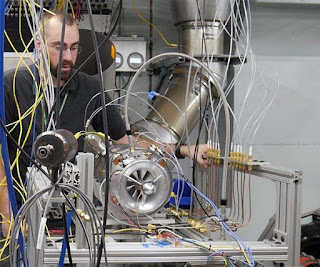

"There's no end to what might be done, but it's all enabled by inexpensive production," said Dr. Greg Bloch, Aerospace Systems Directorate Turbine Engine Division chief engineer. "It's the ability to turn the economics of warfare around."

Bloch added that the design and development of this engine was a unique learning opportunity for younger engineers within the directorate. By participating in the entire process, from cradle to grave, junior workforce engineers gained first-hand experience with every aspect of engine development.

"We have a lengthy history of providing technical oversight at a high level to various engine companies as they develop these engines for the U.S. Air Force," said Bloch. "By teaching our people to do this themselves, we're instilling in them a level of gravitas that will serve the Air Force well when we then apply that oversight to the traditional engine manufacturers."

The team says ROSE is more than just a first-of-its-kind engine development project. It represents a shift in thinking about how to do business.

"We're not trying to compete with our commercial partners, we are leveraging an underutilized sector to meet Air Force needs," said Lt. Col. Ionio Andrus, Aerospace Systems Directorate Turbine Engine Division deputy division chief.

Andrus added that by working closely with other AFRL organizations, including the Materials and Manufacturing Directorate and the Air Force Institute of Technology, the team leveraged internal expertise that helped advance the project. Additionally, by starting from scratch and performing all the work themselves, the AFRL team developed new tools and models that will be available for use in future iterations and new engine design projects.

"This is the right project for the issues that AFRL, the Turbine Engine Division, and the Air Force are facing," said Andrus. "There's a lot of goodness here."

Following this test event, the team will use the measured data to validate their newly-developed design tools and will work toward developing a second iteration of the engine that will be smaller and lighter. With the tools and know-how already in place, Lieghley expects the second design to be completed even more quickly than the first.

Bloch calls ROSE another milestone in the Turbine Engine Division's rich legacy in equipping Air Force platforms. However, this one holds a special place in the hearts and minds of the engineers behind it.

"There's not an Air Force engine fielded today whose technology can't be traced back to Turbine Engine Division in-house work," he said. "We'll eventually hand this off to a manufacturer, but this one is all AFRL on the inside."

Saturday, November 9, 2019

First launch of UK OneWeb communications satellites from Baikonur postponed

The first launch of UK communications satellites OneWeb from Russia's Baikonur Cosmodrome was initially supposed to take place on 19 December. The launch of UK OneWeb space internet system satellites from the Baikonur space centre was postponed from December this year to January 2020, three sources in Russia's rocket and space industry revealed. "The launch is being postponed due to the fact that the spacecraft are not ready. Their delivery to Baikonur is delayed from November to December 2019. The planned launch is postponed from 19 December to 23 January," one of the sources said, with two other sources confirming this information. OneWeb plans to create a constellation of satellites that will provide broadband Internet access to users around the world fully covering the Earth's surface. In cooperation with Roscosmos, the UK communications company sent up its first satellites in February and has planned its next two launches for the end of this year and the first half of 2020.


Thursday, November 7, 2019

New payload fairing from RUAG Space enables quieter journey to space

RUAG Space, a leading supplier to the space industry, has successfully developed and tested a new low shock jettison system for payload fairings. This enables a quieter and smoother journey to space for satellites or other payload. The required payload fairings for the European launchers Ariane and VEGA have been produced by RUAG Space in Emmen, Switzerland, since the 1970s. As part of the Future Launchers Preparatory Programme (FLPP) of the European Space Agency (ESA), RUAG Space has developed this new separation and jettison system for payload fairings. "This new solution enables a quieter journey to space", says Peter Guggenbach, CEO RUAG Space. The payload fairing protects the satellite from aerodynamic and thermal loads during flight. After passing through dense atmospheric layers and as soon as the satellite is no longer at risk, the payload fairing is separated from the launch vehicle. As a rule, two pyrotechnic mechanisms are fired to open hinges, allowing the half-shells to separate safely from the payload. "Pyrotechnics is a proven technology, which may generate significant shock during activation and may result in excitation that needs to be considered in the design of the launcher and payload hardware", says Alberto Sanchez Cebrian, Project Manager at RUAG.


Lower development costs and simpler test conditions
The separation and jettison system has a modular design and reduces development costs, as parts can be improved or replaced without affecting the entire system. Testing is easier and the mechanism does not require synchronization.

The tests were carried out at the RUAG Spaces site in Emmen on a 2.6 m long Vega payload fairing. The new system is scalable and could also be used for, for instance, in the European launch vehicle Ariane.

In addition to the successful separation test, a significant noise reduction was achieved. An integrated sound-reducing perforated insulation layer within the sandwich panels of the payload fairing enables noise reduction without increasing mass and volume.

In certain frequency bands this system could replace acoustic absorber mats currently used in payload fairings. Testing and evaluation of this new system will continue in the next phase of the project.

Wednesday, November 6, 2019

Numerous polar storms on Saturn analyzed by the UPV/EHU's Planetary Sciences Group

Sanchez-Lavega's work appears under the title 'A complex storm system in Saturn's north polar atmosphere in 2018', and was produced in collaboration with Teresa del Rio-Gaztelurrutia, Jon Legarreta and Ricardo Hueso, lecturers at the Faculty of Engineering in Bilbao, and a large group of scientists of other nationalities. It was an amateur Brazilian astronomer who on 29 March, 2018, captured on telescope a brilliant white spot on the disc of the planet Saturn close to its north pole. A few days later the spot increased in size reaching a length of approximately 4,000 km and became the most noteworthy detail on the disc of the ringed planet. A second spot appeared further north on the planet a few months later, and sequentially over subsequent months, a third and fourth spot; the latter spots were much closer to the polar region on the edge of the famous Saturn hexagon that had never been previously observed. The spots drifted throughout all these months at varying speeds dragged along by the atmospheric winds that blow on Saturn like jet streams Eastwards and Westwards and whose intensity depends on the latitude. While the first spot, located further south at a speed of about 220 km/hour drifted Eastwards, the one located further north drifted at about 20 km/hour Westwards. This led to encounters between them; some passed close to others and in the course of their mutual interaction they generated atmospheric disturbances that spread throughout Saturn's polar region.


The features of the spots suggest that they are storms that burst as a result of convection in the deep water clouds about 200 km below the visible clouds. The hot, humid gas rises forcefully in Saturn's thin, hydrogen atmosphere and forms thick clouds of ammonia, which are the ones seen through the telescope.

"It is the first time that we have seen such a phenomenon of numerous storms at different latitudes. To date, we had seen small isolated storms or else the gigantic, rare ones known as the Great White Spots," said Agustin Sanchez-Lavega, who is leading this study. Strangely enough, the first storm arose inside a cyclonic vortex, according to images prior to the discovery and obtained months before the Cassini spacecraft was disposed of.

Long-lived, high intensity storms
According to the models developed to simulate these storms, their energy is midway between small and gigantic ones, but the mechanism causing them to gradually emerge at different altitudes on the planet is not known, and, more crucially, neither is it known how they manage to keep going for so long.

"On the Earth, storms of this type last a few days at the most, but on Saturn, the first of all the spots remained active for more than seven months," said Sanchez-Lavega. What is more, like the Great White Spots, the fresh storms have only been observed in the northern hemisphere (they've never been spotted in the south) and appear to have been in line with their formation rate of one every 30 to 60 years.

Like other planets with an atmosphere, Saturn is a natural laboratory where it is possible to study the meteorological phenomena taking place on our planet and to test out, under extreme conditions, the models used to explain and predict them.

The study was carried out in wide-ranging international collaboration that has involved the Cassini space mission, which was orbiting the planet until September 2017, the Hubble Space Telescope, the UPV/EHU's PlanetCam camera installed at the Calar Alto Observatory, and a whole network of amateur observers who provided the images allowing the evolution of the phenomenon to be monitored on a day-to-day basis.

Saturday, November 2, 2019

Astronomers catch wind rushing out of galaxy

Exploring the influence of galactic winds from a distant galaxy called Makani, UC San Diego's Alison Coil, Rhodes College's David Rupke and a group of collaborators from around the world made a novel discovery. Published in Nature, their study's findings provide direct evidence for the first time of the role of galactic winds - ejections of gas from galaxies - in creating the circumgalactic medium (CGM). It exists in the regions around galaxies, and it plays an active role in their cosmic evolution. The unique composition of Makani - meaning wind in Hawaiian - uniquely lent itself to the breakthrough findings. "Makani is not a typical galaxy," noted Coil, a physics professor at UC San Diego. "It's what's known as a late-stage major merger - two recently combined similarly massive galaxies, which came together because of the gravitational pull each felt from the other as they drew nearer. Galaxy mergers often lead to starburst events, when a substantial amount of gas present in the merging galaxies is compressed, resulting in a burst of new star births. Those new stars, in the case of Makani, likely caused the huge outflows - either in stellar winds or at the end of their lives when they exploded as supernovae." Coil explained that most of the gas in the universe inexplicably appears in the regions surrounding galaxies - not in the galaxies. Typically, when astronomers observe a galaxy, they are not witnessing it undergoing dramatic events - big mergers, the rearrangement of stars, the creation of multiple stars or driving huge, fast winds.


"While these events may occur at some point in a galaxy's life, they'd be relatively brief," noted Coil. "Here, we're actually catching it all right as it's happening through these huge outflows of gas and dust."

Coil and Rupke, the paper's first author, used data collected from the W. M. Keck Observatory's new Keck Cosmic Web Imager (KCWI) instrument, combined with images from the Hubble Space Telescope and the Atacama Large Millimeter Array (ALMA), to draw their conclusions.

The KCWI data provided what the researchers call the "stunning detection" of the ionized oxygen gas to extremely large scales, well beyond the stars in the galaxy. It allowed them to distinguish a fast gaseous outflow launched from the galaxy a few million year ago, from a gas outflow launched hundreds of millions of years earlier that has since slowed significantly.

"The earlier outflow has flowed to large distances from the galaxy, while the fast, recent outflow has not had time to do so," summarized Rupke, associate professor of physics at Rhodes College.

From the Hubble, the researchers procured images of Makani's stars, showing it to be a massive, compact galaxy that resulted from a merger of two once separate galaxies. From ALMA, they could see that the outflow contains molecules as well as atoms.

The data sets indicated that with a mixed population of old, middle-age and young stars, the galaxy might also contain a dust-obscured accreting supermassive black hole. This suggests to the scientists that Makani's properties and timescales are consistent with theoretical models of galactic winds.

"In terms of both their size and speed of travel, the two outflows are consistent with their creation by these past starburst events; they're also consistent with theoretical models of how large and fast winds should be if created by starbursts. So observations and theory are agreeing well here," noted Coil.

Rupke noticed that the hourglass shape of Makani's nebula is strongly reminiscent of similar galactic winds in other galaxies, but that Makani's wind is much larger than in other observed galaxies.

"This means that we can confirm it's actually moving gas from the galaxy into the circumgalactic regions around it, as well as sweeping up more gas from its surroundings as it moves out," Rupke explained. "And it's moving a lot of it - at least one to 10 percent of the visible mass of the entire galaxy - at very high speeds, thousands of kilometers per second."

Rupke also noted that while astronomers are converging on the idea that galactic winds are important for feeding the CGM, most of the evidence has come from theoretical models or observations that don't encompass the entire galaxy.

"Here we have the whole spatial picture for one galaxy, which is a remarkable illustration of what people expected," he said. "Makani's existence provides one of the first direct windows into how a galaxy contributes to the ongoing formation and chemical enrichment of its CGM."