Showing posts with label Long March-5B. Show all posts

Wednesday, June 3, 2020

More details of China's space station unveiled

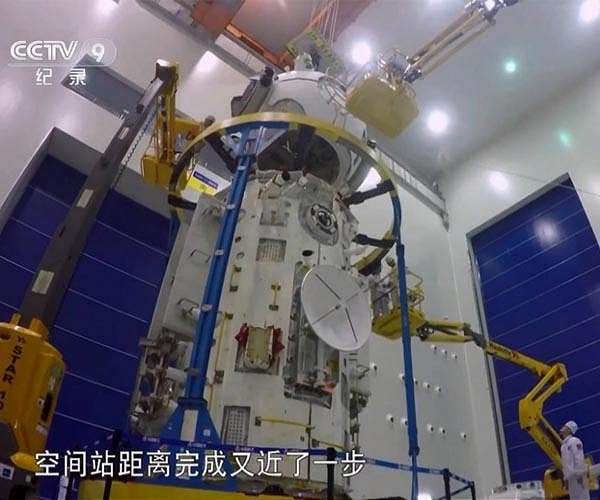
After the successful maiden flight of the Long March-5B large rocket and the testing of China's new-generation manned spaceship, more details of China's space station have been unveiled. The space station, expected to be completed around 2022, will operate in the low-Earth orbit at an altitude from 340 km to 450 km for more than 10 years, supporting large-scale scientific, technological and application experiments, according to a report in the People's Daily. The space station Tiangong, meaning Heavenly Palace, will be able to accommodate three astronauts in normal circumstances and up to six during a crew replacement. The station will be a T shape with the core module at the center and a lab capsule on each side. Each of the modules will be over 20 tonnes, with the total mass of the station about 66 tonnes, said Zhou Jianping, chief designer of China's manned space program. If China's Tiangong-1 and Tiangong-2 space labs are like one-bedroom apartments, the space station is equivalent to an apartment with three bedrooms, a living room, a dining room and a storage room, said Zhu Guangchen, deputy chief designer of the space station from China Academy of Space Technology (CAST). The core module of the station, named Tianhe, has a total length of 16.6 meters, a maximum diameter of 4.2 meters and a takeoff mass of 22.5 tonnes, and is currently the largest spacecraft developed by China.


The Tianhe core module will be the management and control center and the main living space of the crew, and will support some scientific and technological experiments.

The living space in the core module is about 50 cubic meters. Combined with the two lab capsules, the whole living space could be up to 110 cubic meters, according to CAST.

The core module has two berth ports connecting to the two lab capsules, and three docking ports for the crew spacecraft, cargo and other craft. It also has an exit for astronauts to conduct extravehicular activities. (Xinhua)

Saturday, May 9, 2020

Three types of rockets to shoulder construction of China's space station

China's new large carrier rocket Long March-5B made its maiden flight on Tuesday, sending the trial version of China's new-generation manned spaceship and a cargo return capsule for test into space. The successful flight inaugurated the "third step" of China's manned space program, which is to construct a space station, said the China Manned Space Agency (CMSA). After a successful maiden flight, China's Long March-5B carrier rocket joins the Long March-2F and Long March-7 to shoulder the construction of China's space station. Long March-2F: China's Safest Rocket - with a total length of about 58 meters, the Long March-2F has two core stages and four boosters. An escape tower will be installed on top if the rocket is used to launch manned spacecraft. It has a takeoff mass of about 480 tonnes, and is capable of sending payloads of 8.6 tonnes to low-Earth orbit. It is designed to be China's safest and most reliable carrier rocket, according to the rocket's chief designer Zhang Zhi, of the China Academy of Launch Vehicle Technology under the China Aerospace Science and Technology Corporation. It made its maiden flight on Nov. 20, 1999, launching China's first manned spacecraft Shenzhou-1 with no crew. It sent China's first astronaut Yang Liwei into space on Oct. 15, 2003, making China the third country capable of sending astronauts into space. Over the past 20 years, the Long March-2F has completed 13 flights with a success rate of 100 percent, sending 11 spacecraft and two space labs into space, said Jing Muchun, general director of the rocket development team.


Long March-7: Special Cargo Vehicle
With a total length of 53 meters, the Long March-7 rocket has two 3.35-meter-diameter core stages and four 2.25-meter-diameter boosters.

It uses environment-friendly fuel, including liquid oxygen and kerosene. It has a takeoff mass of about 597 tonnes, and a payload capacity of about 13.5 tonnes to low-Earth orbit and about 5.5 tonnes to 700-km Sun-synchronous orbit.

It is specially developed to launch the cargo spacecraft for China's manned space program. After a successful maiden flight in 2016, it sent China's first cargo spacecraft Tianzhou-1 to dock with the Tiangong-2 space lab in 2017.

It will be mainly used to transport materials to China's space station, including living materials for astronauts such as drinking water, food and extravehicular spacesuits, as well as operation and maintenance materials such as solar panels and spare parts, said Meng Gang, general director of the Long March-7 research team.

The rocket can also send cargo spacecraft to conduct in-orbit refueling for the space station, Meng said.

As China's first rocket designed with digital technology and the first launched at the Wenchang Space Launch Center on the coast of south China's island province of Hainan, the Long March-7 has achieved a series of technological innovations, said its chief designer Fan Ruixiang.

Long March-5B: Backbone Of Space Station Construction
With a total length of about 53.66 meters, the Long March-5B rocket has a 5-meter-diameter core stage and four 3.35-meter-diameter boosters. It has a takeoff mass of about 849 tonnes, a takeoff thrust of about 1,078 tonnes and a payload capacity of at least 22 tonnes to low-Earth orbit.

It has currently the largest fairing of China's carrier rockets, which is 20.5 meters long and 5.2 meters in diameter, as tall as a six-floor building.

Specially designed to launch the core module and the experiment capsules of China's space station, it will be the backbone of the station construction, said Wang Jue, general director of the rocket research team.

The research team has achieved a series of technological breakthroughs, such as separation of the large fairing from the payloads safely in space and controlling the launch time error within one second, said its chief designer Li Dong.

Wednesday, January 22, 2020

China's space station core module, manned spacecraft arrive at launch site

A core module prototype of China's space station and a prototype of China's new-generation manned spacecraft arrived at the launch site in south China's Hainan Province after a week of ocean and rail transport, the China Manned Space Engineering Office (CMSEO) announced Monday. The core module will take part in joint rehearsals with the Long March-5B carrier rocket at the Wenchang Space Launch Center while the new manned spacecraft will be launched by the rocket's maiden flight in the first half of this year. This means the building of China's space station in space will begin soon, the CMSEO said. The core module, named Tianhe (harmony of the heavens), will function as the command and control center of the space station. It is 16.6 meters long with a diameter of 4.2 meters and a takeoff weight of 22.5 tonnes. As the largest spacecraft ever developed by China, Tianhe will accommodate three astronauts and serve as a space laboratory to carry out scientific research and technological verifications, the CMSEO said. The new-generation manned spacecraft is 8.8 meters long and has a takeoff weight of 21.6 tonnes. It will be used for transporting crew to the space station and to conduct China's future manned lunar missions. China is scheduled to complete the construction of the space station around 2022.


The Long March-5B rocket is scheduled to arrive at the launch site in early February, the CMSEO said.