Phobos and Deimos, the moons of Mars, are seen in this movie put together from 19 images taken by the Mars Odyssey orbiter's Thermal Emission Imaging System, or THEMIS, camera.The images were taken in visible-wavelength light. THEMIS also recorded thermal-infrared imagery in the same scan.The apparent motion is due to progression of the camera's pointing during the 17-second span of the February 15, 2018, observation, not from motion of the two moons.This was the second observation of Phobos by Mars Odyssey; the first was on September 29, 2017. Researchers have been using THEMIS to examine Mars since early 2002, but the maneuver turning the orbiter around to point the camera at Phobos was developed only recently. The distance to Phobos from Odyssey during the observation was about 3,489 miles (5,615 kilometers). The distance to Deimos from Odyssey during the observation was about 12,222 miles (19,670 kilometers).
THEMIS was developed by and is operated by a team based at Arizona State University, Tempe. NASA's Jet Propulsion Laboratory, Pasadena, California, manages the Mars Odyssey mission for NASA's Science Mission Directorate, Washington. Lockheed Martin Space Systems, Denver, built the orbiter and partners in its operation. JPL is a division of Caltech in Pasadena.
Tuesday, February 27, 2018
Monday, February 26, 2018
SwRI scientist helps characterize water on lunar surface
A Southwest Research Institute scientist with expertise in how water reacts with lunar soil contributed to a new study that indicates water and/or hydroxyl may be more prevalent on the Moon's surface than previously thought."Water on the Moon is of intense interest for many reasons," said SwRI's Dr. Michael Poston, a coauthor of the paper, "Widespread Distribution of OH/ H2O on the Lunar Surface Inferred from Spectral Data," published in Nature Geoscience online. Water has been the focus of many lunar missions, largely because it is a critical resource for a Moon habitat. "When you split water molecules, you end up with oxygen and hydrogen, critical components for breathable air and rocket fuel. Hydroxyl (OH) is a more reactive relative to water and not as attractive as water in terms of supporting a lunar station." Up until the last decade or so, scientists thought negligible amounts of water were present on the Moon, perhaps existing mainly as ice in the permanently shaded craters near the poles. However, in 2009, NASA's Moon Minerology Mapper spectrometer onboard India's Chandrayaan-1 spacecraft and two other NASA flight spectrometers detected signatures interpreted as water in sunlight reflected from the Moon's surface.
These data, along with measurements from NASA's Lunar Reconnaissance Orbiter (LRO), also indicated the amount of water on the surface could vary diurnally ? a cycle based on the time of day ? and be more common at higher latitudes. One of these measurements came from the Lyman Alpha Mapping Project (LAMP), built and managed by SwRI.
"This research is a great example of how multiple instruments and investigations allow you to do more than what you could do with one instrument alone," added the paper's lead author Dr. Josh Bandfield, of the Space Science Institute in Boulder, Colorado. "As new data about the temperature environment on the Moon emerged, it became apparent that we needed to recalibrate our spectral datasets."
The Moon produces a mixture of reflected and emitted light. It glows in the infrared when heated by the Sun, and its surface reflects infrared light from the Sun. Using detailed surface temperature maps from the Diviner Lunar Radiometer Experiment on LRO and thermophysics modeling, Bandfield could subtract the right amount of Moon glow from the reflected sunlight to better characterize the inferred measurements of water.
Poston has conducted extensive experiments with water and lunar samples collected by the Apollo missions that revealed the amount of energy needed to remove water molecules from lunar rock. This helps scientists understand how tightly water is bound to surface materials.
Based on the team's results, it appears that OH/H2O is present on lunar surfaces under much more wide-ranging conditions than previously understood. The OH/H2O, either in a steady state or actually static, does not appear to be daily migrating about the lunar surface in significant quantities. This limits the amount of OH/H2O that would land in dark polar craters and be trapped there for millennia.
"The next step is to determine whether it's water, hydroxyl, or a mixture of the two - and where it came from," Poston said. "Is it from external sources, delivered by comet or asteroid impacts? Is it from internal processes on the Moon itself, such as ancient volcanism? Or could it be an ongoing process of the solar wind reacting with lunar materials to create OH or HH2O?"
"Some of these scientific problems are very, very difficult, and it's only by drawing on multiple resources from different missions that we are able to hone in on an answer," said LRO project scientist John Keller of NASA's Goddard Space Flight Center in Greenbelt, Maryland.
"This research is a great example of how multiple instruments and investigations allow you to do more than what you could do with one instrument alone," added the paper's lead author Dr. Josh Bandfield, of the Space Science Institute in Boulder, Colorado. "As new data about the temperature environment on the Moon emerged, it became apparent that we needed to recalibrate our spectral datasets."
The Moon produces a mixture of reflected and emitted light. It glows in the infrared when heated by the Sun, and its surface reflects infrared light from the Sun. Using detailed surface temperature maps from the Diviner Lunar Radiometer Experiment on LRO and thermophysics modeling, Bandfield could subtract the right amount of Moon glow from the reflected sunlight to better characterize the inferred measurements of water.
Based on the team's results, it appears that OH/H2O is present on lunar surfaces under much more wide-ranging conditions than previously understood. The OH/H2O, either in a steady state or actually static, does not appear to be daily migrating about the lunar surface in significant quantities. This limits the amount of OH/H2O that would land in dark polar craters and be trapped there for millennia.
"The next step is to determine whether it's water, hydroxyl, or a mixture of the two - and where it came from," Poston said. "Is it from external sources, delivered by comet or asteroid impacts? Is it from internal processes on the Moon itself, such as ancient volcanism? Or could it be an ongoing process of the solar wind reacting with lunar materials to create OH or HH2O?"
"Some of these scientific problems are very, very difficult, and it's only by drawing on multiple resources from different missions that we are able to hone in on an answer," said LRO project scientist John Keller of NASA's Goddard Space Flight Center in Greenbelt, Maryland.
Sunday, February 25, 2018
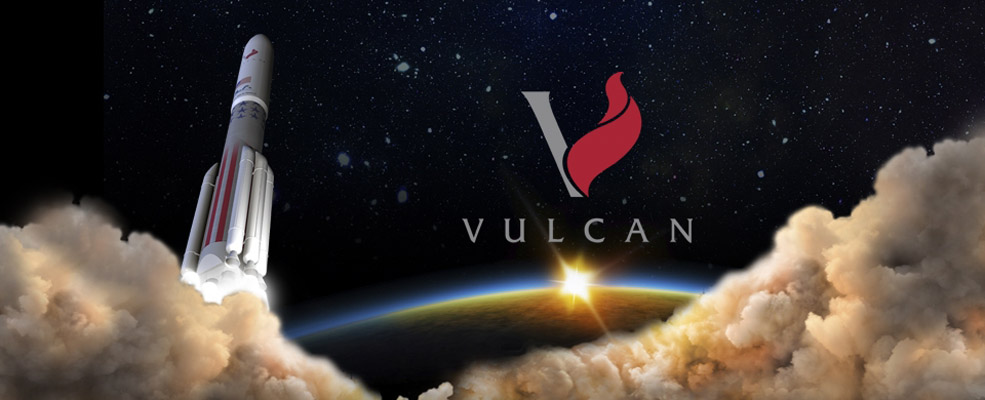
Millenium tapped for certification of Vulcan space launch systems
Millennium Engineering and Integration was awarded a contract for heavy payload launch vehicles and rockets. The deal, announced Thursday by the Department of Defense, is valued at more than $9.9 million under the terms of a cost-plus-fixed-fee task order contract. The agreement taps Millennium Engineering and Integration of Arlington, Va., to provide certification support for the Vulcan launch systems and Next Generation Launcher launch systems.The Vulcan launch system and Next Generation Launcher launch systems are used to deploy carrier rockets into outer space with the goal of transporting security, science and commercial payloads. The Pentagon says the contract will provide systems engineering and integration services for the U.S. government in support of the Vulcan launch systems and Next Generation Launcher launch systems.
Work on the contract will occur in multiple locations across the United States. The contract is expected to be complete in February 2019.
The total amount of the contract will be obligated to Millennium Engineering and Integration at the time of award from fiscal 2018 procurement funds, the Department of Defense said.
Wednesday, February 21, 2018
Laser-ranged satellite measurement now accurately reflects Earth's tidal perturbations
Tides on Earth have a far-reaching influence, including disturbing satellites' measurements by affecting their motion. This disturbance can be studied using a model for the gravitational potential of the Earth, taking into account the fact that Earth's shape is not spherical.The LAser RElativity Satellite (LARES), is the best ever relevant test particle to move in the Earth's gravitational field. In a new study published in EPJ Plus, LARES proves its efficiency for high-precision probing of General Relativity and fundamental physics. By studying the Earth's tidal perturbations acting on the LARES, Vahe Gurzadyan from the Center for Cosmology and Astrophysics at Yerevan State University, Armenia, and colleagues demonstrate the value of laser-range satellites for high-precision measurements. Specifically, laser-ranged satellites bring increased accuracy in the study and testing of what is referred to in physics as frame dragging. In this study, the authors collect the observations of Earth's tidal perturbations acting on LARES and compare them with two similar laser-ranged satellites: LAGEOS and LAGEOS 2. The team analysed 3.5 years of LARES laser-ranging data, together with that of the two LAGEOS satellites.
To extract frame-dragging from the laser-ranging data for high accuracy, the authors model the main gravitational and non-gravitational orbital perturbations. To do so, the team documented 110 significant Earth tide modes for the LARES satellite using the perturbative methods of celestial mechanics and recent data on the satellite's orbit.
Frame-dragging is one of the intriguing phenomena of Einstein's theory of General Relativity. It is an effect on space, and is elastic--in other words, it will revert back to its original shape and energy state after force is exerted on it-whereby particles exchange energy with it. This has implications for astrophysics.
Tuesday, February 20, 2018
CALIFA renews the classification of galaxies
The objects within galaxies have two basic types of motions: orbiting around the galaxy centre in a regular organized disc, or in orbits oriented at random without a clear direction of rotaiton. If we imagined that galaxies behave in the same way as the Solar System we could think that as the objects move further away from the centre their orbital velocities decrease. However this is not necessarily the case for galaxies, as there are several factors which affect the rotational velocity of these objects, such as the dimensions of the galaxy, the gravitational pull of other galaxies, and the quantity of dark matter in a given galaxy. An international team of astrophysicists,among them IAC and Universidad de La Laguna researcher Jesus Falcon Barroso, coordinator of the CALIFa (Calar Alto Legacy Integral Field Area survey) at the IAC who is one of the authors of the article published in Nature Astronomy, has collected tat from 600 galaxies in the neighbourbhood of the Milky Way with the Potsday Multiple Aperture Spectrophotometer (PMAS) on the 3.6m telescope at the Calar Alto Observatory (Almeria, Spain). As part of this catalogue the scientists have made velocity maps of 300 galaxies showing the movements of their stars.
In this way they have defined three different groups among the sets of stellar orbits, which they have called "cold orfbits" "warm orbits" and "hot orbits", the latter typical of stars with random motions. When they analyzed tghe data they showed that circular orbits are frequent in lower mass galaxies, while the "hot orbits" are more often found in galaxies with higher mass. In addition tghey have found quite a number of "warm orbits", greater than that previously expected for this type of galaxies.
Using these maps of stellar motions one can obtain a lot of informatioin about the history of formation of these galaxies. They evolve and grow over thousands of millions of years, merging with other galaxies. Those which have absorbed other smaller galaxies generally have thin rotating discs, while when two galaxies with similar masses merge an elliptical galaxy is formed, in which the orbits are arranged in random directions.
Measuring the orbits in the galaxies analyzed allows us to distinguish between disc galaxies (with colder orbits) and elliptical galaxies (with hotter orbits) even when this difference cannot be detected when using images alone. This implies that by measuring the stellar orbits the researchers will be able to determine if the galaxy we observe is the result of internal evolution of an isolated object, a relatively calm series of mergers with smaller objects, or the product of a violent merger.
CALIFA, which with its 300 galaxy simple has become one of the biggest archives of data on galaxy dynamics up to now is the "first study to propose a scheme of galaxy classification base don the orbital distribution of their stars, which is different from the classical Hubble diagram , based on morphological classification" explains Falcon Barroso. This researcher also acknowledges that the results of this study " present some problems for current theories of formation and evolution of galaxies"
This new classification has been carefully prepared to produce a representative simple which will help astronomers to make models of the evolution of galaxies, and show whether their simulations produce valid predictions.
Using these maps of stellar motions one can obtain a lot of informatioin about the history of formation of these galaxies. They evolve and grow over thousands of millions of years, merging with other galaxies. Those which have absorbed other smaller galaxies generally have thin rotating discs, while when two galaxies with similar masses merge an elliptical galaxy is formed, in which the orbits are arranged in random directions.
Measuring the orbits in the galaxies analyzed allows us to distinguish between disc galaxies (with colder orbits) and elliptical galaxies (with hotter orbits) even when this difference cannot be detected when using images alone. This implies that by measuring the stellar orbits the researchers will be able to determine if the galaxy we observe is the result of internal evolution of an isolated object, a relatively calm series of mergers with smaller objects, or the product of a violent merger.
CALIFA, which with its 300 galaxy simple has become one of the biggest archives of data on galaxy dynamics up to now is the "first study to propose a scheme of galaxy classification base don the orbital distribution of their stars, which is different from the classical Hubble diagram , based on morphological classification" explains Falcon Barroso. This researcher also acknowledges that the results of this study " present some problems for current theories of formation and evolution of galaxies"
This new classification has been carefully prepared to produce a representative simple which will help astronomers to make models of the evolution of galaxies, and show whether their simulations produce valid predictions.
Subscribe to:
Posts (Atom)