ABL Space Systems says a test incident that destroyed the upper stage of its RS1 rocket last week will delay that vehicle’s first flight by three months as it identifies and corrects the failure’s root cause. ABL was in the middle of a test campaign for the RS1 upper stage built for its first launch when an anomaly destroyed the stage during a Jan. 19 static firing at the Mojave Air and Space Port in California. The accident created a dramatic plume of black smoke and prompted a response from local firefighters, but there were no injuries reported and no damage outside of the location where the stage was being tested. Harry O’Hanley, chief executive of ABL, told SpaceNews that the stage’s E2 Vacuum engine suffered a “hard start” in the hot gas circuit of its turbopump. A hard start is when the flow of propellants and ignition fluid in an engine doesn’t allow for a gradual increase in energy, but instead an explosive rise. Hard starts can damage or destroy rocket engines. In the case of this test, O’Hanley said, the hard start caused “a substantial fire on the aft end of the vehicle, resulting in a complete failure about 20 seconds later.” No personnel were near the test stand at the time of the incident, and there no significant damage to three adjacent test cells at the site. Since the accident, engineers have been examining data to work through the fault tree to determine the root cause. “It appears that the failure was a result of multiple risk factors combining in an improbable way,” he said, although the company declined to comment on those risk factors while the investigation is still in progress. “This explains why we haven’t observed the failure after over 80 starts and 3,000 seconds of hot fire testing of the flight-design E2 engine over the past six months.”
A nominal static-fire test of ABL Space System's RS1 upper stage on Jan. 7. A similar test Jan. 19 resulted in a "hard start" of the engine that destroyed the stage. Credit: ABL Space Systems
Dan Piemont, president of ABL, said the company did see some small hard starts during earlier testing of the engine that caused minor damage. “Those were each traced to a simple cause, fairly typical engine R&D events,” he said. “The failure last week was larger and more complex.”
The company is work on what O’Hanley described as “manufacturing and operational improvements” to the E2 engine to reduce the chance that fuel could leak into the turbopump and cause a hard start. “We’re also implementing some simple changes to reduce the probability of an off-nominal startup.”
The incident took place in the seventh in a series of hot-fire tests of the stage in Mojave. The overall test campaign started in December with a series of fill-and-drain, cold flow and ignition tests, followed by the hot-fire tests. Piemont said that, at the time of the anomaly, at least five more tests were planned before the company completed the test campaign.
That upper stage was being tested ahead of the first RS1 launch from Kodiak Island, Alaska. “After some final engine design changes were identified last summer, we set an aggressive schedule to try to launch by the end of 2021,” Piemont said. “Our schedule slipped a bit in past few months, but our programs were converging towards a launch from Kodiak in February.”
After the incident, he said the company expects a three-month delay in that first launch. The upper stage being built for the second RS1 launch will now be used for the first launch. The lower stage is complete and currently in storage in Kodiak, while the interstage between the first and second stages is being shipped to Kodiak. The payload fairing has completed acceptance testing and will soon be shipped to the launch site.
“Our strategy in developing RS1 is to rapidly test, iterate and sometimes fail. An engine hard start was a known risk in this campaign,” O’Hanley said. “This strategy has been highly successful in helping us to uncover unknown unknowns and has been the underpinning of our rapid progress over the past three years.”
Blue Origin is buying Honeybee Robotics, a company that develops robotic systems for space and other extreme environments. Honeybee Robotics announced Jan. 25 that its parent company, Ensign-Bickford Industries, was selling it to Blue Origin. Terms of the deal, expected to close in mid-February, were not disclosed. Honeybee Robotics is best known in the space industry for developing robotics systems, notably drills and other mechanisms, for use on space missions. That has included drills and sample collection systems flown on several Mars missions as well as others under development for missions to the moon and NASA’s Dragonfly mission to Saturn’s moon Titan. “Joining Blue Origin is a major step forward for us,” said Kiel Davis, president of Honeybee Robotics, in a statement. “With Blue Origin we look forward to further expanding our capacity to meet the most exciting challenges in next-generation space transportation, space mobility, space destinations, and planetary science and exploration.” “We’re beyond excited to welcome Honeybee Robotics to our team,” Brent Sherwood, senior vice president of advanced development programs at Blue Origin, said in the statement. “We value the company’s brand, talent, unique expertise, and product lines. And we know that together we will make bold things possible.”
Honeybee Robotics has provided components for several NASA missions, such as the sampling system on Phoenix Mars lander's robotic arm. Credit: NASA/JPL-Caltech
Honeybee was founded in New York City in 1983 and started working on NASA projects in 1986. The company now has locations in Colorado and Southern California and, in addition to space, works in terrestrial mining and energy markets as well as defense and other industrial applications. Ensign-Bickford acquired Honeybee in 2017 and, in 2019, combined it with Avior Controls, a manufacturer of space-rated mechanisms.
Blue Origin said it will retain Honeybee as a separate entity and with “no notable changes” to its products or customers. It did not disclose its long-term plans for the company or its technologies, although Blue Origin and its founder, Jeff Bezos, have long discussed using space resources to enable the expansion of humanity into space.
“Over time, the combined capabilities of Honeybee and Blue Origin will create new opportunities, efficiencies, and innovations as they work together to develop space to benefit Earth,” the companies said.
NASA’s safety advisers are calling on the agency to reexamine how it manages human spaceflight programs to reflect the changing relationship with industry and to better run its core exploration effort. The central theme of the annual report of the Aerospace Safety Advisory Panel (ASAP), released Jan. 11, was a need to reexamine the roles and responsibilities of NASA as human spaceflight programs are increasingly managed by industry rather than NASA itself, as was the case for most of the agency’s history. “If these trends continue, which seems likely, the Panel believes it is crucial for NASA to strategically evaluate the path ahead and determine the future shape of the organization,” the report states. “Once the Agency has clarified a vision and strategy, it should then make the decisions, and take the necessary actions, to enable it to accomplish the required transformation.” The panel argued that this was time to address those issues as the agency was at an “inflection point” given both growing commercial capabilities and roles and the agency’s own long-term plans for human missions to the moon and Mars that need to fit within limited budgets. “Consequently, the Agency will need to operate differently—from strategic planning and how it approaches program management, to workforce development, facility maintenance, acquisition strategies, contract types, and partnerships,” it wrote. That transition is within the mandate of ASAP because of the implications such changes have on human spaceflight safety, the panel argued in the report. “The Panel believes that NASA’s vision for the future, and a clear definition of how it will evaluate and make decisions related to risk (in addition to how it will manage and execute programs), are extremely important factors in ensuring human space flight safety.”
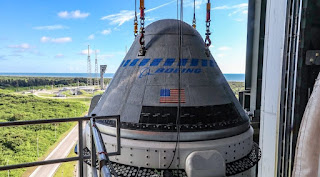
Among the issues raised in the Aerospace Safety Advisory Panel report was a difference in opinion between NASA and Boeing on the risk posed vt stuck propulsion valves in the CST-100 Starliner that the panel said was evidence the two organizations "do not share a common understanding of how to assess and characterize risk." Credit: Boeing/John Grant
The shift to commercial crew transportation has created some specific issues in the last year mentioned in the report. The panel cited a “concerning dissonance” between NASA and SpaceX during preparations for the Crew-1 landing last May. The two organizations “differed in their understanding of the level of risk to be incurred” regarding a nighttime landing of the Crew Dragon spacecraft, with NASA initially preferring a daytime landing as the lowest risk option. SpaceX argued that a nighttime landing was acceptable and offered better sea state conditions than the proposed daytime landing. The report stated that “last-minute communications had been necessary to ensure NASA approved the plans for the night landing.”
There was also a difference of opinion between NASA and Boeing involving the risk of stuck propulsion valves on the company’s CST-100 Starliner that delayed an uncrewed test flight last summer. Boeing evaluated the risk as low, the panel said, while NASA considered it moderate during a flight readiness review. That review, the panel concluded, “revealed NASA and Boeing do not share a common understanding of how to assess and characterize risk.”
The language of the report suggested the issue came up in the flight readiness review held several days before the scheduled launch, while the problem itself was reported only after the launch was scrubbed a few hours before the scheduled liftoff. However, a company spokesman said that the problem was discovered after the flight readiness review, and also played down the difference in opinions highlighted in the ASAP report.
“It is not uncommon to have differences in the risk scoring on the magnitude of various technical issues being addressed at the review. This is because we use different rubrics, or scoring systems, for our risk assessments,” Boeing said in a statement. “Using different assessments can be healthy for the program as it allows management to better understand the total level of risk as the scoring systems look through different lenses to ultimately drive down risk and increase crew safety.”
The panel also took issue with the “disaggregated” way NASA’s exploration efforts are organized. That structure treats the Space Launch System, Orion spacecraft and Exploration Ground Systems as separate programs, which the panel attributes to the uncertain direction of the agency’s exploration programs after the cancellation of the Constellation program more than a decade ago.
“In essence, it appears that the cancellation of the Constellation program has led to a cautious stance among NASA leaders driven by the assumption that having an Apollo-like program now is a problematic political optic, and like Constellation, a possible target for cancellation by a future Administration,” the panel wrote. “In effect, NASA has accepted the disaggregated program structure as normal, and is now propagating this structure as a preferred business and risk management model, even though it is essentially an untried approach for an integrated systems engineering effort of this magnitude and complexity.”
Among the panel’s recommendations was to create an integrated Artemis program led by a single manager “endowed with authority, responsibility, and accountability” along with a bottoms-up approach to systems engineering and integration as well as risk management. NASA sometimes refers to an “Artemis program” today, the panel noted, but without the formal program architecture that risks “confusing both employees and contractors about who is ultimately responsible and accountable.”
The panel recommended NASA establish a “board of directors” consisting of senior NASA Headquarters officials as well as its center directors. The members would examine agency issues outside of their perspectives as heads of programs or centers. It also recommended a strategic vision for the future of space exploration and operations that would look out at least 20 years, including roles for commercial and international partners and its workforce requirements.
“NASA is no longer the sole driver or customer for human space flight capabilities and related technology, nor is it the sole organization creating demand,” the panel stated. “Consequently, it is imperative for NASA leaders to establish a clear vision of the future and an understanding of the Agency’s purpose to anchor its decisions today and tomorrow.”
With a deadline for an agreement between the United Kingdom and the European Union on British involvement in, and funding for, Copernicus come and gone, the European Space Agency is pressing ahead on several missions in the hopes a deal can eventually be reached. British and European negotiators had been working toward a Nov. 30 deadline regarding British participation in the E.U. aspects of Copernicus post-Brexit, including a British contribution of 750 million euros ($850 million) to the program. That deadline passed, though, without a deal. Without an agreement, the Copernicus program faces a funding shortfall that could jeopardize work on six new Earth science missions approved at ESA’s 2019 ministerial meeting, contracts for which ESA awarded in July 2020. The issue came up at the latest meeting of the ESA Council that concluded Dec. 15. Josef Aschbacher, director general of ESA, mentioned the 750 million euro funding shortfall during a media briefing after the meeting. Several options were under consideration, he said, including simply delaying the deadline on an agreement for as long as possible. “One [option] that is most likely to be brought forward is to keep the door open and postpone the decision point into the future,” he said, specifically until the critical design review (CDR) for the missions. “We can, with some arrangements and negotiations with industry, we could push this date into 2024, which would give us three more years to negotiate and, basically, find the 750 million. The participation of the U.K. is still a priority and our preferred option.”
The Copernicus Carbon Dioxide Monitoring, or CO2M, mission is one of six Copernicus missions whose development is jeopardized by a 750 million euro funding shortfall caused by a lack of an agreement on U.K. participation in E.U. elements of the program. Credit: OHB
That would mean that the CDR, where final approval is given to move into full-scale assembly of the spacecraft, would become what he called the “break point or go/no-go decision” on proceeding based on available funding.
That plan poses complications for the companies working on those missions. “What we expect from our institutions is to come up with an agreement in between the PDR and the CDR,” said Philippe Pham, senior vice president for Earth observation, navigation and science at Airbus Defence and Space, during a panel at World Satellite Business Week Dec. 16. The preliminary design review, or PDR, of those Copernicus missions is scheduled for 2022, with CDRs between late 2023 and 2024.
“It gives us some room for maneuver for final agreement to preserve the six missions,” he said. “What we expect is that the E.U. will come up with a solution for the missing Brexit budget and keeping the schedule of the six missions.”
“It’s so important that we protect all the six missions,” said Massimo Comparini, deputy chief executive of Thales Alenia Space, on the same panel. He said that while the missions have a high level of technical maturity, there shouldn’t be any attempt to compress development schedules between reviews, or from CDR to launch.
“We’re talking about such important missions that we cannot have any kind of shortcut,” he said.
The Federal Aviation Administration awarded a license Dec. 20 to a proposed commercial launch site in Georgia, but that facility still faces legal and business challenges. The FAA issued a launch site operators license, also known as a spaceport license, to Camden County, Georgia, for the proposed Spaceport Camden. The license came after years of environmental reviews of the site that slowed the licensing process, as well as the county’s decision two years ago to focus on small launch vehicles rather than larger ones originally envisioned for the site. The license came after a formal “record of decision” by the FAA regarding those environmental reviews. The document outlined the assessed environmental impacts of the proposed site, supporting a dozen launches a year of small launch vehicles, and the measures required to mitigate those effects, concluding that “all practicable means to avoid or minimize environmental harm from the Selected Alternative have been adopted.” County officials, who have invested an estimated $10 million into spaceport plans, hailed the decision as a boost to the area’s economy. “This once in a generation opportunity will provide a new frontier of economic prosperity for Camden, the region and the state of Georgia,” said Steve Howard, county administrator and project leader for the spaceport, in a statement. The license is a necessary but not sufficient step toward enabling launches from the site. Any company that seeks to launch from Spaceport Camden would have to get an FAA launch license, a process that includes environmental reviews. The terms of the license also prohibit the county from entering into an agreement with a launch provider until the county has a purchase or lease agreement for the property where the launch facility would be built.
An earlier concept for Spaceport Camden in Georgia. While the FAA issued a license for the spaceport, the site still faces legal and business obstacles. Credit: Spaceport Camden
The county has an agreement with Union Carbide, the company owns the property, to purchase it. However, a petition signed by several thousand county residents seeks a referendum on whether to allow the county to spend any money acquiring the property. A state court is reviewing the petition to see if the referendum should go forward in early 2022 and also whether to block the county from acquiring the land in the meantime. Should the referendum pass, it would effectively kill the project.
Another challenge for the county is identifying potential users of the spaceport. While there are dozens of small launch vehicles under development, none has formally committed to launching from Spaceport Camden.
The county statement about the FAA license included a quote from James Cantrell, chief executive of Phantom Space, which is working on a small launcher. “Phantom Space is thrilled to see Spaceport Camden open for business,” he said. “The additional launch capacity aligns well to our efforts to make access to space commonplace with reliable and responsive space transportation systems.”
Cantrell was previously chief executive of Vector, which conducted a low-altitude test flight of a vehicle prototype from the Spaceport Camden site in 2017. He departed Vector in 2019 when the company lost financing, leading eventually to Vector’s bankruptcy and liquidation. Earlier this month, the liquidating trustee for Vector filed suit in U.S. Bankruptcy Court in Delaware against Cantrell for breach of fiduciary duty during Cantrell’s time as chief executive, alleging “disloyal and systematic looting of Vector for his own personal financial gain in order to fund Cantrell’s personal racing hobby and other business ventures unrelated to Vector.”
Spaceport Camden backers have argued that demand for small launches can’t be met by other spaceports, notably Cape Canaveral. However, small launch vehicle company Astra Space announced Dec. 6 it would perform its next launch from Space Launch Complex 46 at Cape Canaveral Space Force Station in January. That facility was previously used for Athena launches but had been idle in recent years other than an Orion launch abort test in 2019.