Wednesday, August 19, 2020

NASA researchers track slowly splitting 'dent' in Earth's magnetic field

A small but evolving dent in Earth's magnetic field can cause big headaches for satellites. Earth's magnetic field acts like a protective shield around the planet, repelling and trapping charged particles from the Sun. But over South America and the southern Atlantic Ocean, an unusually weak spot in the field - called the South Atlantic Anomaly, or SAA - allows these particles to dip closer to the surface than normal. Particle radiation in this region can knock out onboard computers and interfere with the data collection of satellites that pass through it - a key reason why NASA scientists want to track and study the anomaly. The South Atlantic Anomaly is also of interest to NASA's Earth scientists who monitor the changes in magnetic field strength there, both for how such changes affect Earth's atmosphere and as an indicator of what's happening to Earth's magnetic fields, deep inside the globe. Currently, the SAA creates no visible impacts on daily life on the surface. However, recent observations and forecasts show that the region is expanding westward and continuing to weaken in intensity. It is also splitting - recent data shows the anomaly's valley, or region of minimum field strength, has split into two lobes, creating additional challenges for satellite missions. A host of NASA scientists in geomagnetic, geophysics, and heliophysics research groups observe and model the SAA, to monitor and predict future changes - and help prepare for future challenges to satellites and humans in space.


It's what's inside that counts
The South Atlantic Anomaly arises from two features of Earth's core: The tilt of its magnetic axis, and the flow of molten metals within its outer core.

Earth is a bit like a bar magnet, with north and south poles that represent opposing magnetic polarities and invisible magnetic field lines encircling the planet between them. But unlike a bar magnet, the core magnetic field is not perfectly aligned through the globe, nor is it perfectly stable. That's because the field originates from Earth's outer core: molten, iron-rich and in vigorous motion 1800 miles below the surface. These churning metals act like a massive generator, called the geodynamo, creating electric currents that produce the magnetic field.

As the core motion changes over time, due to complex geodynamic conditions within the core and at the boundary with the solid mantle up above, the magnetic field fluctuates in space and time too. These dynamical processes in the core ripple outward to the magnetic field surrounding the planet, generating the SAA and other features in the near-Earth environment - including the tilt and drift of the magnetic poles, which are moving over time. These evolutions in the field, which happen on a similar time scale to the convection of metals in the outer core, provide scientists with new clues to help them unravel the core dynamics that drive the geodynamo.

"The magnetic field is actually a superposition of fields from many current sources," said Terry Sabaka, a geophysicist at NASA's Goddard Space Flight Center in Greenbelt, Maryland. Regions outside of the solid Earth also contribute to the observed magnetic field. However, he said, the bulk of the field comes from the core.

The forces in the core and the tilt of the magnetic axis together produce the anomaly, the area of weaker magnetism - allowing charged particles trapped in Earth's magnetic field to dip closer to the surface.

The Sun expels a constant outflow of particles and magnetic fields known as the solar wind and vast clouds of hot plasma and radiation called coronal mass ejections. When this solar material streams across space and strikes Earth's magnetosphere, the space occupied by Earth's magnetic field, it can become trapped and held in two donut-shaped belts around the planet called the Van Allen Belts. The belts restrain the particles to travel along Earth's magnetic field lines, continually bouncing back and forth from pole to pole. The innermost belt begins about 400 miles from the surface of Earth, which keeps its particle radiation a healthy distance from Earth and its orbiting satellites.

However, when a particularly strong storm of particles from the Sun reaches Earth, the Van Allen belts can become highly energized and the magnetic field can be deformed, allowing the charged particles to penetrate the atmosphere.

"The observed SAA can be also interpreted as a consequence of weakening dominance of the dipole field in the region," said Weijia Kuang, a geophysicist and mathematician in Goddard's Geodesy and Geophysics Laboratory. "More specifically, a localized field with reversed polarity grows strongly in the SAA region, thus making the field intensity very weak, weaker than that of the surrounding regions."

A pothole in space
Although the South Atlantic Anomaly arises from processes inside Earth, it has effects that reach far beyond Earth's surface. The region can be hazardous for low-Earth orbit satellites that travel through it. If a satellite is hit by a high-energy proton, it can short-circuit and cause an event called single event upset or SEU. This can cause the satellite's function to glitch temporarily or can cause permanent damage if a key component is hit. In order to avoid losing instruments or an entire satellite, operators commonly shut down non-essential components as they pass through the SAA. Indeed, NASA's Ionospheric Connection Explorer regularly travels through the region and so the mission keeps constant tabs on the SAA's position.

The International Space Station, which is in low-Earth orbit, also passes through the SAA. It is well protected, and astronauts are safe from harm while inside. However, the ISS has other passengers affected by the higher radiation levels: Instruments like the Global Ecosystem Dynamics Investigation mission, or GEDI, collect data from various positions on the outside of the ISS. The SAA causes "blips" on GEDI's detectors and resets the instrument's power boards about once a month, said Bryan Blair, the mission's deputy principal investigator and instrument scientist, and a lidar instrument scientist at Goddard.

"These events cause no harm to GEDI," Blair said. "The detector blips are rare compared to the number of laser shots - about one blip in a million shots - and the reset line event causes a couple of hours of lost data, but it only happens every month or so."

In addition to measuring the SAA's magnetic field strength, NASA scientists have also studied the particle radiation in the region with the Solar, Anomalous, and Magnetospheric Particle Explorer, or SAMPEX - the first of NASA's Small Explorer missions, launched in 1992 and providing observations until 2012. One study, led by NASA heliophysicist Ashley Greeley as part of her doctoral thesis, used two decades of data from SAMPEX to show that the SAA is slowly but steadily drifting in a northwesterly direction. The results helped confirm models created from geomagnetic measurements and showed how the SAA's location changes as the geomagnetic field evolves.

"These particles are intimately associated with the magnetic field, which guides their motions," said Shri Kanekal, a researcher in the Heliospheric Physics Laboratory at NASA Goddard. "Therefore, any knowledge of particles gives you information on the geomagnetic field as well."

Greeley's results, published in the journal Space Weather, were also able to provide a clear picture of the type and amount of particle radiation satellites receive when passing through the SAA, which emphasized the need for continuing monitoring in the region.

The information Greeley and her collaborators garnered from SAMPEX's in-situ measurements has also been useful for satellite design. Engineers for the Low-Earth Orbit, or LEO, satellite used the results to design systems that would prevent a latch-up event from causing failure or loss of the spacecraft.

Modeling a safer future for satellites
In order to understand how the SAA is changing and to prepare for future threats to satellites and instruments, Sabaka, Kuang and their colleagues use observations and physics to contribute to global models of Earth's magnetic field.

The team assesses the current state of the magnetic field using data from the European Space Agency's Swarm constellation, previous missions from agencies around the world, and ground measurements. Sabaka's team teases apart the observational data to separate out its source before passing it on to Kuang's team. They combine the sorted data from Sabaka's team with their core dynamics model to forecast geomagnetic secular variation (rapid changes in the magnetic field) into the future.

The geodynamo models are unique in their ability to use core physics to create near-future forecasts, said Andrew Tangborn, a mathematician in Goddard's Planetary Geodynamics Laboratory.

"This is similar to how weather forecasts are produced, but we are working with much longer time scales," he said. "This is the fundamental difference between what we do at Goddard and most other research groups modeling changes in Earth's magnetic field."

One such application that Sabaka and Kuang have contributed to is the International Geomagnetic Reference Field, or IGRF. Used for a variety of research from the core to the boundaries of the atmosphere, the IGRF is a collection of candidate models made by worldwide research teams that describe Earth's magnetic field and track how it changes in time.

"Even though the SAA is slow-moving, it is going through some change in morphology, so it's also important that we keep observing it by having continued missions," Sabaka said. "Because that's what helps us make models and predictions."

The changing SAA provides researchers new opportunities to understand Earth's core, and how its dynamics influence other aspects of the Earth system, said Kuang. By tracking this slowly evolving "dent" in the magnetic field, researchers can better understand the way our planet is changing and help prepare for a safer future for satellites.

Monday, August 17, 2020

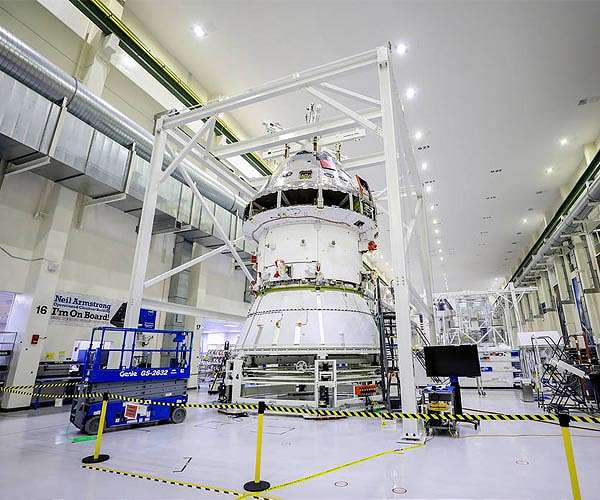
NASA begins installing orion adapter for first Artemis lunar flight

Technicians at NASA's Kennedy Space Center in Florida are working to install an adapter that will connect the Orion spacecraft to its rocket for the Artemis I mission around the Moon. This is one of the final major hardware operations for Orion inside the Neil Armstrong Operations and Checkout Building prior to integration with the Space Launch System (SLS) rocket. The spacecraft adapter cone (seen at the bottom of the stack pictured above) connects to the bottom of Orion's service module and will later join another adapter connected to the top of the rocket's interim cryogenic propulsion stage (ICPS). During the process to install the cone on Orion, the spacecraft is lifted out of the Final Assembly and Systems Testing, or FAST, cell and placed into the Super Station support fixture. During flight, the SLS rocket separates in multiple stages as it pushes Orion into deep space. After accelerating Orion towards the Moon, the spacecraft will separate from the ICPS and adapter cone using pyrotechnics and springs. Next up before stacking Orion on the rocket, technicians will install coverings to protect fluid lines and electrical components on the crew module adapter that connects Orion to the service module. Workers also will install the solar array wings that will provide Orion with power, spacecraft adapter jettison fairings that enclose the service module for launch, and the forward bay cover that protects the parachute system.


Orion will fly on the agency's Artemis I mission - the first in a series of increasingly complex missions to the Moon that will lead to human exploration of Mars. Through the Artemis program, NASA is working to land the first woman and the next man on the Moon by 2024.

Altius Space Machines to support on-orbit servicing for the Dynetics Human Landing System

Voyager Space Holdings, Inc. (Voyager), a global leader in integrated space services, has announced that its subsidiary, Altius Space Machines, Inc. (Altius), was selected as a subcontractor to Dynetics, a wholly owned subsidiary of Leidos, to support the development of a human landing system for NASA's Artemis program. With Altius support, Dynetics aims to enable the Artemis program that will land the first woman and next man on the Moon by 2024. Leveraging its deep expertise in space robotics, Altius develops on-orbit servicing technology, specializing in on-orbit assembly and manufacturing, orbital rendezvous and capture robotics, as well as in-space refueling. Altius will support development of the docking and refueling interfaces between the Dynetics lander and the modular propellant vehicle drop tanks, leveraging technologies the company has been developing for the satellite servicing and in-space refueling markets. "We are living during an incredible time for the space industry, and developing a human landing system is a vital step as we embark on a new era of space exploration," said Jonathan Goff, founder and CEO, Altius Space Machines. "Altius is excited to support Dynetics as it helps NASA achieve its Artemis mission." Altius' partnership with Dynetics continues a momentous inaugural year for Voyager, which includes the holding company's recent acquisition of Pioneer Astronautics. Pioneer Astronautics is currently focused on making sustainable life beyond Earth a reality, and was recently one of four businesses selected by NASA to help mature a range of lunar technologies for the sustainable exploration of the Moon, also under the Artemis program.


Both Altius and Pioneer Astronautics' successes demonstrate the tangible benefits of Voyager's model, with increased vertical integration and mission capability helping to enable humanity's most ambitious projects.

"Voyager and its subsidiaries continue to perform extremely well and we are excited to participate in the development of the next generation human landing system for the Artemis program," said Matthew Kuta, president and COO, Voyager. "We're proud to support Altius as it contributes to this historic mission."

Thursday, August 13, 2020

BE-4 engine will support US Space Force space launch program

Blue Origin issued the following statement regarding the U.S. Space Force's National Security Space Launch (NSSL) Phase 2 Launch Services Procurement (LSP) announcement. Bob Smith, CEO, Blue Origin said, "We are disappointed in the decision that New Glenn was not selected for the National Security Space Launch (NSSL) Phase 2 Launch Services Procurement (LSP). We submitted an incredibly compelling offer for the national security community and the U.S. taxpayer. "Blue Origin's offer was based on New Glenn's heavy-lift performance, unprecedented private investment of more than $2.5 billion, and a very competitive single basic launch service price for any mission across the entire ordering period. "We are proceeding with New Glenn development to fulfill our current commercial contracts, pursue a large and growing commercial market, and enter into new civil space launch contracts. "We remain confident New Glenn will play a critical role for the national security community in the future due to the increasing realization that space is a contested domain and a robust, responsive, and resilient launch capability is ever more vital to U.S security. "Blue Origin is very proud that our BE-4 engine will power United Launch Alliance's Vulcan launch vehicle in support of the Space Force's NSSL program and end reliance on Russian-built engines.


"The BE-4 is the most powerful liquefied natural gas-fueled rocket engine ever developed and the first oxygen-rich staged combustion engine made in the U.S. We look forward to supporting ULA's long-standing role in launching national security payloads."

Tuesday, August 11, 2020

Dwarf planet Ceres is an ocean world: study

The dwarf planet Ceres -- long believed to be a barren space rock -- is an ocean world with reservoirs of sea water beneath its surface, the results of a major exploration mission showed Monday. Ceres is the largest object in the asteroid belt between Mars and Jupiter and has its own gravity, enabling the NASA Dawn spacecraft to capture high-resolution images of its surface. Now a team of scientists from the United States and Europe have analysed images relayed from the orbiter, captured around 35 kilometres (22 miles) from the asteroid. They focused on the 20-million-year-old Occator crater and determined that there is an "extensive reservoir" of brine beneath its surface. Several studies published Monday in the journals Nature Astronomy, Nature Geoscience and Nature Communications also shed further light on the dwarf planet, which was discovered by Italian polymath Giuseppe Piazzi in 1801. Using infrared imaging, one team discovered the presence of the compound hydrohalite -- a material common in sea ice but which until now had never been observed off of Earth. Maria Cristina De Sanctis, from Rome's Istituto Nazionale di Astrofisica said hydrohalite was a clear sign Ceres' used to have sea water. "We can now say that Ceres is a sort of ocean world, as are some of Saturn's and Jupiter's moons," she told AFP. The team said the salt deposits looked like they had built up within the last two million years -- the blink of an eye in space time. This suggests that the brine may still be ascending from the planet's interior, something De Sanctis said could have profound implications in future studies. "The material found on Ceres is extremely important in terms of astrobiology," she said.


"We know that these minerals are all essential for the emergence of life."

Writing in an accompanying comment article, Julie Castillo-Rogez, from the California Institute of Technology's Jet Propulsion Laboratory, said the discovery of hydrohalite was a "smoking gun" for ongoing water activity.

"That material is unstable on Ceres' surface, and hence must have been emplaced very recently," she said.

In a separate paper, US-based researchers analysed images of the Occator crater and found that its mounds and hills may have formed when water ejected by the impact of a meteor froze on the surface.

The authors said their findings showed that such water freezing processes "extend beyond Earth and Mars, and have been active on Ceres in the geologically recent past".