Showing posts with label Artemis. Show all posts

Sunday, December 27, 2020

SpaceX, Blue Origin, Dynetics await NASA lunar lander decision

Elon Musk's SpaceX, Jeff Bezos' Blue Origin and a lesser-known company, Huntsville, Ala.-based Dynetics, are preparing for a major decision by NASA early in 2021 about which company will build human-carrying landers for trips to the moon. The three space firms were selected in April to submit proposals early this month. Having done that, they now await NASA's decision, which is scheduled for February. The space agency has indicated it could pick one or two of the proposals. At stake is the future of lunar exploration for the United States and large, multimillion-dollar contracts as part of NASA's planned Artemis program. The agency had a goal of landing people on the moon again by 2024, although Congress hasn't funded NASA's budget requests to meet that schedule. A contract for a human lander may be awarded, but it's not clear if such landers will be built anytime soon, said Marco Caceres, space analyst for the Teal Group based in Fairfax, Va. "Artemis was proposed in another age in our history before the pandemic and the recent election, so I'm not convinced it will happen," Caceres said Tuesday. "From a technical standpoint, the Dynetics proposal has strengths, but NASA tends to pick a known quantity for such spaceflight missions." SpaceX already has multiple high-profile contracts with NASA, including the commercial crew contract to take astronauts to the International Space Station, while Blue Origin has flown NASA hardware on the company's New Shepard rocket. Blue Origin lined up legacy space companies Northrop Grumman and Lockheed Martin to help develop a lander, Caceres noted.


Blue Origin, of Kent, Wash., plans to develop a three-stage lander to be launched on its own New Glenn rocket and United Launch Alliance's Vulcan rocket. But neither of those rockets has launched; both are being developed.

SpaceX, based in Hawthorne, Calif., is developing the Starship, a fully integrated lander intended for launch on the Starship Super Heavy rocket. It also is being developed, having completed a prototype test flight to nearly 8 miles high Dec. 9.

Dynetics' lander will provide ascent and descent capabilities and also is planned to be launched on the Vulcan. Dynetics is a tech and engineering firm and a subsidiary of engineering firm Leidos.

All three proposed landers could be refueled at the moon, but Dynetics' lander is designed to be easily reusable for multiple hops around the moon, Robert Wright, Dynetics' program manager, said in an interview Thursday.

Dynetics is the only lander with a horizontal crew cabin, as opposed to an upright, vertical cabin, which would allow faster and easier access to the lunar surface, Wright said.

Both SpaceX and Blue Origin would require a crew to descend on long ladders from a cabin high atop a landing vehicle.

"We're in the unique position of being closer to the lunar surface than the other competitors have shown in their concepts," Wright said.

"Having the horizontal capsule, or chamber, means astronauts would have more room to put spacesuits on, and a dust barrier to prevent gritty moon dust from entering the quarters."

But putting the crew cabin higher over the ground is an advantage for Blue Origin's lander, Blue Moon, the company's chief scientist Steve Squyres said in a recent video news release.

"When you land on an unprepared surface, on no landing pad, there are bad things that can happen," such as rocket thrusters kicking up sharp rocks, Squyres said. "The other thing that can happen is you can crunch your engine on the ground when you land."

Therefore, he said, the Blue Moon lander would put the crew and ascent engines on top, "out of harm's way."

Dynetics' Wright said the company's lander still protects the engines with its design, which shows the bottom of a barrel-shaped capsule extending below the engines to protect them from the ground.

SpaceX declined a request for comment. NASA declined requests for interviews "to protect the integrity of the process" as the contract award announcement nears, a spokeswoman said.

The human lander contract will mark a milestone toward "sending the first woman and next man to the lunar surface in 2024 and establishing sustainable exploration by the end of the decade," according to a NASA statement.

Monday, August 17, 2020

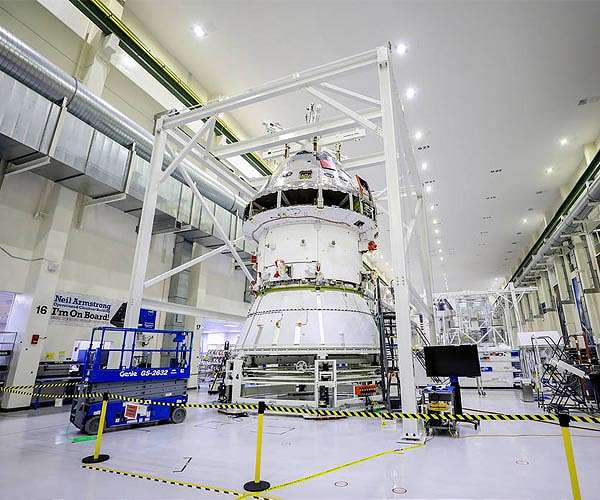
NASA begins installing orion adapter for first Artemis lunar flight

Technicians at NASA's Kennedy Space Center in Florida are working to install an adapter that will connect the Orion spacecraft to its rocket for the Artemis I mission around the Moon. This is one of the final major hardware operations for Orion inside the Neil Armstrong Operations and Checkout Building prior to integration with the Space Launch System (SLS) rocket. The spacecraft adapter cone (seen at the bottom of the stack pictured above) connects to the bottom of Orion's service module and will later join another adapter connected to the top of the rocket's interim cryogenic propulsion stage (ICPS). During the process to install the cone on Orion, the spacecraft is lifted out of the Final Assembly and Systems Testing, or FAST, cell and placed into the Super Station support fixture. During flight, the SLS rocket separates in multiple stages as it pushes Orion into deep space. After accelerating Orion towards the Moon, the spacecraft will separate from the ICPS and adapter cone using pyrotechnics and springs. Next up before stacking Orion on the rocket, technicians will install coverings to protect fluid lines and electrical components on the crew module adapter that connects Orion to the service module. Workers also will install the solar array wings that will provide Orion with power, spacecraft adapter jettison fairings that enclose the service module for launch, and the forward bay cover that protects the parachute system.


Orion will fly on the agency's Artemis I mission - the first in a series of increasingly complex missions to the Moon that will lead to human exploration of Mars. Through the Artemis program, NASA is working to land the first woman and the next man on the Moon by 2024.

Sunday, June 7, 2020

Northrop Grumman snags $187 million to design NASA's lunar Gateway habitat for astronauts

NASA has awarded Northrop Grumman $187 million to design the habitat module for the space agency's lunar Gateway, a planned moon-orbiting space station for astronauts. We learned last year that NASA had tapped Virginia-based Northrop Grumman to build Gateway's pressurized crew cabin, called the habitation and logistics outpost (HALO). The company will base HALO on its Cygnus spacecraft, which has been flying contracted robotic cargo missions to the International Space Station for NASA since 2014. On Friday (June 5), the space agency announced some terms of the deal: Northrop Grumman will receive $187 million to fund HALO's design through a key milestone called preliminary design review, which is expected to be complete by the end of this year. "This contract award is another significant milestone in our plan to build robust and sustainable lunar operations," NASA Administrator Jim Bridenstine said in a statement. "The Gateway is a key component of NASA’s long-term Artemis architecture, and the HALO capability furthers our plans for human exploration at the moon in preparation for future human missions to Mars." Artemis is NASA's program of crewed lunar exploration, which aims to land two astronauts near the moon's south pole in 2024 and establish a sustainable human presence on and around the cosmic body by 2028. As Bridenstine noted, the agency envisions such work paving the way for the next giant leap: getting astronauts to Mars, which NASA aims to do in the 2030s.


Gateway likely won't be involved in the 2024 landing, but NASA sees the mini space station as crucial to its longer-term lunar plans. The outpost will serve as a jumping-off point for sorties, both crewed and uncrewed, to the lunar surface.

The current plan calls for launching Gateway's first two elements — HALO and the power and propulsion element (PPE), which will be built by Maxar Technologies — together in 2023. NASA expects to award Northrop Grumman a second contract by the end of the year, to build HALO and integrate it with the PPE, agency officials said.

Also key to the Artemis vision are NASA's Orion crew capsule and Space Launch System (SLS) megarocket, which together will get astronauts off the ground and on their way to deep space.

Orion has one flight under its belt, an uncrewed test mission to Earth orbit that took place in December 2014. SLS has not launched yet; it's scheduled to debut late next year on the Artemis 1 mission, which will send an uncrewed Orion on a test flight around the moon.

Orion will provide life support for astronauts aboard the Gateway, along with HALO, which will provide about as much living space as a small studio apartment.


Gateway, and the Artemis program overall, will leverage considerable cooperation from partners in the international community and the private sector. For example, the European Space Agency will provide Orion's service module, and the landers that ferry NASA astronauts from the outpost to the lunar surface will be privately built.

Thursday, February 13, 2020

Artemis I progresses toward launch

The flight hardware has been built, the launch facilities are ready, and NASA and its industry partners are checking off final milestones for the launch that will put America on the path to landing the first woman and next man on the Moon. The Artemis I mission - the culmination of work by people across the country in support of the Space Launch System (SLS), Orion and Exploration Ground System (EGS) programs - will preserve the nation's leadership in human space exploration and set the U.S. on a new journey to explore deep space. "Thanks to the hard work of women and men across our country, NASA's deep space exploration system is the Artemis program's foundation. With their contributions, America leads in human exploration at the Moon and it will be the same for Mars," said NASA Deputy Administrator Jim Morhard. "The success of the Artemis program depends on our suppliers, and we're confident they'll rise to the challenge of our 2024 deadline." The Artemis I team includes five prime contractors and hundreds of suppliers from all 50 states, all of which are committed to the safe and successful launch of the most powerful rocket ever built and the only capsule capable of transporting and sustaining a crew in deep space, as well as successful mission execution and safe return of the lunar orbit mission. Representatives from this team of suppliers will meet in Washington, D.C. this week to share the latest program progress with legislators and highlight the work that is done in their respective states.


The five major industry players that are building and preparing to launch the SLS and Orion spacecraft for NASA's crewed exploration missions include:

+ Aerojet Rocketdyne, which provides the reliable, flight-proven RS-25 and RL10 engines for the core and upper stage that carry SLS and Orion into orbit and on to deep space. It also provides the jettison motor for Orion's Launch Abort System and 21 thrusters on the Orion crew and service modules.

Boeing, which designed, developed, built and is now testing the rocket's massive core stage and avionics, having completed the upper stage last year.

Jacobs, which has modernized and upgraded ground systems and launch facilities at the Kennedy Space Center, and is preparing to integrate and process the SLS and Orion flight hardware for launch.

Lockheed Martin, which has designed and is building the Orion spacecraft that will carry astronauts out to the Moon and beyond.

Northrop Grumman, which provides the rocket boosters that supply more than 75% of initial required thrust during the first two minutes of flight, as well as the attitude control motor and abort motor for Orion's Launch Abort System.

Recent SLS milestones include production completion of the Artemis I core stage flight hardware for first flight, now at Stennis Space Center for its final major test, called Green Run; delivery of booster aft exit cones to Kennedy Space Center (KSC) and completion of booster design certification review and first five-segment booster flight set; completion of the RS-25 engine hot-fire series for the first four SLS flights and attaching the RS-25s to the first core stage for testing. In addition, NASA is completing avionics systems at NASA's Marshall Space Flight Center that will control launch and guidance systems for the rocket.

The Artemis I Orion spacecraft is complete and was shipped to NASA's Plum Brook Station in Sandusky, Ohio, in late November for environmental testing to ensure that it can withstand the harsh environment of space on its journey around the Moon and back. In addition, Orion's full launch abort system was successfully tested this past July during a flight test called Ascent Abort-2 in Florida.

At KSC, the EGS team recently completed verification and validation of the modified mobile launcher and Launch Pad 39B systems. The team also received the massive SLS Core Stage Pathfinder at KSC, and conducted a month-long series of exercises in the Vehicle Assembly Building, during which they practiced handling and lifting of the full-scale mockup hardware. In the KSC Launch Control Center, the team is using the upgraded launch control system to complete SLS ground systems checkout and launch team training in the new control room environment.

Upcoming 2020 milestones for launch readiness will see these following programs integrated at KSC:

The SLS rocket booster segments will be delivered to KSC and, along with the booster forward and aft assemblies, will be integrated in the Vehicle Assembly Building.

The core stage and integrated RS-25 engines will complete Green Run testing at Stennis, and refurbishment, before being shipped to KSC for mating with the boosters.

The Orion Artemis I crew and service module will return from Plum Brook Station for final testing and integration prior to launch.

In addition to receiving SLS and Orion hardware for processing and stacking, the EGS team will conduct the Underway Recovery Test-8 in the Pacific Ocean in March, to validate the recovery procedures and operational timelines during a full mission rehearsal of Orion capsule recovery after splashdown.

Artemis I will be the first integrated flight test of the SLS rocket and Orion spacecraft. The mission will send Orion into a lunar distant retrograde orbit - a wide orbit around the Moon that is farther from Earth than any human-rated spacecraft has ever traveled. The uncrewed mission will last more than 20 days and will validate the design and safety of Orion and SLS for human exploration missions to follow.

Wednesday, January 15, 2020

NASA rings in busy new year in Florida to prepare for Artemis Missions

NASA's Kennedy Space Center in Florida will have a busy year preparing facilities, ground support equipment and space hardware for the launch of Artemis I, the first uncrewed launch of the Space Launch System (SLS) rocket and the Orion spacecraft. In 2020, Exploration Ground Systems (EGS) activities will ramp up as launch hardware arrives and teams put systems in place for Artemis I and II missions. Launch countdown simulations will continue to ramp up in 2020 to train and certify the launch control team for Artemis missions. The types of simulations will build on one another and will walk through the final portions of the launch countdown sequence, called the terminal countdown. Integrated simulations will tie in all NASA centers working the mission to ensure all members of the team are ready to work together, including Mission Control at Johnson Space Center in Houston, and the SLS Engineering Support Center at Marshall Space Flight Center in Alabama. Simulations will begin at the end of January and will occur up through one week before launch, with an average of one training exercise each month. Much of the work in 2020 will be to complete a punch list of detail work inside the Vehicle Assembly Building (VAB). This includes cleaning the platforms and making minor repairs to any platform hardware that will be near flight hardware as the facility prepares for arrival of SLS components and stacking operations. "We are at a very significant point in NASA's Artemis mission," said Mike Bolger, program manager of EGS. "The EGS team has finished mobile launcher testing at the launch pad and will finish testing at the VAB in January. At that point, all of the launch infrastructure will be tested and ready for operations."


Launch Complex 39B
Teams will continue work on a new emergency egress system for Pad 39B where flight or ground crew could board a basket with a braking system at the crew access level of the mobile launcher. The crew would ride the basket down a cable and come to a stop near a bunker to the west of the pad surface, providing quick escape in the unlikely event of an emergency. The design phase began in 2019 and construction will be complete in time to support crewed Artemis missions.

The pad is currently getting a liquid hydrogen upgrade. The project involves the integration of a new 1.4 million gallon, liquid hydrogen (LH2) storage sphere into the existing Launch Complex 39B system. The new LH2 sphere will work with the current LH2 sphere to supply LH2 for Artemis II and beyond. The larger tank will allow NASA to attempt SLS launches on three consecutive days, instead of opportunities two out of three days, in the event of a scrub. The newer technology reduces liquid hydrogen burn-off, allowing more launch attempts before having to refill the larger tank. Construction began in 2019 and will be complete prior to Artemis II.

Orion Underway Recovery Test 8
The integrated recovery team of NASA, EGS, Lockheed Martin and the U.S. Navy, along with additional contractor support, will head out to sea off the coast of California in March to conduct the eighth Underway Recovery Test. Using a Navy ship with a well deck and several small boats, the primary objective is to validate Orion recovery operations for Artemis I - including procedures and timelines, and practicing different scenarios.

Orion Spacecraft
This spring, the Orion spacecraft for Artemis I will return from NASA's unique test facility at Plum Brook Station in Ohio, where it is currently undergoing environmental testing inside the vacuum chamber that simulates the harsh environment of space.

Inside the Neil Armstrong Operations and Checkout (O and C) Building at Kennedy, technicians will install the spacecraft's solar array wings before performing final checkouts. EGS will begin Orion ground processing and stacking activities later in the year.

The team will process and fuel Orion in the Multi-Purpose Processing Facility then transfer it over to the Launch Abort System Facility where engineers will attach the launch abort system. Orion will then roll out to the VAB for inspections before stacking Orion on top of the SLS rocket.

In its early processing stages, the Artemis II crew module milestones inside the O and C include propulsion tank installation, a pressure test and subsystems installations in the spring. The initial power-on of the crew module will occur in early fall. The heat shield that will protect the first crewed mission of Orion will be completed and installed by the end of the year. Processing and testing of the crew module adapter - the ring that connects to the European Service Module - for Artemis II will happen in the first half of the year prior to the arrival of the European Service Module in the fall.

Space Launch System
Training activities with pathfinders, or full-scale replicas, of the SLS core stage and booster segments occurred in 2019, and more training with various pathfinder segments and hardware will continue. In 2020, training will involve stacking inert booster segments on the mobile launcher in the VAB.

Hardware for SLS will continue to arrive for processing and integration in various Kennedy facilities. This year all ten of the solid propellant booster segments will arrive by train from their Northrop Grumman manufacturing facility in Promontory, Utah.

The launch vehicle stage adapter, which will connect the SLS core stage to the interim cryogenic propulsion stage, will arrive by barge. The booster aft skirts - which contain the thrust vector control system that steers the rocket - will trek from the Booster Fabrication Facility to the Rotation, Processing and Surge Facility where they will be attached to the aft exit cones.

The exit cones are attached to the bottommost part of each of the twin boosters to provide extra thrust to the boosters and protect the aft skirts from the thermal environment during launch.

The core stage of the SLS rocket will undergo a Green Run test campaign over several months in the B-2 test stand at the agency's Stennis Space Center in Mississippi. Following Green Run completion, the 225,000-pound core stage will leave Stennis and arrive at Kennedy on the Pegasus barge. The core stage and solid rocket boosters will then be integrated inside the VAB.

Mobile Launcher 2
In 2019, NASA awarded a contract for Mobile Launcher 2 to Bechtel National Inc. of Reston, Virginia. The ground structure that will be used to assemble, process and launch the second and more powerful configuration of the SLS rocket, called Block 1B, is in its early stages of design and development and will be ready for Artemis IV.

Artemis I will be the first in a series of increasingly challenging missions that will enable human exploration to the Moon and Mars. In 2020, the mission will truly begin to take shape as hardware arrives and stacking operations begin inside the VAB.

"The operations team is writing procedures, training, and preparing for flight hardware processing," Bolger said. "When the SLS and Orion are turned over to EGS later this year, Kennedy will be ready!"

Future Artemis missions will establish a sustainable presence at the Moon for decades to come, and Kennedy teams will move forward in 2020 to build the infrastructure and make those missions possible.