Showing posts with label Space Launch System. Show all posts

Friday, November 18, 2022

SLS launches Artemis 1 mission

After years of delays, NASA’s Space Launch System lifted off for the first time Nov. 16, sending an uncrewed Orion spacecraft on a shakedown cruise around the moon. The SLS lifted off from Launch Complex 39B here at 1:47 a.m. Eastern. The rocket’s upper stage, called the Interim Cryogenic Propulsion Stage (ICPS), separated from the core stage eight and a half minutes after liftoff. The Orion spacecraft separated from the ICPS nearly two hours after liftoff, after the stage completed a translunar injection burn. “We have a priority-one mission in play right now,” said Mike Sarafin, NASA Artemis 1 mission manager, at a post-launch briefing. He was referring to the mission’s top priority to have the Orion capsule reenter at lunar velocities at the end of the mission, something enabled by the successful launch. “We had the rocket do its job and deliver the spacecraft to the point of translunar injection.” The Orion spacecraft was “performing exactly as we intended,” he said, with the exception of a few “funnies” or minor issues. That included a glitch with a spacecraft star tracker and microswitches in a solar array that did not immediately indicate it latched into place as expected when the array deployed, but later did so. The launch took place more than 40 minutes into a two-hour window after overcoming two issues during the countdown. A little more than three hours before the opening of the launch window, NASA reported a leak in a valve in ground equipment used to replenish the core stage’s liquid hydrogen tank. The launch director dispatched a small “red crew” to the pad to tighten bolts in the valve, fixing the leak.

“Our most likely case here was that we just had some loose nuts on those valves,” said Mike Bolger, Exploration Ground Systems Program manager, at a post-launch briefing. “We sent the team out and they did a terrific job, and we got the issue resolved.”

“It was a low moment when we first saw the leak,” he added, bringing up hydrogen leaks in past launch attempts, “but really a high moment when we recognized we’d solved the problem.”

Around the time the red crew completed its work, the U.S. Space Force, which operates the Eastern Range that includes KSC, said a radar needed to track the launch had malfunctioned, a problem traced to a faulty Ethernet switch. Replacing the switch took more than an hour.

The successful launch came after two scrubbed attempts in late August and early September. The first, Aug. 29, was called off when sensors indicated one of four RS-25 core stage engines had not properly cooled down, a problem later blamed on a faulty sensor. NASA scrubbed the second, Sept. 3, after detecting a hydrogen leak during fueling of the core stage.

NASA replaced damaged seals in the liquid hydrogen line and changed tanking procedures, which it successfully tested Sept. 21. However, Hurricane Ian forced NASA to send the SLS back to the safety of the Vehicle Assembly Building before making another attempt in a launch period that closed in early October.

NASA rolled the SLS back to the pad Nov. 4, then had to wait as Hurricane Nicole passed through Nov. 10. The storm caused “very minor” damage that mission managers concluded either could be repaired or was not a constraint to launch.

That damage included a caulk material called RTV that had started to come off the interface between the Orion crew capsule and its launch abort system in the aftermath of the hurricane. Sarafin said imagery showed “a couple indications” that additional material came off during flight, but that engineers were still studying the data to determine what, if anything did come off Orion during ascent.

Those earlier launch scrubs, though, were only minor setbacks for a launch vehicle whose development suffered extensive delays. The 2010 NASA Authorization Act, which instructed NASA to develop SLS, called for the vehicle to be ready by the end of 2016. Various technical issues, primarily with the rocket’s core stage, steadily pushed back the first flight of the vehicle until now.

The Artemis 1 mission will see the Orion spacecraft, without astronauts on board, go to the moon and enter a distant retrograde orbit there. Orion will remain in that orbit for five days, reaching a maximum distance from Earth of 480,500 kilometers. It will then depart the orbit and return to Earth, splashing down off the coast of San Diego, California, at 12:40 p.m. Eastern Dec. 11.

The 25-day mission is considered a “short-class” mission by NASA, versus missions of up to 42 days that Orion would have flown in two earlier launch attempts. The shorter mission will still achieve all the test objectives, but in a more compressed timeframe.

“We did proofs of concept early on to demonstrate that you can fit all the objects the program has decided they want us to accomplish into the shortest class mission,” said Emily Nelson, NASA chief flight director, in a Nov. 14 interview. “But, it’s much more of a Tetris puzzle to make sure all of those things fit in.”

Those plans are revised for each launch opportunity. “Each different launch opportunity is a new challenge in terms of when is the spacecraft in the right place to accomplish those different mission objectives,” she said.

Artemis 1 is designed to test the Orion spacecraft in cislunar space, including testing the spacecraft’s heat shield when reentering at lunar return velocities. It will be followed by Artemis 2, the first crewed Orion mission, no earlier than 2024.

Saturday, November 5, 2022

SLS returns to the pad for next Artemis launch attempt

The Space Launch System and Orion spacecraft rolled back out to the launch pad Nov. 4 as the agency prepares for the third attempt to launch the vehicle on Artemis 1 mission later this month. SLS and Orion, on its mobile launch platform, arrived at Launch Complex 39B at 8:30 a.m. Eastern Nov. 4, a little more than nine hours after emerging from the Vehicle Assembly Building. The rollout was the fourth for the vehicle since March. The rollout supports NASA’s plans to conduct the next Artemis 1 launch attempt Nov. 14, with liftoff scheduled at 12:07 a.m. Eastern at the beginning of a 69-minute launch window. Two backup windows are reserved for Nov. 16 and Nov. 19. In a Nov, 3 call with reporters, Jim Free, associate administrator for exploration systems development, said managers gave the go-ahead for the rollout after reviewing weather forecasts that show the risk of a tropical storm system forming and heading towards Florida early next week. “Our engineering team thought it was an OK risk to go out tonight,” he said. Mark Burger, launch weather officer with the U.S. Space Force’s Space Launch Delta 45, said there is only a 30% chance of the system becoming a named storm, with peak wind gusts not expected to exceed 74 kilometers per hour. “Those are well within our constraints for riding out” the storm at the pad, he said. “We’ll have impacts from that in terms of the wind, but we’re not looking at any likelihood at this point of see a strong system emerge out of this.” SLS and Orion had been in the VAB since late September, when NASA rolled back to protect the vehicle from Hurricane Ian. Before the storm forced the rollback, agency officials felt they had resolved hydrogen leak problems that scrubbed the previous launch attempt Sept. 3.

The investigation into that leak has not turned up a single clear cause. “There’s not really a smoking gun, per se,” said Cliff Lanham, senior vehicle operations manager in NASA’s Exploration Ground Systems program. “We feel pretty confident that, through the loading procedures and controlling the pressures, we understand it much better now.”

“Our teams have continued to grow and learn about the vehicle, and we’re confident,” said Free, who added he felt they had three good opportunities to launch. “But, it’s a flight test.”

“What we’ve learned in every wet dress [rehearsal], our two launch attempts and our tanking test help build our confidence,” he said. “I don’t think we would roll out if we didn’t feel confident.”

If the vehicle does not launch by Nov. 19, there is a fourth possible launch window on Nov. 25. Beyond that, Free said NASA would likely leave the vehicle on the pad and wait until the next launch period opens in December, which would require getting waivers from the Eastern Range for the SLS flight termination system, much like what happened in September.

December also marks the deadline for the lifetime of the two solid rocket boosters. Lanham said that the boosters, which originally had a 12-month life when they were stacked in early 2021, have been certified through Dec. 9 for one booster and Dec. 14 for the other. If the vehicle doesn’t launch by then, Free said, they would do another “analysis cycle” on the boosters to see if their lives can be further extended.

Tuesday, August 23, 2022

Artemis 1 passes flight readiness review

An uncrewed test of NASA’s Space Launch System and Orion spacecraft moved a step closer to launch with the completion of a flight readiness review Aug. 22. NASA officials said late Aug. 22 that the review confirmed plans for a launch of the Artemis 1 mission from Kennedy Space Center’s Launch Complex 39B as soon as 8:33 a.m. Eastern Aug. 29, at the beginning of a two-hour window. A second two-hour window is available Sept. 2, and a 90-minute window Sept. 5. “We had no exceptions today. We actually had no actions coming out of the review and we had no dissenting opinions,” Jim Free, NASA associate administrator for exploration systems development, said at a briefing after the review. There is still some “open work” to do on the SLS and Orion spacecraft before launch, said Mike Sarafin, Artemis mission manager at NASA. Some of that is planned work to prepare the vehicles for launch, “largely things that we have a path to close before we go fly.” One issue that won’t be checked until the final stages of the countdown is a step called the “hydrogen kickstart” to thermally condition the engines. That could not be tested during the series of wet dress rehearsals of the vehicle in April and June because a leak in a hydrogen bleed line detected in the final rehearsal in June. Sarafin and Charlie Blackwell-Thompson, Artemis launch director, said there is a plan to test that step during a “quiescent” phase in the countdown a few hours before launch once the core stage’s liquid hydrogen tank is filled. “We believe that we have taken all the actions to correct that problem,” Blackwell-Thompson said, but won’t know for certain until the test at the pad.


“If we do not successfully demonstrate that,” Sarafin said, “we are not going to launch that day.”

A launch on Aug. 29 would start what is scheduled to be a 42-day mission for the Orion spacecraft. The SLS’s upper stage will place the spacecraft on a trajectory to the moon, called translunar injection (TLI), less than two hours after liftoff. Orion will fly by the moon five days later, maneuvering into a distant retrograde orbit around the moon. After spending two weeks in that orbit, the spacecraft will maneuver back to the moon, performing another powered flyby to bring it back to Earth, splashing down off coast of San Diego, California Oct. 10.

The six-week mission is a stress test of sorts of the spacecraft. Howard Hu, NASA Orion program manager, noted that Orion is designed to support a four-person crew for three weeks. “This mission allows us to push a lot of capability,” he said. “The long-class mission we’re talking about, 42 days, will allow us to stress a lot of systems.”

“Going 42 days puts a lot more stress on those systems, plus the environment it’s in — longer exposure to radiation, longer exposure to micrometeoroid hits — means we’re going to learn a lot from this test flight,” said Bob Cabana, NASA associate administrator. “We’re stressing it beyond what it is designed for and we’ll see what we learn.”

Cabana and others at the briefing emphasized that Artemis 1 was a test flight. “It’s not without risk,” he said. That includes scenarios, he said, where Orion is not able to complete the planned mission and returns early.

NASA, though, will push to at least send Orion towards the moon to enable the mission’s top objective, testing the spacecraft’s heat shield at lunar reentry velocities of about 40,000 kilometers per hour. That includes pressing ahead with TLI even if there are issues with the spacecraft, like a solar panel that doesn’t properly deploy immediately after launch.

“We have a lean-forward strategy to get our high-priority objective, which is to demonstrate the heat shield at lunar reentry conditions,” said Sarafin. “We’re going to press to the point of translunar injection unless we’re sure we’re going to lose the vehicle.”

“We would be go on this flight for conditions that we would normally be no-go for on a crewed flight in the interest of crew safety, because we want to buy down risk,” he added.

Sunday, April 17, 2022

NASA to roll back SLS for repairs

NASA announced late April 16 it will roll back the Space Launch System from the launch pad for various repairs, further delaying the rocket’s long-anticipated first launch. In a statement late April 16, NASA announced it planned to roll back the SLS to the Vehicle Assembly Building (VAB) “due to upgrades required at an off-site supplier of gaseous nitrogen used for the test,” the agency said. Problems with the supply of gaseous nitrogen, used to support activities at the pad, had delayed two previous countdown rehearsals. NASA did not state when the vehicle would go back from Launch Complex 39B, where it rolled out March 17, to the VAB. The agency said it will hold a briefing April 18 about its plans. The agency added it would use the time in the VAB to repair a faulty helium check valve in the SLS’s upper stage and a hydrogen leak detected shortly after starting to load liquid hydrogen into the rocket’s core stage during the April 14 attempt. It was the first time that controllers had reached that stage of the countdown after technical problems halted two previous attempts before liquid hydrogen could start loading. The leak is on the ground side of an umbilical plate on the mobile launcher’s tail service mast, and not on the SLS itself. “The good news is that there’s only a few things in that purge enclosure and there’s a couple of discrete penetrations that could be the culprit,” said Charlie Blackwell-Thompson, Artemis launch director, during an April 15 briefing.


At that briefing, agency officials expressed some optimism about correcting the problem on the pad. Mike Sarafin, NASA Artemis mission manager, said those potential sources for the leak represented “low-hanging fruit” for fixing the problem and allowing another wet dress rehearsal as soon as April 21.

However, he suggested even then that rolling the SLS back the VAB was an option. “There are some more invasive options that require getting further into the hardware and potentially having to get into some extended troubleshooting,” he said, work he indicated might be best done in the VAB.

Sarafin said engineers also had to consider environmental issues of having the vehicle on the pad for an extended period, such as wind stresses on the towering vehicle. “The longer we stay at the pad, the more we stress the vehicle,” he explained. “Every time the wind blows against it, it creates a bending moment and, over time, that adds up.”

“We haven’t fully outlined all the options right now,” he said at the April 15 briefing. “The one that we’re pursuing with great vigor is the low-hanging fruit option and we’ll let the team come up with some other options.”

Blackwell-Thompson suggested one option would be to do another tanking test once the vehicle returns to the pad for the Artemis 1 launch. “You could certainly look at your schedule risk for launch countdown and make a decision whether or not you wanted to do a tanking prior to a launch countdown,” she said. In that scenario, the rocket would go through a tanking test and practice countdown and, if all went well, “some days later decide to go launch.”

Despite not getting through the countdown test in three attempts to date, and uncertainty about when the hydrogen leak will be fixed, Blackwell-Thompson said she was not particularly concerned. She noted there were five or six tanking tests before the first launch of the shuttle more than four decades ago. “Putting it into context, I would say we’re within family of our experience in the past for first-time ops,” she said.

Tuesday, September 22, 2020

NASA publishes Artemis plan to return Americans to Moon in 2024

Following a series of critical contract awards and hardware milestones, NASA has shared an update on its Artemis program, including the latest Phase 1 plans to land the first woman and the next man on the surface of the Moon in 2024. In the 18 months since NASA accepted a bold challenge to accelerate its exploration plans by more than four years and establish sustainable exploration by the end of the decade, the agency has continued to gain momentum toward sending humans to the Moon again for the first time since the last Apollo lunar mission in 1972. "With bipartisan support from Congress, our 21st century push to the Moon is well within America's reach," said NASA Administrator Jim Bridenstine. "As we've solidified more of our exploration plans in recent months, we've continued to refine our budget and architecture. We're going back to the Moon for scientific discovery, economic benefits, and inspiration for a new a generation of explorers. As we build up a sustainable presence, we're also building momentum toward those first human steps on the Red Planet." In its formal plan, NASA captures Artemis progress to date, identifying the key science, technology and human missions, as well as the commercial and international partnerships that will ensure we continue to lead in exploration and achieve our ambitious goal to land astronauts on the Moon. The agency's powerful new rocket, the Space Launch System (SLS), and the Orion spacecraft are closer than ever to their first integrated launch. The spacecraft is complete while the core stage and its attached four engines are undergoing a final series of tests that will culminate in a critical hot fire test this fall.


Early Artemis Missions
Following a successful hot fire test, the core stage will be shipped to the agency's Kennedy Space Center in Florida for integration with the spacecraft. NASA will launch an SLS and an Orion together on two flight tests around the Moon to check performance, life support, and communication capabilities. The first mission - known as Artemis I - is on track for 2021 without astronauts, and Artemis II will fly with crew in 2023.

In the Phase 1 plan, NASA notes additional details about conducting a new test during the Artemis II mission - a proximity operations demonstration. Shortly after Orion separates from the interim cryogenic propulsion stage, astronauts will manually pilot Orion as they approach and back away from the stage.

This demonstration will assess Orion's handling qualities and related hardware and software to provide performance data and operational experience that cannot be readily gained on the ground in preparation for rendezvous, proximity operations, and docking, as well as undocking operations in lunar orbit beginning on Artemis III.

While preparing for and carrying out these flight test missions, NASA already will be back on the Moon robotically - using commercial delivery services to send dozens of new science investigations and technology demonstrations to the Moon twice per year beginning in 2021.

In 2024, Artemis III will be humanity's return to the surface of the Moon. After launching on SLS, astronauts will travel about 240,000 miles to lunar orbit aboard Orion, at which point they will directly board one of the new commercial human landing systems, or dock to the Gateway to inspect it and gather supplies before boarding the landing system for their expedition to the surface.

Wearing modern spacesuits that allow for greater flexibility and movement than those of their Apollo predecessors, astronauts will collect samples and conduct a range of science experiments over the course of nearly seven days. Using the lander, they will return to lunar orbit before ultimately heading home to Earth aboard Orion.

Work is progressing rapidly on the Gateway. NASA will integrate the first two components to launch - the power and propulsion element and the habitation and logistics outpost - in 2023. This foundation for the Gateway will be able to operate autonomously, conducting remote science experiments when astronauts are not aboard. NASA has selected the first two science instrument suites to conduct space weather investigations in lunar orbit before crew visits.

While NASA has not made a final decision to use the Gateway for Artemis III, Artemis IV and beyond will send crew aboard Orion to dock to the Gateway, where two crew members can stay aboard the spaceship in orbit while two go to the surface. Over time, the outpost will evolve, with new modules added by international partners, allowing crew members to conduct increasingly longer lunar missions.

As detailed in the agency's concept for surface sustainability earlier this year, an incremental buildup of infrastructure on the surface will follow later this decade, allowing for longer surface expeditions with more crew. That concept calls for an Artemis Base Camp that would include new rovers, power systems, habitats, and more on the surface for long-term exploration of the Moon.

Throughout the Artemis program, robots and humans will search for, and potentially extract, resources such as water that can be converted into other usable resources, including oxygen and fuel. By fine-tuning precision landing technologies as well as developing new mobility capabilities, astronauts will travel farther distances and explore new regions of the Moon.

Monday, August 17, 2020

NASA begins installing orion adapter for first Artemis lunar flight

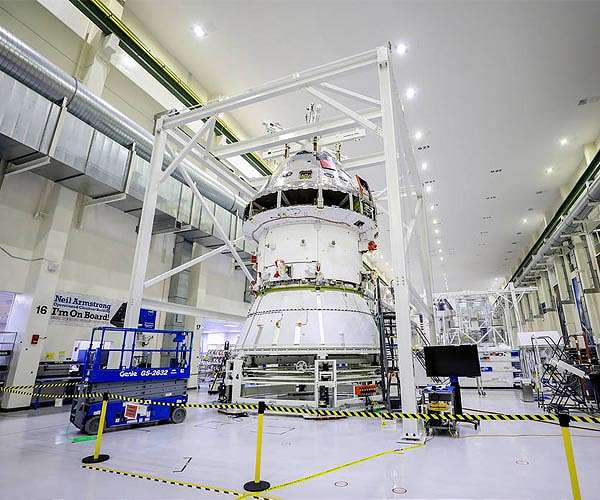
Technicians at NASA's Kennedy Space Center in Florida are working to install an adapter that will connect the Orion spacecraft to its rocket for the Artemis I mission around the Moon. This is one of the final major hardware operations for Orion inside the Neil Armstrong Operations and Checkout Building prior to integration with the Space Launch System (SLS) rocket. The spacecraft adapter cone (seen at the bottom of the stack pictured above) connects to the bottom of Orion's service module and will later join another adapter connected to the top of the rocket's interim cryogenic propulsion stage (ICPS). During the process to install the cone on Orion, the spacecraft is lifted out of the Final Assembly and Systems Testing, or FAST, cell and placed into the Super Station support fixture. During flight, the SLS rocket separates in multiple stages as it pushes Orion into deep space. After accelerating Orion towards the Moon, the spacecraft will separate from the ICPS and adapter cone using pyrotechnics and springs. Next up before stacking Orion on the rocket, technicians will install coverings to protect fluid lines and electrical components on the crew module adapter that connects Orion to the service module. Workers also will install the solar array wings that will provide Orion with power, spacecraft adapter jettison fairings that enclose the service module for launch, and the forward bay cover that protects the parachute system.


Orion will fly on the agency's Artemis I mission - the first in a series of increasingly complex missions to the Moon that will lead to human exploration of Mars. Through the Artemis program, NASA is working to land the first woman and the next man on the Moon by 2024.

Thursday, February 13, 2020

Artemis I progresses toward launch

The flight hardware has been built, the launch facilities are ready, and NASA and its industry partners are checking off final milestones for the launch that will put America on the path to landing the first woman and next man on the Moon. The Artemis I mission - the culmination of work by people across the country in support of the Space Launch System (SLS), Orion and Exploration Ground System (EGS) programs - will preserve the nation's leadership in human space exploration and set the U.S. on a new journey to explore deep space. "Thanks to the hard work of women and men across our country, NASA's deep space exploration system is the Artemis program's foundation. With their contributions, America leads in human exploration at the Moon and it will be the same for Mars," said NASA Deputy Administrator Jim Morhard. "The success of the Artemis program depends on our suppliers, and we're confident they'll rise to the challenge of our 2024 deadline." The Artemis I team includes five prime contractors and hundreds of suppliers from all 50 states, all of which are committed to the safe and successful launch of the most powerful rocket ever built and the only capsule capable of transporting and sustaining a crew in deep space, as well as successful mission execution and safe return of the lunar orbit mission. Representatives from this team of suppliers will meet in Washington, D.C. this week to share the latest program progress with legislators and highlight the work that is done in their respective states.


The five major industry players that are building and preparing to launch the SLS and Orion spacecraft for NASA's crewed exploration missions include:

+ Aerojet Rocketdyne, which provides the reliable, flight-proven RS-25 and RL10 engines for the core and upper stage that carry SLS and Orion into orbit and on to deep space. It also provides the jettison motor for Orion's Launch Abort System and 21 thrusters on the Orion crew and service modules.

Boeing, which designed, developed, built and is now testing the rocket's massive core stage and avionics, having completed the upper stage last year.

Jacobs, which has modernized and upgraded ground systems and launch facilities at the Kennedy Space Center, and is preparing to integrate and process the SLS and Orion flight hardware for launch.

Lockheed Martin, which has designed and is building the Orion spacecraft that will carry astronauts out to the Moon and beyond.

Northrop Grumman, which provides the rocket boosters that supply more than 75% of initial required thrust during the first two minutes of flight, as well as the attitude control motor and abort motor for Orion's Launch Abort System.

Recent SLS milestones include production completion of the Artemis I core stage flight hardware for first flight, now at Stennis Space Center for its final major test, called Green Run; delivery of booster aft exit cones to Kennedy Space Center (KSC) and completion of booster design certification review and first five-segment booster flight set; completion of the RS-25 engine hot-fire series for the first four SLS flights and attaching the RS-25s to the first core stage for testing. In addition, NASA is completing avionics systems at NASA's Marshall Space Flight Center that will control launch and guidance systems for the rocket.

The Artemis I Orion spacecraft is complete and was shipped to NASA's Plum Brook Station in Sandusky, Ohio, in late November for environmental testing to ensure that it can withstand the harsh environment of space on its journey around the Moon and back. In addition, Orion's full launch abort system was successfully tested this past July during a flight test called Ascent Abort-2 in Florida.

At KSC, the EGS team recently completed verification and validation of the modified mobile launcher and Launch Pad 39B systems. The team also received the massive SLS Core Stage Pathfinder at KSC, and conducted a month-long series of exercises in the Vehicle Assembly Building, during which they practiced handling and lifting of the full-scale mockup hardware. In the KSC Launch Control Center, the team is using the upgraded launch control system to complete SLS ground systems checkout and launch team training in the new control room environment.

Upcoming 2020 milestones for launch readiness will see these following programs integrated at KSC:

The SLS rocket booster segments will be delivered to KSC and, along with the booster forward and aft assemblies, will be integrated in the Vehicle Assembly Building.

The core stage and integrated RS-25 engines will complete Green Run testing at Stennis, and refurbishment, before being shipped to KSC for mating with the boosters.

The Orion Artemis I crew and service module will return from Plum Brook Station for final testing and integration prior to launch.

In addition to receiving SLS and Orion hardware for processing and stacking, the EGS team will conduct the Underway Recovery Test-8 in the Pacific Ocean in March, to validate the recovery procedures and operational timelines during a full mission rehearsal of Orion capsule recovery after splashdown.

Artemis I will be the first integrated flight test of the SLS rocket and Orion spacecraft. The mission will send Orion into a lunar distant retrograde orbit - a wide orbit around the Moon that is farther from Earth than any human-rated spacecraft has ever traveled. The uncrewed mission will last more than 20 days and will validate the design and safety of Orion and SLS for human exploration missions to follow.

Wednesday, January 15, 2020

NASA rings in busy new year in Florida to prepare for Artemis Missions

NASA's Kennedy Space Center in Florida will have a busy year preparing facilities, ground support equipment and space hardware for the launch of Artemis I, the first uncrewed launch of the Space Launch System (SLS) rocket and the Orion spacecraft. In 2020, Exploration Ground Systems (EGS) activities will ramp up as launch hardware arrives and teams put systems in place for Artemis I and II missions. Launch countdown simulations will continue to ramp up in 2020 to train and certify the launch control team for Artemis missions. The types of simulations will build on one another and will walk through the final portions of the launch countdown sequence, called the terminal countdown. Integrated simulations will tie in all NASA centers working the mission to ensure all members of the team are ready to work together, including Mission Control at Johnson Space Center in Houston, and the SLS Engineering Support Center at Marshall Space Flight Center in Alabama. Simulations will begin at the end of January and will occur up through one week before launch, with an average of one training exercise each month. Much of the work in 2020 will be to complete a punch list of detail work inside the Vehicle Assembly Building (VAB). This includes cleaning the platforms and making minor repairs to any platform hardware that will be near flight hardware as the facility prepares for arrival of SLS components and stacking operations. "We are at a very significant point in NASA's Artemis mission," said Mike Bolger, program manager of EGS. "The EGS team has finished mobile launcher testing at the launch pad and will finish testing at the VAB in January. At that point, all of the launch infrastructure will be tested and ready for operations."


Launch Complex 39B
Teams will continue work on a new emergency egress system for Pad 39B where flight or ground crew could board a basket with a braking system at the crew access level of the mobile launcher. The crew would ride the basket down a cable and come to a stop near a bunker to the west of the pad surface, providing quick escape in the unlikely event of an emergency. The design phase began in 2019 and construction will be complete in time to support crewed Artemis missions.

The pad is currently getting a liquid hydrogen upgrade. The project involves the integration of a new 1.4 million gallon, liquid hydrogen (LH2) storage sphere into the existing Launch Complex 39B system. The new LH2 sphere will work with the current LH2 sphere to supply LH2 for Artemis II and beyond. The larger tank will allow NASA to attempt SLS launches on three consecutive days, instead of opportunities two out of three days, in the event of a scrub. The newer technology reduces liquid hydrogen burn-off, allowing more launch attempts before having to refill the larger tank. Construction began in 2019 and will be complete prior to Artemis II.

Orion Underway Recovery Test 8
The integrated recovery team of NASA, EGS, Lockheed Martin and the U.S. Navy, along with additional contractor support, will head out to sea off the coast of California in March to conduct the eighth Underway Recovery Test. Using a Navy ship with a well deck and several small boats, the primary objective is to validate Orion recovery operations for Artemis I - including procedures and timelines, and practicing different scenarios.

Orion Spacecraft
This spring, the Orion spacecraft for Artemis I will return from NASA's unique test facility at Plum Brook Station in Ohio, where it is currently undergoing environmental testing inside the vacuum chamber that simulates the harsh environment of space.

Inside the Neil Armstrong Operations and Checkout (O and C) Building at Kennedy, technicians will install the spacecraft's solar array wings before performing final checkouts. EGS will begin Orion ground processing and stacking activities later in the year.

The team will process and fuel Orion in the Multi-Purpose Processing Facility then transfer it over to the Launch Abort System Facility where engineers will attach the launch abort system. Orion will then roll out to the VAB for inspections before stacking Orion on top of the SLS rocket.

In its early processing stages, the Artemis II crew module milestones inside the O and C include propulsion tank installation, a pressure test and subsystems installations in the spring. The initial power-on of the crew module will occur in early fall. The heat shield that will protect the first crewed mission of Orion will be completed and installed by the end of the year. Processing and testing of the crew module adapter - the ring that connects to the European Service Module - for Artemis II will happen in the first half of the year prior to the arrival of the European Service Module in the fall.

Space Launch System
Training activities with pathfinders, or full-scale replicas, of the SLS core stage and booster segments occurred in 2019, and more training with various pathfinder segments and hardware will continue. In 2020, training will involve stacking inert booster segments on the mobile launcher in the VAB.

Hardware for SLS will continue to arrive for processing and integration in various Kennedy facilities. This year all ten of the solid propellant booster segments will arrive by train from their Northrop Grumman manufacturing facility in Promontory, Utah.

The launch vehicle stage adapter, which will connect the SLS core stage to the interim cryogenic propulsion stage, will arrive by barge. The booster aft skirts - which contain the thrust vector control system that steers the rocket - will trek from the Booster Fabrication Facility to the Rotation, Processing and Surge Facility where they will be attached to the aft exit cones.

The exit cones are attached to the bottommost part of each of the twin boosters to provide extra thrust to the boosters and protect the aft skirts from the thermal environment during launch.

The core stage of the SLS rocket will undergo a Green Run test campaign over several months in the B-2 test stand at the agency's Stennis Space Center in Mississippi. Following Green Run completion, the 225,000-pound core stage will leave Stennis and arrive at Kennedy on the Pegasus barge. The core stage and solid rocket boosters will then be integrated inside the VAB.

Mobile Launcher 2
In 2019, NASA awarded a contract for Mobile Launcher 2 to Bechtel National Inc. of Reston, Virginia. The ground structure that will be used to assemble, process and launch the second and more powerful configuration of the SLS rocket, called Block 1B, is in its early stages of design and development and will be ready for Artemis IV.

Artemis I will be the first in a series of increasingly challenging missions that will enable human exploration to the Moon and Mars. In 2020, the mission will truly begin to take shape as hardware arrives and stacking operations begin inside the VAB.

"The operations team is writing procedures, training, and preparing for flight hardware processing," Bolger said. "When the SLS and Orion are turned over to EGS later this year, Kennedy will be ready!"

Future Artemis missions will establish a sustainable presence at the Moon for decades to come, and Kennedy teams will move forward in 2020 to build the infrastructure and make those missions possible.

Wednesday, September 25, 2019

Top Five Technologies Needed for a Spacecraft to Survive Deep Space

When a spacecraft built for humans ventures into deep space, it requires an array of features to keep it and a crew inside safe. Both distance and duration demand that spacecraft must have systems that can reliably operate far from home, be capable of keeping astronauts alive in case of emergencies and still be light enough that a rocket can launch it. Artemis Missions near the Moon will start when NASA's Orion spacecraft leaves Earth atop the world's most powerful rocket, NASA's Space Launch System. After launch from the agency's Kennedy Space Center in Florida, Orion will travel beyond the Moon to a distance more than 1,000 times farther than where the International Space Station flies in low-Earth orbit, and farther than any spacecraft built for humans has ever ventured. To accomplish this feat, Orion has built-in technologies that enable the crew and spacecraft to explore far into the solar system.


Systems to Live and Breathe

As humans travel farther from Earth for longer missions, the systems that keep them alive must be highly reliable while taking up minimal mass and volume. Orion will be equipped with advanced environmental control and life support systems designed for the demands of a deep space mission. A high-tech system already being tested aboard the space station will remove carbon dioxide (CO2) and humidity from inside Orion. Removal of CO2 and humidity is important to ensure air remains safe for the crew breathing. And water condensation on the vehicle hardware is controlled to prevent water intrusion into sensitive equipment or corrosion on the primary pressure structure.

The system also saves volume inside the spacecraft. Without such technology, Orion would have to carry many chemical canisters that would otherwise take up the space of 127 basketballs (or 32 cubic feet) inside the spacecraft-about 10 percent of crew livable area. Orion will also have a new compact toilet, smaller than the one on the space station. Long duration missions far from Earth drive engineers to design compact systems not only to maximize available space for crew comfort, but also to accommodate the volume needed to carry consumables like enough food and water for the entirety of a mission lasting days or weeks.

Highly reliable systems are critically important when distant crew will not have the benefit of frequent resupply shipments to bring spare parts from Earth, like those to the space station. Even small systems have to function reliably to support life in space, from a working toilet to an automated fire suppression system or exercise equipment that helps astronauts stay in shape to counteract the zero-gravity environment in space that can cause muscle and bone atrophy. Distance from home also demands that Orion have spacesuits capable of keeping astronaut alive for six days in the event of cabin depressurization to support a long trip home.

Proper Propulsion
The farther into space a vehicle ventures, the more capable its propulsion systems need to be to maintain its course on the journey with precision and ensure its crew can get home.

Orion has a highly capable service module that serves as the powerhouse for the spacecraft, providing propulsion capabilities that enable Orion to go around the Moon and back on its exploration missions. The service module has 33 engines of various sizes. The main engine will provide major in-space maneuvering capabilities throughout the mission, including inserting Orion into lunar orbit and also firing powerfully enough to get out of the Moon's orbit to return to Earth. The other 32 engines are used to steer and control Orion on orbit.

In part due to its propulsion capabilities, including tanks that can hold nearly 2,000 gallons of propellant and a back up for the main engine in the event of a failure, Orion's service module is equipped to handle the rigors of travel for missions that are both far and long, and has the ability to bring the crew home in a variety of emergency situations.

The Ability to Hold Off the Heat
Going to the Moon is no easy task, and it's only half the journey. The farther a spacecraft travels in space, the more heat it will generate as it returns to Earth. Getting back safely requires technologies that can help a spacecraft endure speeds 30 times the speed of sound and heat twice as hot as molten lava or half as hot as the sun.

When Orion returns from the Moon, it will be traveling nearly 25,000 mph, a speed that could cover the distance from Los Angeles to New York City in six minutes. Its advanced heat shield, made with a material called AVCOAT, is designed to wear away as it heats up. Orion's heat shield is the largest of its kind ever built and will help the spacecraft withstand temperatures around 5,000 degrees Fahrenheit during reentry though Earth's atmosphere.

Before reentry, Orion also will endure a 700-degree temperature range from about minus 150 to 550 degrees Fahrenheit. Orion's highly capable thermal protection system, paired with thermal controls, will protect Orion during periods of direct sunlight and pitch black darkness while its crews will comfortably enjoy a safe and stable interior temperature of about 77 degrees Fahrenheit.

Radiation Protection

As a spacecraft travels on missions beyond the protection of Earth's magnetic field, it will be exposed to a harsher radiation environment than in low-Earth orbit with greater amounts of radiation from charged particles and solar storms that can cause disruptions to critical computers, avionics and other equipment. Humans exposed to large amounts of radiation can experience both acute and chronic health problems ranging from near-term radiation sickness to the potential of developing cancer in the long-term.

Orion was designed from the start with built in system-level features to ensure reliability of essential elements of the spacecraft during potential radiation events. For example, Orion is equipped with four identical computers that each are self-checking, plus an entirely different backup computer, to ensure Orion can still send commands in the event of a disruption. Engineers have tested parts and systems to a high standard to ensure that all critical systems remain operable even under extreme circumstances.

Orion also has a makeshift storm shelter below the main deck of the crew module. In the event of a solar radiation event, NASA has developed plans for crew on board to create a temporary shelter inside using materials on board. A variety of radiation sensors will also be on the spacecraft to help scientists better understand the radiation environment far away from Earth. One investigation called AstroRad, will fly on Artemis I and test an experimental vest that has the potential to help shield vital organs and decrease exposure from solar particle events.

Constant Communication and Navigation
Spacecraft venturing far from home go beyond the Global Positioning System (GPS) in space and above communication satellites in Earth orbit. To talk with mission control in Houston, Orion will use all three of NASA's space communications networks. As it rises from the launch pad and into cislunar space, Orion will switch from the Near Earth Network to the Space Network, made possible by the Tracking and Data Relay Satellites, and finally to the Deep Space Network that provides communications for some of NASA's most distant spacecraft.

Orion is also equipped with backup communication and navigation systems to help the spacecraft stay in contact with the ground and orient itself if it's primary systems fail. The backup navigation system, a relatively new technology called optical navigation, uses a camera to take pictures of the Earth, Moon and stars and autonomously triangulate Orion's position from the photos. Its backup emergency communications system doesn't use the primary system or antennae for high-rate data transfer.

Saturday, September 21, 2019

Kentucky companies give NASA Artemis missions a boost

When American astronauts set foot on the Moon's surface in 2024, men and women across Kentucky can say they helped to make it possible. NASA recognized three Kentucky businesses - Parker Hannifin Corp., American Synthetic Rubber Co., a Michelin company; and Eckart America Corp. - in Lexington and Louisville Sept. 18-19 for their continued support in supplying critical elements and tools for the twin solid rocket boosters of NASA's powerful Space Launch System (SLS) rocket. "It is exciting to watch as NASA leads this new era of space exploration," said Kentucky Lt. Gov. Jenean Hampton. "I am proud the three businesses we're recognizing today play key roles in our nation's return to the Moon and beyond. Every worker who helps produce the seals, polymers, pigments and parts for NASA's new rocket systems should be proud of their contribution. Kentucky's aerospace and aviation industry stands ready to assist as NASA pushes the boundaries of research, exploration and innovation." Working with Northrop Grumman, the SLS booster lead contractor, each of the suppliers has played a role in manufacturing and producing the rocket's boosters that will be used for the Artemis missions. 


+ American Synthetic Rubber Co. is the only manufacturer in the United States of a unique liquid polymer that serves as the binder, or glue, in the SLS propellant that powers the rocket boosters. The polymer enhances the strength of the propellant while it is under pressure, helping the propellant withstand ignition forces.

+ Eckart produces the aluminum powder used in the SLS propellant.

+ Parker Hannifin's O-ring and Engineered Seals Division provides elastomer sealing that is a key component for the SLS boosters as well as the Mars 2020 Rover, which will search for signs of habitable conditions on Mars.

American Synthetic Rubber Co. and Parker Hannifin were each presented with the Space Launch System Program Manager's Commendation award by retired NASA astronaut Col. William "Bill" McArthur on behalf of the agency. NASA and Northrop Grumman personnel toured each of the facilities to meet the men and women helping to build the boosters for the SLS rocket.

"NASA and Northrop Grumman earlier this year completed casting all 10 of the booster motor segments for both the first and second Artemis lunar missions," said Mark Olsen of Northrop Grumman. "Men and women here in Kentucky and across the U.S. are providing vital services to build the SLS rocket as efficiently as possible."

Based on the booster design from NASA's Space Shuttle Program, the five-segment SLS booster is the largest, most powerful solid propellant booster ever built for flight. Each booster produces more than 3.6 million pounds of thrust to send SLS and NASA's Orion spacecraft to the Moon. Together, the twin boosters produce more than 75 percent of the total SLS thrust at launch.

American Synthetic Rubber Co., Parker Hannifin and Eckart supplied elements for the production of the boosters during the space shuttle program.

"The boosters for SLS were adapted from the space shuttle booster with the addition of a fifth propellant segment," said Hank Miller, SLS booster element deputy manager. "That additional motor segment enables the SLS to lift more weight and travel farther than the shuttle."

Sending American astronauts to the Moon by 2024 takes power, precision and the combined efforts from companies across the United States. More than 3,800 businesses in all 50 states support the production of SLS and Orion for the Artemis lunar missions.

Kentucky is a leader in America's aerospace industry, ranking second as the top aerospace export state in the country. With more than 600 Kentucky companies in the aerospace and defense business, the state had more than $12 billion in aerospace and defense exports in 2018. Additionally, NASA astronauts Randy Bresnik and Terri Wilcutt, the agency's chief of safety and mission assurance and former space shuttle pilot, are from Kentucky.

Thursday, September 19, 2019

Orion Test Article on the Move

Engineers recently lifted and moved a full-scale test version of the 13-ton Orion service module in preparation for upcoming pyroshock tests at NASA Glenn's Plum Brook Station in Sandusky, Ohio. During the tests, engineers will fire pyrotechnics to simulate the shocks the service module will experience as Orion separates from the Space Launch System (SLS) rocket. The service module is an essential part of the spacecraft. It will propel, power and cool Orion in addition to providing air and water for the crew. In this time-lapse video, the Plum Brook team removes the test article from the world's most powerful spacecraft vibration table and transports it into the assembly high bay area in Plum Brook's Space Environments Complex. Prior to the move, the test article passed a series of vibration tests to verify that it can withstand the vibrations as it launches and travels into space. A thousand sensors collected data on Orion's service module as it was shaken on a vibration table. This testing simulated how Orion's structure flexed and will stand up to 35 tons of spacecraft weight during a launch. Orion's first flight atop SLS, known as Artemis 1, is targeted to launch in 2020. It will venture tens of thousands of miles beyond the moon. The test article was provided by ESA (European Space Agency) and built by Airbus Defence and Space.


Thursday, August 29, 2019

NASA prepares for green run testing, practices lifting SLS Core Stage

NASA cleared a milestone in preparation for Green Run testing of its Space Launch System (SLS) core stage with an Aug. 23/24 lift and installation of the core stage pathfinder simulator onto the B-2 Test Stand at Stennis Space Center near Bay St. Louis, Miss. The lift and installation of the core stage pathfinder - a size and weight replica of the SLS core stage - is helping teams at Stennis prepare for the Green Run test series. For this test of the new core stage, Stennis will lift the flight core stage for Artemis 1, the first SLS mission into the stand. SLS and the new Orion spacecraft being built are the foundation for NASA's Artemis Program, which will send the first woman and next man to walk on the Moon by 2024. Stennis modified the B-2 Test Stand for the core stage Green Run testing. The procedure involved lifting the core stage pathfinder from its horizontal position on the B-2 Test Stand tarmac with the facility boom crane line attached to the forward end and a ground crane line attached to the aft end. The pathfinder then was "broken over" into a vertical position. Once the ground crane line was disconnected, the core stage pathfinder was lifted into place by the stand boom crane. This "fit test" validated auxiliary lift equipment, procedures, and verified that stand modifications and preparations are in place and prepared for delivery and testing of the SLS core stage flight hardware. To prepare for the test, Stennis modified or upgraded every major area and system of the test stand, as well as the high-pressure industrial water system and high-pressure gas facility that support test operations.


NASA is building the SLS flight core stage at its Michoud Assembly Facility in New Orleans and is scheduled for transport to Stennis by the end of the year. The stage recently completed a critical review in preparation for adding the last piece of the core stage structure: the engine section.

After this piece is added, the four RS-25 engines can be connected to the stage. When the stage is completely assembled, NASA's Pegasus barge will deliver it to Stennis. For the Green Run test, the core stage flight unit will be lifted and installed onto the B-2 stand, using procedures developed and practiced during the recent core stage pathfinder lift.

NASA then will conduct a series of tests to check out stage systems and make sure all are working as needed. Once systems are checked, NASA will conduct a full hot fire test of the stage, firing its four RS-25 engines simultaneously, just as during an actual launch.

The hot fire test will generate more than 2 million pounds of combined thrust and provide critical performance data needed to demonstrate the core stage design is flightworthy and ready for launch.

Following necessary refurbishment of the stage, it will be transported by barge to Kennedy Space Center in Florida. At Kennedy, the stage will be mated with other SLS major elements and prepared for launch of the Artemis 1 mission.

Tuesday, October 16, 2018

Space Launch System Intertank completes functional testing

The intertank that will be flown on Exploration Mission-1 as part of NASA's new rocket, the Space Launch System, has completed its avionics functional testing, at the Michoud Assembly Center in New Orleans. The avionics, shown here inside the intertank structure, guide the vehicle and direct its power during flight. The intertank houses critical electronics that "talk to" the flight computers in the forward skirt. The intertank, forward skirt, two colossal fuel tanks and the engine section make up the massive core stage of the SLS rocket. The avionics units on the core stage work with the rocket's flight software to perform various functions during the first eight minutes of flight. Now that the intertank and forward skirt have passed avionics testing, they are ready to be mechanically joined and tested to verify they can successfully work together. To prepare for the first mission, engineers from Boeing, the prime contractor from Huntsville, Alabama, building the SLS core stage, are currently checking out the avionics systems for the entire rocket at the systems integration laboratory at NASA's Marshall Space Flight Center in Huntsville.


They are verifying that the core stage avionics can use the flight software to operate and communicate with all the parts of the rocket as well as to Orion and to ground control computers.

Friday, September 28, 2018

NASA Unveils Sustainable Campaign to Return to Moon, on to Mars

In December of 2017, President Donald Trump signed Space Policy Directive-1, in which the president directed NASA "to lead an innovative and sustainable program of exploration with commercial and international partners to enable human expansion across the solar system and to bring back to Earth new knowledge and opportunities." In answer to that bold call, and consistent with the NASA Transition Authorization Act of 2017, NASA recently submitted to Congress a plan to revitalize and add direction to NASA's enduring purpose. The National Space Exploration Campaign calls for human and robotic exploration missions to expand the frontiers of human experience and scientific discovery of the natural phenomena of Earth, other worlds and the cosmos. The Exploration Campaign builds on 18 continuous years of Americans and our international partners living and working together on the International Space Station. It leverages advances in the commercial space sector, robotics and other technologies, and accelerates in the next few years with the launch of NASA's Orion spacecraft and Space Launch System (SLS) rocket.


The Exploration Campaign has five strategic goals:

1. Transition U.S. human spaceflight activities in low-Earth orbit to commercial operations that support NASA and the needs of an emerging private sector market.
2. Lead the emplacement of capabilities that support lunar surface operations and facilitate missions beyond cislunar space.
3. Foster scientific discovery and characterization of lunar resources through a series of robotic missions.
4. Return U.S. astronauts to the surface of the Moon for a sustained campaign of exploration and use.
5. Demonstrate the capabilities required for human missions to Mars and other destinations.

Transition Low-Earth Orbit Activities
NASA intends to transition from the current model of human space activities in low-Earth orbit to a model where the government is only one customer for commercial services.

Based on inputs from current partners, commercial and other stakeholders, NASA will shape the plan for the transition of low-Earth orbit activities from direct government funding to commercial services and partnerships, with new, independent commercial platforms or a non-NASA operating model for some form or elements of the International Space Station by 2025. In addition, NASA will expand public-private partnerships to develop and demonstrate technologies and capabilities to enable new commercial space products and services.

The International Space Station will continue to serve as a core long-duration human spaceflight platform through at least 2024, which will mark almost 25 years of continuous human occupancy and successful international cooperation in space.

NASA leverages the space station to learn how to keep crews healthy and productive on deep space missions, and as a testbed to develop technologies to support those missions. It is an experiential testing ground that enables discovery and development of advanced robotics, communications, medicine, agriculture and environmental science.

The space station also can help enable the transition to commercial activities in low-Earth orbit. NASA recently awarded 12 contracts to industry to investigate the best way to use the space station to engage the U.S. commercial industry to take a lead role in low-Earth orbit. The portfolio of selected studies will include specific industry concepts detailing business plans and the viability of habitable platforms, using the space station or separate free-flying structures.

To the Moon

The Moon is a fundamental part of Earth's past and future - an off-world continent that may hold valuable resources to support space activity and scientific treasures that may tell us more about our own planet. Although Americans first walked on its surface almost 50 years ago, our explorers left footprints at only six sites, during a total of 16 days on the surface. The next wave of lunar exploration will be fundamentally different.

NASA is building a plan for Americans to orbit the Moon starting in 2023, and land astronauts on the surface no later than the late 2020s. This will be the first chance for the majority of people alive today to witness a Moon landing - a moment when, in awe and wonder, the world holds its breath. However, America will not stop there.

A key component of establishing the first permanent American presence and infrastructure on and around the Moon is the Gateway, a lunar orbiting platform to host astronauts farther from Earth than ever before.

On the Gateway, America and its partners will prepare to transit deep space, testing new technologies and systems as we build the infrastructure to support missions to the surface of the Moon and prepare for the epochal mission to Mars. NASA also will study the effects of the deep space environment of the Gateway, learning how living organisms react to the radiation and microgravity of a deep space environment over long periods.

The Gateway also will be assessed as a platform for the assembly of payloads and systems; a reusable command module for lunar vicinity and surface exploration; and a way station for the development of refueling depots, servicing platforms, and a sample return facility.

Some elements of the Gateway already are under construction at NASA centers across the United States, including facilities in Ohio, Texas and Alabama, and at commercial partner facilities. The Gateway will be assembled in space, incrementally, using the Orion spacecraft and SLS, as well as commercial launch vehicles. The first element, providing power and propulsion, will launch from Florida in 2022.

The lunar surface will serve as a crucial training ground and technology demonstration test site where we will prepare for future human missions to Mars and other destinations. Through an innovative combination of missions involving commercial and international partners, robotic lunar surface missions will begin as early as 2020, focus on scientific exploration of lunar resources, and prepare the lunar surface for a sustained human presence.

By the late 2020s, a lunar lander capable of transporting crews and cargo will begin trips to the surface of the Moon. The sustainable, long-term lunar surface activities enabled by these efforts, in tandem with the Gateway, will expand and diversify over time, taking advantage of the Moon and near space for scientific exploration in the broadest sense.


On to Mars

The first human landing on Mars - audacious in its complexity - will be an achievement recalled with awe far into humanity's future. Key components of the Exploration Campaign already are underway and include long-duration human spaceflight on the space station, development of advanced life support systems, and continuing to lead and advance the world in deep space science missions.

Overall, the Exploration Campaign focuses on a transformative approach that includes the development of technologies and systems that enable a series of human and robotic lunar missions that are extensible to Mars.

NASA continues to maintain leadership in robotic exploration on and around Mars. The agency's InSight mission now is on its way to Mars and will land in November to study the interior of the Red Planet. Development of NASA's next rover to Mars continues to make excellent progress and is scheduled to launch in July 2020.

The Mars 2020 rover will aid our search for past life and demonstrate the production of fuel and other resources that enable human exploration. We also will use this mission as a building block for a subsequent roundtrip robotic mission with the historic first rocket launch off another planet and a sample return. That mission will serve as a critical precursor to an eventual series of crewed missions to Mars planned to start in the 2030's and culminating in a surface landing, which will be supported by the work we'll do on the Moon in the coming years.

Thursday, September 13, 2018

NASA tests engine part to reduce costs

NASA redesigned and tested a key component for the RS-25 engine that powers the agency's new deep space rocket, the Space Launch System (SLS), by incorporating modern manufacturing techniques that significantly reduce both cost and fabrication time. The redesigned main combustion chamber, which is the heart of the engine, has performed well during two tests in flight-like conditions. During the tests, temperatures reached 6,000 degrees Fahrenheit, and the part experienced 3,000 pounds of pressure as the engine fired up in a test stand at NASA's Stennis Space Center in Bay St. Louis, Mississippi. When SLS launches, four RS-25 engines will produce two million pounds of thrust to help send SLS to space for missions to the Moon and beyond. "We're testing propulsion parts like the main combustion chamber, one of the most complex and critical components for engine operations, to show it can be made less expensively without sacrificing reliability, safety or performance," said Steve Wofford, SLS liquid engines manager. "The SLS rocket will be the most powerful rocket in the world, and these tests show engines can be made with modern manufacturing techniques and still provide the power to safely send astronauts to the Moon."


Inside the chamber, the fuel and oxidizer combust and flow through the nozzle, to turn the high-pressure combustion into the 500,000 pounds of thrust that each engine produces. The new chamber design reduces the complexity of the part by eliminating 29 welds. The chamber is made in less time for less money with a bonding technique called Hot Isostatic Pressure - or HIP - bonding. The chamber's internal metal liner and external jacket are bonded together under very high pressures and temperatures.

"The innovative bonding process has reduced the chamber cost and build time by around 50 percent each." said Mike Shadoan, the SLS combustion devices manager for liquid engines. "This series of nine tests allows us to test flight controllers for early missions and at the same time expose parts made with innovative techniques to the same conditions they will see during launch and flight."

The RS-25 was proven during the Space Shuttle Program and has been updated with new controllers and nozzle insulation for its job with SLS. Currently, the SLS Program has 16 engines in its inventory from the Space Shuttle Program, enough for four flights.

Engines for later flights are being built by the SLS core stage engine prime contractor, Aerojet Rocketdyne, at its factory in Canoga Park, California. NASA and Aerojet engineers are working to smartly incorporate today's modern manufacturing techniques not just in the chamber, but also on key components across the entire engine, leading to a host of benefits in cost, schedule and reduced complexity.

"Engine hot fire testing is the ultimate demonstration that new component designs and incorporation of modern manufacturing technologies are paying off big-time for the program," said Dan Adamski, RS-25 program director for Aerojet Rocketdyne. "Continued testing will integrate additional upgraded components into the engine design culminating with final certification testing in 2021."

During six tests, technicians and engineers tested the first 3D printed part on an RS-25 engine, the pogo accumulator. Aerojet Rocketdyne is under contract to manufacture an initial set of six new engines for future SLS missions. These new engines will be fabricated using the components and techniques that are being validated on development engines during engine tests at Stennis.

NASA is leading a return to the Moon through an innovative and sustainable program of exploration to expand human presence into the solar system. Beginning with Exploration Mission-1, SLS and Orion will demonstrate the critical backbone capabilities that will carry humans to the Moon and farther into space than ever before on a variety of missions with increasing complexity. SLS's unprecedented power and volume will also carry the large pieces of hardware needed to build the Gateway and other long-term infrastructure at the Moon and, later, for human missions to Mars.

Thursday, August 23, 2018

Heat shield install brings Orion spacecraft closer to space

During Exploration Mission-1 (EM-1), an uncrewed Orion spacecraft will launch atop NASA's Space Launch System rocket and begin a three-week voyage in space, taking it about 40,000 miles beyond the Moon and back to Earth. On its return, the spacecraft's heat shield will need to withstand temperatures of nearing 5,000 degrees Fahrenheit during its fiery re-entry through the Earth's atmosphere before it splashes down in the Pacific Ocean. Technicians at NASA's Kennedy Space Center (KSC) in Florida recently secured the heat shield to the bottom of the crew module, using 68 bolts. Designed and manufactured by Orion prime contractor, Lockheed Martin, the heat shield is like an intricate puzzle with pieces that all have to fit together perfectly. Before the final installation, a fit check was performed to ensure all of the bolt fittings lined up. "Installation of the EM-1 crew module heat shield is a significant milestone representing the beginning of closing out the crew module assembly," said Jules Schneider, Lockheed Martin Orion senior manager for KSC Operations. "When the heat shield is installed, access to components becomes more difficult, and in some cases there is no more access. So by installing the heat shield you are declaring that a certain percentage of the spacecraft is finished."


Measuring 16.5 feet in diameter, Orion's new heat shield is the largest of its kind developed for missions that will carry astronauts. The heat shield base structure has a titanium truss covered with a composite substrate, or a skin composed of layers of carbon fiber material.

In a new process, several large blocks of an ablative material called Avcoat, licensed from Boston-based Textron Systems, were produced at Michoud Assembly Facility in New Orleans by Lockheed Martin. They were shipped to Kennedy, where Lockheed Martin technicians machined them into more than 180 unique blocks and bonded them to the heat shield's surface.

To fill tiny gaps between the blocks, the seams were filled with a mixture that over time will become solid. Technicians applied a coat of white epoxy paint to the heat shield's surface and then applied aluminized tape after the painted surface dried. The tape provides surface resistivity, and absorbs solar heat and infrared emissions.

"Witnessing assembly, test and installation of the EM-1 crew module heat shield brought an appreciation for its innovative design and assembly techniques," said Amy Marasia, the Crew Module Assembly operations lead in NASA's Orion Production Operations.

While Avcoat isn't new to spacecraft - it was used on the heat shields of Apollo and the Orion Exploration Flight Test-1 - the technique of using blocks instead of injecting the ablative material is proving to be a real production time-saver.

"A benefit of switching from the honeycomb system to the blocks is we now can make the Avcoat blocks at the same time that the Orion structure is being made, and when the module is ready we can secure the blocks, which saves time," said John Kowal, NASA Orion Thermal Protection System manager at Johnson Space Center in Houston.

"Before, with EFT-1, we had to wait for the carrier portion to be done, and then apply the Avcoat directly to the crew module."

During its first mission around the Moon, engineers will monitor how Orion's systems perform in the environment of deep space and its return to Earth. During re-entry the ablative material of the Avcoat blocks will burn away, essentially carrying the heat away from Orion because of the gases created during the ablative process.

Orion is the exploration spacecraft that will carry astronauts to deep-space destinations, including the Moon and on to Mars. Orion will be equipped with power, communications and life support systems to sustain space travelers during their long-duration missions and return them safely to Earth.