Showing posts with label spacecraft. Show all posts

Tuesday, February 25, 2020

Magnetic field at Martian surface ten times stronger than expected

New data gleaned from the magnetic sensor aboard NASA's InSight spacecraft is offering an unprecedented close-up of magnetic fields on Mars. In a study published in Nature Geoscience, scientists reveal that the magnetic field at the InSight landing site is ten times stronger than anticipated, and fluctuates over time-scales of seconds to days. "One of the big unknowns from previous satellite missions was what the magnetization looked like over small areas," said lead author Catherine Johnson, a professor at the University of British Columbia and senior scientist at the Planetary Science Institute. "By placing the first magnetic sensor at the surface, we have gained valuable new clues about the interior structure and upper atmosphere of Mars that will help us understand how it - and other planets like it - formed." Before the InSight mission, the best estimates of Martian magnetic fields came from satellites orbiting high above the planet, and were averaged over large distances of more than 150 kilometres. "The ground-level data give us a much more sensitive picture of magnetization over smaller areas, and where it's coming from," said Johnson. "In addition to showing that the magnetic field at the landing site was ten times stronger than the satellites anticipated, the data implied it was coming from nearby sources." Scientists have known that Mars had an ancient global magnetic field billions of years ago that magnetized rocks on the planet, before mysteriously switching off. Because most rocks at the surface are too young to have been magnetized by this ancient field, the team thinks it must be coming from deeper underground.


"We think it's coming from much older rocks that are buried anywhere from a couple hundred feet to ten kilometres below ground," said Johnson. "We wouldn't have been able to deduce this without the magnetic data and the geology and seismic information InSight has provided."

The team hopes that by combining these InSight results with satellite magnetic data and future studies of Martian rocks, they can identify exactly which rocks carry the magnetization and how old they are.

Day-night fluctuations and things that pulse in the dark
The magnetic sensor has also provided new clues about phenomena that occur high in the upper atmosphere and the space environment around Mars.

Just like Earth, Mars is exposed to solar wind, which is a stream of charged particles from the Sun that carries an interplanetary magnetic field (IMF) with it, and can cause disturbances like solar storms. But because Mars lacks a global magnetic field, it is less protected from solar weather.

"Because all of our previous observations of Mars have been from the top of its atmosphere or even higher altitudes, we didn't know whether disturbances in solar wind would propagate to the surface," said Johnson. "That's an important thing to understand for future astronaut missions to Mars."

The sensor captured fluctuations in the magnetic field between day and night and short, mysterious pulsations around midnight, confirming that events in and above the upper atmosphere can be detected at the surface.

The team believe that the day-night fluctuations arise from a combination of how the solar wind and IMF drape around the planet, and solar radiation charging the upper atmosphere and producing electrical currents, which in turn generate magnetic fields.

"What we're getting is an indirect picture of the atmospheric properties of Mars - how charged it becomes and what currents are in the upper atmosphere," said co-author Anna Mittelholz, a postdoctoral fellow at the University of British Columbia.

And the mysterious pulsations that mostly appear at midnight and last only a few minutes?

"We think these pulses are also related to the solar wind interaction with Mars, but we don't yet know exactly what causes them," said Johnson. "Whenever you get to make measurements for the first time, you find surprises and this is one of our 'magnetic' surprises."

In the future, the InSight team wants to observe the surface magnetic field at the same time as the MAVEN orbiter passes over InSight, allowing them to compare data.

"The main function of the magnetic sensor was to weed out magnetic "noise," both from the environment and the lander itself, for our seismic experiments, so this is all bonus information that directly supports the overarching goals of the mission," said InSight principal investigator Bruce Banerdt of NASA's Jet Propulsion Laboratory in Pasadena, California. "The time-varying fields, for example, will be very useful for future studies of the deep conductivity structure of Mars, which is related to its internal temperature."

Monday, December 23, 2019

Boeing spacecraft lands in New Mexico after mission cut short

Boeing's new Starliner unmanned spacecraft returned to Earth on Sunday, landing in the New Mexico desert in the United States six days early after a clock problem scuppered a rendezvous with the International Space Station. NASA hailed the aborted flight as a success, despite its failure to reach the ISS on what was meant to be a final dress rehearsal before a crewed mission. Images broadcast by NASA showed the spacecraft touching down, cushioned by airbags, after a pre-dawn descent slowed by three large parachutes."We had some challenges, but a lot of things did in fact go right," NASA Administrator Jim Bridenstine told reporters, describing the landing as an "absolute bull's-eye." "We did not make it to the International Space Station. We did not dock, but the spacecraft flew exceptionally well. We've got a lot of data to review." The Starliner capsule was launched Friday from Cape Canaveral in Florida, but shortly after separating from its Atlas V launch rocket, its thrusters failed to activate as planned, preventing it from reaching a high enough orbit. The space station orbits at an altitude of about 400 kilometers (250 miles) above sea level. As the craft had burned too much propellant, Boeing and NASA were forced to guide the Starliner back to Earth.


"Maybe it's acceptable to go next step -- fly the crew flight test, but we have to go through the data first," Steve Stich, deputy manager of NASA's Commercial Crew Program, said.

"We tested a majority of the core system of the vehicle... We had a little issue with the timer in the beginning."

The test flight was a key part of NASA's plans to end US dependence on Russia for space rides.

Its flight troubles also dealt a fresh reputational blow to Boeing, which faces a safety crisis in its commercial air division.

The company is reeling from two fatal crashes of its 737 Max airliner. The crashes, in October 2018 in Indonesia and in March 2019 in Ethiopia, claimed a total 346 lives.

Boeing plans to suspend production of the plane in January.

- Capsule named 'Calypso' -

The Starliner was able to establish a communications link with the ISS, and to test its docking mechanism, solar panels, batteries, thrusters and heat regulation system.

Its heat shield protected the capsule during re-entry, when temperatures outside the vehicle rose to over 1,600 degrees Celsius (2,900 degrees Fahrenheit) due to friction.

Before its descent, the Starliner was orbiting at an altitude of 250 kilometers (150 miles) and traveling at over 28,000 kilometers an hour (17,400 mph).

In a test in November, only two of the three parachutes opened, although they proved sufficient for the landing.

NASA said the Starliner had landed in excellent condition and would now be refurbished ahead of a decision on whether to carry out another test flight or to trust that the vehicle was safe to carry astronauts.

The capsule has been named "Calypso" after French marine explorer Jacques Cousteau's ship, NASA added.

Starliner's first crewed flight had been scheduled for early 2020. That development was much-anticipated as NASA has been forced to rely on Russian Soyuz rockets to transport its astronauts to the space station since the Space Shuttle program was shuttered in 2011 after 30 years.

Under former president Barack Obama, NASA opted for a shift in how it operates.

Instead of owning the hardware, it hired private companies to take over, awarding Boeing and SpaceX billions of dollars to develop "Made in the USA" solutions.

The Crew Dragon, developed by SpaceX, is expected to be ready for launch next year.

NASA has committed to pay $8 billion to Boeing and SpaceX, which in return are to deliver six trips carrying four astronauts each from now to 2024.

Starliner carried a test dummy called "Rosie" after "Rosie the Riveter," the star of a campaign aimed at recruiting women to munitions factory jobs during World War II.

Rosie was packed with sensors to verify the voyage would be safe for future teams of humans.

Monday, December 9, 2019

SpaceX Dragon docks with International Space Station

The SpaceX Dragon cargo spacecraft containing 5,700 pounds of cargo arrived at the International Space Station on Sunday morning. The spacecraft, which is SpaceX's 19th delivery to the ISS, was captured by the Canadarm2 robotic arm operated by astronauts Luca Parmitano and Andrew Morgan at 5:05 a.m. At 7:47 a.m., it was installed at the ISS, according to NASA. Aboard were genetically enhanced "mighty mice," 36,000 worms and a new version of the CIMON rocket to interact with astronauts. The worms will reproduce 3 million mice in an incubator and be brought back to Earth in a frozen state, Space.com reported. The mice will help scientists understand how to limit muscle and bone loss in humans in space, CNN reported. Experiments also will study malting barley in microgravity, the spread of fire. Also delivered were a high-tech toolbox to be mounted outside the station and a new hyperspectral Earth imaging system developed by the Japanese government for use in oil exploration among other things. The spacecraft was launched aboard the Falcon 9 rocket Thursday from Cape Canaveral Air Force Station in Florida. The liftoff was delayed from Wednesday because of strong high-altitude winds. The capsule is scheduled to leave the space station and re-enter Earth's atmosphere in January, splashing down in the Pacific Ocean off the coast of Baja California with 3,600 pounds of return cargo. Early Monday morning, a second resupply spacecraft is scheduled to arrive: the Russian Progress 74 that launched Friday morning. NASA TV will provide live coverage of Progress rendezvous and docking at 4:45 a.m.


earlier report
SpaceX launches 19th cargo mission to space station with robot aboard
A SpaceX Falcon 9 rocket launched into a bright Florida sky Thursday from Cape Canaveral Air Force Station on the company's 19th cargo mission to the International Space Station.

The rocket, lifting off at 12:29 p.m., carried 5,700 pounds of supplies, experiments and a new version of the CIMON robot designed to interact with astronauts. The onboard robot is designed to float in the space station's habitat.

SpaceX had postponed a launch attempt Wednesday because of strong high-altitude winds that could knock the Falcon 9 rocket off course, but company officials said the weather was ideal Thursday and the launch came on time.

The first-stage booster of the rocket, which had not been used previously, landed on a barge in the Atlantic Ocean about eight minutes after launch. A live feed showing the barge was interrupted as the booster descended, causing a gasp from the group watching at SpaceX headquarters. The feed was restored a few seconds later and showed the booster standing safely upright.

The Dragon capsule will travel through space for several days as it catches up to the station. On Dec. 8, the capsule will make a slow approach to space station, and astronauts on board will capture it using the station's Canadarm and attach it to an airlock.

After being unpacked and repacked, the capsule is scheduled to leave the space station from the station and re-enter Earth's atmosphere in January, splashing down in the Pacific Ocean off the coast of Baja California with 3,600 pounds of return cargo.

The robot being sent to the space station, CIMON - an acronym for Crew Interactive Mobile Companion - is capable of conversing with astronauts, helping them remember procedures and eventually detecting their mood in case of problems on board. It was built by Airbus with help from IBM and the German Aerospace Center.

The first version of CIMON was tested on the station in November 2018 with mixed results. Video showed German astronaut Alexander Gerst switching on the robot and holding a five-minute conversation with it. CIMON appeared to malfunction, floating down toward the deck of the station despite Gerst's attempt to pull it back.

But the robot did answer questions and play a song that was billed as Gerst's favorite in the video, The Man Machine, by German band Kraftwerk. Finally CIMON told Gerst to "Be nice to me," prompting snickers from the crew.

At one point in the conversation, the robot responded with comments about dancing when Gerst told it to "cancel" the music it was playing.

"The first CIMON was sent back to Earth and will go to a museum," said Till Eisenberg, a project manager for Airbus. "The new version has better microphones and software life that can last up to three years in space."

The goal, Eisenberg said, is to have CIMON support the crew's mental health and mood with conversation. It also could be equipped with sensors, such as those that would detect carbon monoxide if astronauts appear groggy.

Other items on the rocket included a high-tech toolbox, designed to be mounted outside the station, and a new hyperspectral Earth imaging system that was developed by the Japanese government for use in oil exploration among other things.

The toolbox will hold two leak detectors, and help reduce preparation time in space because they no longer will be brought through airlocks. The leak detectors are equipped with mass spectrometers that can find small leaks from the space station, NASA said.

The tool stowage assembly was developed at NASA's Goddard Space Flight Center in Greenbelt, Md., in partnership with NASA's Johnson Space Center in Houston.

The Dragon capsule that carried the cargo previously flew on SpaceX's CRS-6 and CRS-11 missions.

Wednesday, September 25, 2019

Top Five Technologies Needed for a Spacecraft to Survive Deep Space

When a spacecraft built for humans ventures into deep space, it requires an array of features to keep it and a crew inside safe. Both distance and duration demand that spacecraft must have systems that can reliably operate far from home, be capable of keeping astronauts alive in case of emergencies and still be light enough that a rocket can launch it. Artemis Missions near the Moon will start when NASA's Orion spacecraft leaves Earth atop the world's most powerful rocket, NASA's Space Launch System. After launch from the agency's Kennedy Space Center in Florida, Orion will travel beyond the Moon to a distance more than 1,000 times farther than where the International Space Station flies in low-Earth orbit, and farther than any spacecraft built for humans has ever ventured. To accomplish this feat, Orion has built-in technologies that enable the crew and spacecraft to explore far into the solar system.


Systems to Live and Breathe

As humans travel farther from Earth for longer missions, the systems that keep them alive must be highly reliable while taking up minimal mass and volume. Orion will be equipped with advanced environmental control and life support systems designed for the demands of a deep space mission. A high-tech system already being tested aboard the space station will remove carbon dioxide (CO2) and humidity from inside Orion. Removal of CO2 and humidity is important to ensure air remains safe for the crew breathing. And water condensation on the vehicle hardware is controlled to prevent water intrusion into sensitive equipment or corrosion on the primary pressure structure.

The system also saves volume inside the spacecraft. Without such technology, Orion would have to carry many chemical canisters that would otherwise take up the space of 127 basketballs (or 32 cubic feet) inside the spacecraft-about 10 percent of crew livable area. Orion will also have a new compact toilet, smaller than the one on the space station. Long duration missions far from Earth drive engineers to design compact systems not only to maximize available space for crew comfort, but also to accommodate the volume needed to carry consumables like enough food and water for the entirety of a mission lasting days or weeks.

Highly reliable systems are critically important when distant crew will not have the benefit of frequent resupply shipments to bring spare parts from Earth, like those to the space station. Even small systems have to function reliably to support life in space, from a working toilet to an automated fire suppression system or exercise equipment that helps astronauts stay in shape to counteract the zero-gravity environment in space that can cause muscle and bone atrophy. Distance from home also demands that Orion have spacesuits capable of keeping astronaut alive for six days in the event of cabin depressurization to support a long trip home.

Proper Propulsion
The farther into space a vehicle ventures, the more capable its propulsion systems need to be to maintain its course on the journey with precision and ensure its crew can get home.

Orion has a highly capable service module that serves as the powerhouse for the spacecraft, providing propulsion capabilities that enable Orion to go around the Moon and back on its exploration missions. The service module has 33 engines of various sizes. The main engine will provide major in-space maneuvering capabilities throughout the mission, including inserting Orion into lunar orbit and also firing powerfully enough to get out of the Moon's orbit to return to Earth. The other 32 engines are used to steer and control Orion on orbit.

In part due to its propulsion capabilities, including tanks that can hold nearly 2,000 gallons of propellant and a back up for the main engine in the event of a failure, Orion's service module is equipped to handle the rigors of travel for missions that are both far and long, and has the ability to bring the crew home in a variety of emergency situations.

The Ability to Hold Off the Heat
Going to the Moon is no easy task, and it's only half the journey. The farther a spacecraft travels in space, the more heat it will generate as it returns to Earth. Getting back safely requires technologies that can help a spacecraft endure speeds 30 times the speed of sound and heat twice as hot as molten lava or half as hot as the sun.

When Orion returns from the Moon, it will be traveling nearly 25,000 mph, a speed that could cover the distance from Los Angeles to New York City in six minutes. Its advanced heat shield, made with a material called AVCOAT, is designed to wear away as it heats up. Orion's heat shield is the largest of its kind ever built and will help the spacecraft withstand temperatures around 5,000 degrees Fahrenheit during reentry though Earth's atmosphere.

Before reentry, Orion also will endure a 700-degree temperature range from about minus 150 to 550 degrees Fahrenheit. Orion's highly capable thermal protection system, paired with thermal controls, will protect Orion during periods of direct sunlight and pitch black darkness while its crews will comfortably enjoy a safe and stable interior temperature of about 77 degrees Fahrenheit.

Radiation Protection

As a spacecraft travels on missions beyond the protection of Earth's magnetic field, it will be exposed to a harsher radiation environment than in low-Earth orbit with greater amounts of radiation from charged particles and solar storms that can cause disruptions to critical computers, avionics and other equipment. Humans exposed to large amounts of radiation can experience both acute and chronic health problems ranging from near-term radiation sickness to the potential of developing cancer in the long-term.

Orion was designed from the start with built in system-level features to ensure reliability of essential elements of the spacecraft during potential radiation events. For example, Orion is equipped with four identical computers that each are self-checking, plus an entirely different backup computer, to ensure Orion can still send commands in the event of a disruption. Engineers have tested parts and systems to a high standard to ensure that all critical systems remain operable even under extreme circumstances.

Orion also has a makeshift storm shelter below the main deck of the crew module. In the event of a solar radiation event, NASA has developed plans for crew on board to create a temporary shelter inside using materials on board. A variety of radiation sensors will also be on the spacecraft to help scientists better understand the radiation environment far away from Earth. One investigation called AstroRad, will fly on Artemis I and test an experimental vest that has the potential to help shield vital organs and decrease exposure from solar particle events.

Constant Communication and Navigation
Spacecraft venturing far from home go beyond the Global Positioning System (GPS) in space and above communication satellites in Earth orbit. To talk with mission control in Houston, Orion will use all three of NASA's space communications networks. As it rises from the launch pad and into cislunar space, Orion will switch from the Near Earth Network to the Space Network, made possible by the Tracking and Data Relay Satellites, and finally to the Deep Space Network that provides communications for some of NASA's most distant spacecraft.

Orion is also equipped with backup communication and navigation systems to help the spacecraft stay in contact with the ground and orient itself if it's primary systems fail. The backup navigation system, a relatively new technology called optical navigation, uses a camera to take pictures of the Earth, Moon and stars and autonomously triangulate Orion's position from the photos. Its backup emergency communications system doesn't use the primary system or antennae for high-rate data transfer.

Sunday, October 7, 2018

SwRI scientists study Saturn's rings to discover downpour

Using some of the Cassini spacecraft's final measurements, Southwest Research Institute scientists have discovered that complex organics rain down from Saturn's rings into its upper atmosphere. Cassini's final orbits allowed instruments to sample particles in the ring environment, discovering that the inflow of water and other material is much heavier than expected. "For its final adventure, Cassini dove into the unknown region between Saturn's rings and its atmosphere," said SwRI's Dr. Kelly Miller, who coauthored the paper "Chemical interactions between Saturn's atmosphere and its rings" published Oct. 4 in the journal Science. "Based on previous work, scientists expected water was raining from the rings into Saturn's atmosphere, so the spacecraft used its radio antenna as an umbrella to protect it from debris." After almost 20 years in space and 13 years in the Saturn system, the Cassini spacecraft was running out of fuel. NASA decided to use its last orbits to skim the upper atmosphere and skirt the edge of the inner rings before taking its final destructive dive into the planet's atmosphere in September 2017. Those final 22 orbits allowed instruments to measure the composition of Saturn's upper atmosphere and its chemical interactions with material originating in the rings.


"Turns out, ring rain is more like a ring downpour," said SwRI's Dr. Hunter Waite, the paper's lead author and principal investigator of Cassini's Ion and Neutral Mass Spectrometer (INMS). "While INMS was designed to investigate gases, we were able to measure the ring particles because they hit the spacecraft at such high velocities they vaporized. Water ice, along with the newly discovered organic compounds, is falling out of the rings way faster than anyone thought - as much as 10,000 kilograms of material per second."

"Molecular hydrogen was, as expected, the most abundant atmospheric constituent," Miller said. "But the downpour coming from the rings included plenty of water as well as molecules like butane and propane - the kind of chemicals you might use for a grill or camping stove."

The high speed of the Cassini spacecraft relative to Saturn's atmosphere allowed INMS to measure the ring particles, but it also complicated the interpretation of the data. Molecules and particles would likely shatter upon impact with the detector so the various organic compounds detected by INMS are likely fragments. The observations also show evidence for variations from one spacecraft orbit to the next in the relative abundances of infalling material, suggesting that regions in Saturn's innermost D ring are materially variable, either over time or by locality.

"While INMS was one of the last instruments collecting data to the mission's end, getting these results was not easy," said SwRI's Rebecca Perryman, INMS operations lead and the paper's second author. The team spent months processing, examining and reexamining the data.

"It was worth it. The large mass of infalling material has implications for ring evolution, hinting that material from the C ring repeatedly replenishes the neighboring D ring," Waite said. "This infalling material likely affects the atmospheric chemistry and the carbon content of Saturn's ionosphere and atmosphere."

Saturday, September 29, 2018

Both halves of NASA's Webb Telescope successfully communicate

For the first time, the two halves of NASA's James Webb Space Telescope - the spacecraft and the telescope--were connected together using temporary ground wiring that enabled them to "speak" to each other like they will in flight. Although it was a significant step forward for the program, this test was an optional "risk reduction" test that took advantage of an opportunity to connect the two halves of the observatory together electrically months earlier than planned. If any issues had been found, it would have given engineers more time to fix them and without causing further delays. As a bonus, it also provided a jumpstart for the separate spacecraft and telescope test teams to begin working jointly as they will when the whole observatory is put together in one piece next year. The James Webb telescope is both an exceedingly complex and rewarding undertaking for NASA and its international partners. Scientists anticipate its findings to rewrite textbooks on astronomy by providing revolutionary observations of the cosmos, while engineers and involved technicians forecast that its challenging design will enable and influence future spacecraft architecture for years to come.Each piece of Webb has undergone rigorous testing throughout various historic and state of the art facilities across the United States. This ensures the entire observatory is prepared to survive the inherent harshness of a rocket launch to space, and years of continuous exposure to the extremes encountered on a mission nearly a million miles away from Earth.


In February, Webb made an important, and symbolic step forward in its path to completion when all primary flight components of the observatory came to reside under the same roof at Northrop Grumman in Los Angeles, California. This is where all flight hardware is undergoing final assembly and testing until cleared to launch from the Guiana Space Centre near Kourou in French Guiana.

"What we did now was make electrical connections between the flight telescope and flight spacecraft to understand all the nuances of the electrical interface. Specifically in this test, the spacecraft commanded mirror motion on the telescope, and the telescope replied back with telemetry confirming it.

Even though we have tested each half with a simulator of the other half during their parallel construction, there is nothing exactly like connecting the real thing to the real thing. While the sunshield was being reassembled to get back into its environmental testing, we took advantage of the time and did a flight-to-flight electrical dry run right now to reduce schedule risk later," said Mike Menzel, Webb's Mission System Engineer.

"The full complement of electrical and software tests will be run next year when the observatory is finally fully assembled for flight."

The James Webb Space Telescope will be a giant leap forward in our quest to understand the universe and where humans fit in the great cosmic expanse. Webb will examine every phase of cosmic history: from the first luminous glows after the big bang to the formation of galaxies, stars, and planets to the evolution of our own solar system.

Allowing for unprecedented scientific observation and discovery worldwide. Webb will broaden and enrich the discoveries achieved by the great space observatories Hubble, Spitzer, and Chandra.

"This test also afforded us an early chance to ensure that the two teams, who had been working separately over the years building and testing the two separate halves of Webb respectively, were able to operate as a single observatory test team.

"We are enthused that the early communications and commanding risk reduction test has been successfully executed. The procedure was designed and executed by an integrated set of team members from Goddard Space Flight Center, Northrop Grumman, and Ball Aerospace," said Jeff Kirk, Test Operations Lead.

Wednesday, September 19, 2018

Orion's first Service Module integration complete

Last week at the Airbus integration hall in Bremen, Germany, technicians installed the last radiator on the European Service Module for NASA's Orion spacecraft marking the module's finished integration. ESA's European service module will provide power, water, air and electricity to NASA's Orion exploration spacecraft that will eventually fly beyond the Moon with astronauts. The European Service Module is now complete for Orion's first mission that will do a lunar fly-by without astronauts to demonstrate the spacecraft's capabilities. Much like closing the bonnet on a car, with the radiators in place technicians can no longer access the internals of the European service module, symbolically ending the assembly and integration of the module that will fly further into our Solar System than any other human-rated spacecraft has ever flown before. Technicians worked 24 hours a day in three shifts to complete the service module's assembly which is now going through the last stages of its extensive testing. Engineers will put the module through its paces with functional tests that include checking the newly installed radiators and testing the propulsion system with its intricate pipelines that deliver fuel and oxidiser to the spacecraft's 33 engines. Once complete the service module will be packed and flown to NASA's Kennedy Space Center in Florida, USA. Orion's solar wings will be shipped separately, also from Bremen. In the USA the module will be stacked together with NASA's Crew Module Adaptor and Crew Module, the first time the complete spacecraft will be on display.


More tests await the Orion spacecraft at NASA's Plum Brook facility where it will be put in the world's largest vacuum chamber to simulate spaceflight as well as being subjected to acoustic tests to simulate the intense vibrations Orion will endure when launched on the world's largest rocket, NASA's Space Launch Systems.

Second module getting ready

Meanwhile technicians in Bremen are not resting as work on the second European Service Module is already well under way. The structure is complete and over 11 km of cables are being meticulously placed in preparation for the computers and equipment that will keep astronauts alive and well for the second Orion mission called Exploration Mission-2.

Monday, September 17, 2018

Roscosmos Finds No Flaw in Fabric of Soyuz Vehicle at Assembly Stage

The commission of Russia's rocket and space corporation Energia, which investigated the emergence of a hole in the fabric of the Soyuz MS-09 spacecraft, attached to the conclusions the space vehicle's photographs at the assembly stage, a source in the rocket and space industry told Sputnik on Sunday. "The last photographs of the fabric of the Soyuz MS-09 spacecraft have been done in shop 45 of the experimental machine-building plant of the Energia rocket and space corporation... The photographs show no holes in the fabric [of the spacecraft]," the source said. "Thus, leaving aside the version of the spacecraft's drilling in space, the hole emerged during 180 days between its transportation from the shop in the Energia rocket and space corporation and the orbital launch," the source indicated. On Wednesday, Dmitry Rogozin, the Roscosmos chief, held phone talks with NASA Administrator Jim Bridenstine. They discussed the issue and agreed on interaction at the level of technical experts and, as Roscosmos noted, "agreed to refrain from any preliminary conclusions and from providing any explanation before the final completion of the investigation."


The air leak on the ISS was found almost two weeks ago, prior to which the ISS crew discovered a microfracture in one of the walls of the living section of the Soyuz MS-09 spacecraft. It was not located in the landing section, so it did not risk the spacecraft's return flight.

Two sources told Sputnik later that a manufacturing defect - a hole drilled into the internal body of the spacecraft while it was still on Earth - was apparently became the cause of depressurization. At the same time, it was previously thought that the hole appeared due to a hit from a micrometeorite.

Saturday, September 15, 2018

MarCO makes space for small explorers

Twenty years ago, CubeSats - a class of boxy satellites small enough to fit in a backpack - were used by universities as a teaching aid. Simpler, smaller and cheaper than traditional satellites, they've made space more accessible to private companies and science agencies. This summer, NASA has been flying the first two next-generation CubeSats to deep space. They're currently on their way to Mars, trailing thousands of miles behind the InSight spacecraft. InSight and its CubeSat tag-alongs are already more than halfway to the Red Planet. The mini-mission, called Mars Cube One (MarCO), has already proved this class of spacecraft can survive the deep-space environment. It will next test the use of miniaturized communication technology to relay data when InSight attempts to land in November. Relaying landing data is one of the jobs of NASA's orbiters, which will record InSight's descent; engineers learn more from every landing attempt. MarCO will test whether this technology can ably perform the relay job for future missions. To complete their mission, the MarCOs have miniature high-gain antennas and radios that can communicate with Earth from roughly 93 million miles away. Their propulsion systems are capable of steering towards Mars; each MarCO completed its second steering maneuver in August. They even have color cameras, one of which snapped the first image from a CubeSat of the Earth and the Moon - proof of just how far this technology has literally come.


MarCO is still experimental. It's meant to demonstrate that spacecraft technology can be shrunk into a tiny package and still do something useful in deep space. And while CubeSats will never compete with the larger and more complex spacecraft NASA usually flies, the MarCO spacecraft are pioneering a new class of robotic exploration.

"Our hope is that MarCO could help democratize deep space," said Jakob Van Zyl, director of the Solar System Exploration Directorate at NASA's Jet Propulsion Laboratory in Pasadena, California. "The technology is cheap enough that you could envision countries entering space that weren't players in the past. Even universities could do this."

A Legacy of Pathfinders

JPL initiated and built MarCO, just one of several CubeSat projects the Lab has developed. JPL is a natural place to host CubeSats: The Lab built the first U.S. satellite, Explorer 1, which discovered the Van Allen radiation belts in 1958. Not unlike a CubeSat, it was a small, rudimentary spacecraft. The history of the U.S. space program followed in its wake.

JPL later built a Mars mini-rover called Sojourner that took baby steps in 1997 and proved to be a trial run for NASA's Spirit, Opportunity and Curiosity rovers.

Innovation often begins with pathfinder technology, Van Zyl said. Once engineers prove something can be done, science missions follow.

"When it comes to innovation, MarCO is in the same class as Explorer 1 and Sojourner," Van Zyl said. "The question is: Can we use CubeSats to do more science? Not all science, because they're too limited to carry many instruments. But this technology creates a vehicle for people to do science at a much lower investment to the taxpayer."

NASA has already committed to answering the question. Thomas Zurbuchen, associate administrator of the agency's Science Mission Directorate, is a proponent of CubeSats; last month, he announced NASA will be funding $100 million worth of SmallSat science missions each year.


Preparing for Future CubeSats

MarCO has already laid the groundwork for future exploration with small spacecraft.

"Almost all the features of MarCO are being adapted for use on future spacecraft," said John Baker, the program manager responsible for small spacecraft at JPL. "And many parts started with a commercial partner's product that was modified."

The role of MarCO's commercial partners can't be overstated. Its solar panels, cameras, avionics, propulsion systems and attitude-control systems were all provided by commercial contractors. One advantage of CubeSats is they can use standardized parts and systems, allowing private companies to lower the price of new technology. Lower-cost spacecraft also mean engineers can take more design risks, testing that technology in space.

Van Zyl said that MarCO's main goal was to prove CubeSats can survive the harsh journey to deep space. MarCO's team can check that box off their list.

They're already focused on their next goal: Mars is just a few months and 68 million miles (110 million kilometers) away.

Friday, August 31, 2018

Lockheed Martin begins final assembly on NASA's Orion

Technicians have completed construction on the spacecraft capsule structure that will return astronauts to the Moon, and have successfully shipped the capsule to Florida for final assembly into a full spacecraft. The capsule structure, or pressure vessel, for NASA's Orion Exploration Mission-2 (EM-2) spacecraft was welded together over the last seven months by Lockheed Martin technicians and engineers at the NASA Michoud Assembly Facility near New Orleans. Orion is the world's only exploration-class spaceship, and the EM-2 mission will be its first flight with astronauts on board, taking them farther into the solar system than ever before. "It's great to see the EM-2 capsule arrive just as we are completing the final assembly of the EM-1 crew module," said Mike Hawes, Lockheed Martin vice president and program manager for Orion. "We've learned a lot building the previous pressure vessels and spacecraft and the EM-2 spacecraft will be the most capable, cost-effective and efficient one we've built." Orion's pressure vessel is made from seven large, machined aluminum alloy pieces that are welded together to produce a strong, light-weight, air-tight capsule. It was designed specifically to withstand the harsh and demanding environment of deep space travel while keeping the crew safe and productive.


"We're all taking extra care with this build and assembly, knowing that this spaceship is going to take astronauts back to the Moon for the first time in four decades," said Matt Wallo, senior manager of Lockheed Martin Orion Production at Michoud.

"It's amazing to think that, one day soon, the crew will watch the sun rise over the lunar horizon through the windows of this pressure vessel. We're all humbled and proud to be doing our part for the future of exploration."

The capsule was shipped over the road from New Orleans to the Kennedy Space Center, arriving on Friday, Aug. 24. Now in the Neil Armstrong Operations and Checkout Building, Lockheed Martin technicians will immediately start assembly and integration on the EM-2 crew module.

Saturday, August 11, 2018

NASA postpones for 24 hours launch of historic spaceship to Sun

NASA postponed until Sunday the launch of the first ever spacecraft to fly directly toward the Sun on a mission to plunge into our star's sizzling atmosphere and unlock its mysteries. The reason for the delay was not immediately clear, but was called for after a gaseous helium alarm was sounded in the last moments before liftoff, officials said. Engineers are taking utmost caution with the $1.5 billion Parker Solar Probe, which Thomas Zurbuchen, head of NASA's science mission directorate, described as one of the agency's most "strategically important missions." The next launch window opens at 3:31 am (0731 GMT) on Sunday, when weather conditions are 60 percent favorable for launch, NASA said. By coming closer to the Sun than any spacecraft in history, the unmanned probe's main goal is to unveil the secrets of the corona, the unusual atmosphere around the Sun. Not only is the corona about 300 times hotter than the Sun's surface, but it also hurls powerful plasma and energetic particles that can unleash geomagnetic space storms, wreaking havoc on Earth by disrupting the power grid. These solar outbursts are poorly understood, but pack the potential to wipe out power to millions of people.


- 'Full of mysteries' -

The probe is protected by an ultra-powerful heat shield that is 4.5 inches (11.43 centimeters) thick.

The shield should enable the spacecraft to survive its close shave with the fiery star, coming within 3.83 million miles (6.16 million kilometers) of the Sun's surface.

The heat shield is built to withstand radiation equivalent to up to about 500 times the Sun's radiation on Earth.

Even in a region where temperatures can reach more than a million degrees Fahrenheit, the sunlight is expected to heat the shield to just around 2,500 degrees Fahrenheit (1,371 degrees Celsius).

If all works as planned, the inside of the spacecraft should stay at just 85 degrees Fahrenheit.

"The sun is full of mysteries," said Nicky Fox, project scientist at the Johns Hopkins University Applied Physics Lab.

- 91-year-old namesake -

The tools on board will measure the expanding corona and continually flowing atmosphere known as the solar wind, which solar physicist Eugene Parker first described in 1958.

Parker, now 91, recalled that at first some people did not believe in his theory.

But then, the launch of NASA's Mariner 2 spacecraft in 1962 -- becoming the first robotic spacecraft to make a successful planetary encounter -- proved them wrong.

"It was just a matter of sitting out the deniers for four years until the Venus Mariner 2 spacecraft showed that, by golly, there was a solar wind," Parker said earlier this week.

Parker said he was "impressed" by the Parker Solar Probe, calling it "a very complex machine."

According to Zurbuchen, Parker is an "incredible hero of our scientific community."

"Life is all about these big arcs. Sometimes you just see, like how over a lifetime, things just come together and create these amazing stories, these leaps going forward."

Friday, August 3, 2018

Flight Tests to Prove Commercial Systems Fit for Human Spaceflight

The first test flights for new spacecraft designed by commercial companies in collaboration with NASA to carry astronauts to and from the International Space Station from the United States are known as Demo-1 for SpaceX and Orbital Flight Test for Boeing. NASA's goal in collaborating with Boeing and SpaceX is to achieve safe, reliable and cost-effective transportation to and from station on the companies' spacecraft. Both companies have matured their designs, are making significant progress through their extensive testing campaigns, and are headed toward flight tests to validate their systems. An uncrewed flight test was not a NASA requirement for certifying these systems for human spaceflight. Boeing and SpaceX volunteered to perform these tests to demonstrate their systems are safe for crew. "This was above and beyond the NASA requirement in the contract," said Kathy Lueders, Commercial Crew Program manager at NASA Kennedy. "Both partners said they really wanted to have an uncrewed flight test to make sure the integrated rockets, spacecraft and re-entry systems are all working as designed to be able to ensure the integrated system is functioning." Each test flight will provide data on the performance of the rockets, spacecraft, ground systems, and operations to ensure the systems are safe to fly astronauts. Boeing's CST-100 Starliner spacecraft will be launched atop a United Launch Alliance Atlas V rocket from Space Launch Complex 41 on Cape Canaveral Air Force Station in Florida.


"Tomorrow we will meet the astronauts who will be the first to fly the CST-100 Starliner. Our commitment has always been to provide NASA and those crews the highest level of mission assurance," said John Mulholland, vice president and program manager for Boeing's Commercial Crew effort.

"We believe the earliest time we can confidently do that will be in mid-2019 after flying an uncrewed flight test late this year or early next year. I'm incredibly proud of the progress our team has made, and it has been inspiring to watch them work through challenges quickly, while developing a brand new human-rated spacecraft that Boeing, NASA and the nation can be proud of."

SpaceX designed its Crew Dragon spacecraft to launch atop the company's Falcon 9 rocket from historic Launch Complex 39A at NASA's Kennedy Space Center in Florida.

"Safely and reliably flying commercial crew missions for NASA remains the highest priority for SpaceX," said Benji Reed, Director of Crew Mission Management at SpaceX.

"We look forward to launching Crew Dragon-designed to be one of the safest, most-advanced human spaceflight systems ever built-and returning human-spaceflight capabilities to the United States for the first time since the Space Shuttle Program retired in 2011. SpaceX is targeting November 2018 for Crew Dragon's first demonstration mission and April 2019 for Crew Dragon's second demonstration mission, which will carry two NASA astronauts to and from the International Space Station."

NASA is making crew assignments now for the Boeing Crew Flight Test and SpaceX Demo-2 to support flight training as we return to launching our astronauts from American soil. As a partner approaches its target readiness date, NASA will work with the company and the Eastern Range to identify launch dates within the busy International Space Station schedule to ensure science investigations, as well as logistics activities and critical operations continue while these new spacecraft are tested.

Many of the team members leading the unique public-private partnership believe the agency is on the cusp of something life changing with its Commercial Crew Program.

"I'm excited to be part of the future of space travel," said Jon Cowart, acting deputy manager for the Commercial Crew Program's Mission Management and Integration office at NASA's Kennedy Space Center in Florida. "When we get to this point the companies will have tested every piece of the spacecraft individually, but there is so much more learning that occurs when the spacecraft is actually operated in space. The systems will be operated in the actual environment to test it and ensure it's ready for crew."

The hardware for these uncrewed missions is being prepared for launch. Boeing's Starliner spacecraft is being outfitted at the Commercial Crew and Cargo Processing Facility on the Kennedy and the United Launch Alliance Atlas V dual engine Centaur that will launch Starliner will be shipped to Cape Canaveral Air Force Station in Florida in August to prepare for the upcoming flight.

Separately, SpaceX's Crew Dragon spacecraft for Demo-1 arrived to the Cape in July for final processing. Falcon 9's first and second stages for the Demo-1 mission are targeted to ship from SpaceX's headquarters in Hawthorne, California to the company's rocket testing facility in McGregor, Texas for additional testing in August.

Once the uncrewed flight tests are complete and the data reviews have validated the spacecraft systems, NASA astronauts will have their first opportunity to fly in the spacecraft. Crew for Boeing's Crew Flight Test and SpaceX's Demo-2 flights will each include at least a flight commander and pilot aboard to test out the systems.

These flight tests will have similar configurations to the uncrewed tests, but the crew will have the ability to interface with spacecraft displays, communicate with mission control, and practice manual controls during flight. Starliner and Crew Dragon will dock and undock autonomously to the space station before returning the crew safely home.

"The crew right now is actually working on integrated crew simulations on the flight systems," said Lueders. "They are providing input to the partners to help ensure the interior of the cabin is appropriately located and set up so crew can function and conduct key activities. They're verifying crew layout, doing simulations where they're actually practicing their maneuvers, and also checking out the software and the display systems, and everything else for the crew to be functioning safely in the spacecraft."

After successful completion of the flight tests with crew, NASA will review flight data to verify the systems meet the agency's safety and performance certification requirements and are ready to begin regular servicing missions to the space station.

"I see parallels between commercial crew and the early aviation industry, when government nurtured that commercial innovation," said Cowart. "In similar fashion, NASA is empowering private industry to gain solid footing in low-Earth orbit, which will allow NASA to explore new frontiers in deep space."

Monday, July 23, 2018

The True Colors of Pluto and Charon

Three years after NASA's New Horizons spacecraft gave humankind our first close-up views of Pluto and its largest moon, Charon, scientists are still revealing the wonders of these incredible worlds in the outer solar system. Marking the anniversary of New Horizons' historic flight through the Pluto system on July 14, 2015, mission scientists have released the most accurate natural color images of Pluto and Charon. These natural-color images result from refined calibrations of data gathered by New Horizons' Multispectral Visible Imaging Camera (MVIC). "That processing creates images that would approximate the colors that the human eye would perceive - bringing them closer to 'true color' than the images released near the encounter," said Alex Parker, a New Horizons science team co-investigator from Southwest Research Institute, Boulder, Colorado. Because MVIC's color filters don't closely match the wavelengths sensed by human vision, mission scientists applied special processing to translate the raw MVIC data into an estimate of the colors that the eye would see. The colors are more subdued than those constructed from the raw MVIC color data, because of the narrower wavelength range sensed by the human eye.


Both images were taken as New Horizons zipped toward closest approach to Pluto and its moons on July 14, 2015; Charon was taken from a range of 46,091 miles (74,176 kilometers) and Pluto from 22,025 miles (35,445 kilometers).

Each is a single color MVIC scan, with no data from other New Horizons imagers or instruments added. The striking features on each are clearly visible, from Charon's reddish north-polar region known as Mordor Macula, to the bright expanse of Pluto's, nitrogen-and-methane-ice rich "heart," named Sputnik Planitia.

Preparations are well underway for New Horizons' next encounter, a flyby of Kuiper Belt object Ultima Thule, on Jan. 1, 2019 - a billion miles beyond Pluto. Currently about 3.8 billion miles (6.1 billion kilometers) from Earth - more than 40 times farther from the Sun than Earth - the spacecraft is operating normally and will begin making long-distance observations and measurements of Ultima in late August.

Added New Horizons Principal Investigator Alan Stern, of the Southwest Research Institute: "Even as we celebrate the third anniversary of the historic exploration of the Pluto system - the most distant worlds ever explored - we're looking forward to the far more distant and record-shattering exploration of Ultima Thule, just five months from now!"

Wednesday, July 11, 2018

Israel plans its first moon launch in December

An Israeli organisation announced plans Tuesday to launch the country's first spacecraft to the moon in December, with hopes of burnishing Israel's reputation as a small nation with otherworldly high-tech ambitions. The unmanned spacecraft, shaped like a pod and weighing some 585 kilogrammes (1,300 pounds) at launch, will land on the moon on February 13, 2019 if all goes according to plan, organisers SpaceIL told a news conference in Yehud, central Israel.The vessel will be launched via a rocket from American entrepreneur Elon Musk's SpaceX firm and its mission will include research on the moon's magnetic field. Its first task, however, will be to plant an Israeli flag on the moon, organisers said. The project began as part of the Google Lunar XPrize, which in 2010 offered $30 million (25 million euros) in awards to encourage scientists and entrepreneurs to come up with relatively low-cost moon missions.Three young Israeli scientists, Yariv Bash, Kfir Damari and Yonatan Winetraub, decided to join the fray. "We met in a pub and started to discuss what it meant," Damari recalled.


The trio formed SpaceIL and partnered with state-owned Israel Aerospace Industries, envisioning a very small craft they believed could land on the moon by 2013.

"As we went deeper into the project and the more people joined, we understood its complexity," Damari said.

Although the Google prize expired in March without a winner having reached the moon, Israel's team pledged to push forward.

A key figure to hop on board the project was Morris Kahn, a South African-born Israeli billionaire, who heard SpaceIL present their project.

"I thought this was a great idea," he said, "and I asked them -- 'do you have any money?'"

"They hadn't really thought about the financial side," Kahn said, relaying how he gave them an initial grant of $100,000, with his support growing with the project to largely cover the $95 million project.

To Kahn, for Israel to have a stake on the moon alongside the three global powers already there -- the United States, Russia and China -- would be "a tremendous achievement" that "will give us a sense of pride we really need".

- 'Backup plans' -

Yossi Weiss, the CEO of IAI, said conquering space is not just a way to prove technological prowess, but also an increasingly urgent need for a human race rapidly dilapidating its resources.

"We need to think about backup plans," Weiss said. "Earth is becoming small," and ultimately "the future of humanity is in space".

While the planned landing of the small unmanned vessel is one small step toward that end, it is nonetheless "a very significant one", Weiss said.

On the moon, the vessel will transmit data to the control centre at IAI for two days before its systems shut down.

It is hoped the mission's success will inspire scientific curiosity among Israeli youth.

"We're trying to replicate the Apollo effect in the US," Kahn said, referring to the US programme that landed the first humans on the moon in 1969.

"If we're going to continue being the start-up country we've got to get engineers."

But even before its launch, the pod and its project have stirred great interest among children, according to Damari.

"They say kids are excited by space, robots and dinosaurs. We have a robotic spacecraft -- that's two out of three," he said.

"When you meet school children and tell them about the project you can see the spark in their eye.

"Even if they don't deal with space but enter another scientific or engineering field, we've realised the vision."

Damari noted the shift his project created in the Israeli space industry, which has focused on security-related projects and long carried out satellite launches.

"Since we began you can see more and more start-ups and projects that deal with space in the civilian aspect," he said.

The relatively lean Israeli project, which was not initiated or funded by the state, could also mark a change in the way space-related projects are construed and performed, paving the way for more private initiatives.

"It's going to show the way for the rest of the world" to send a spacecraft to the moon at a reasonable cost, said Ofer Doron, head of IAI's space division.

Friday, April 6, 2018

Virgin Galactic completes first rocket-powered Unity space craft launch

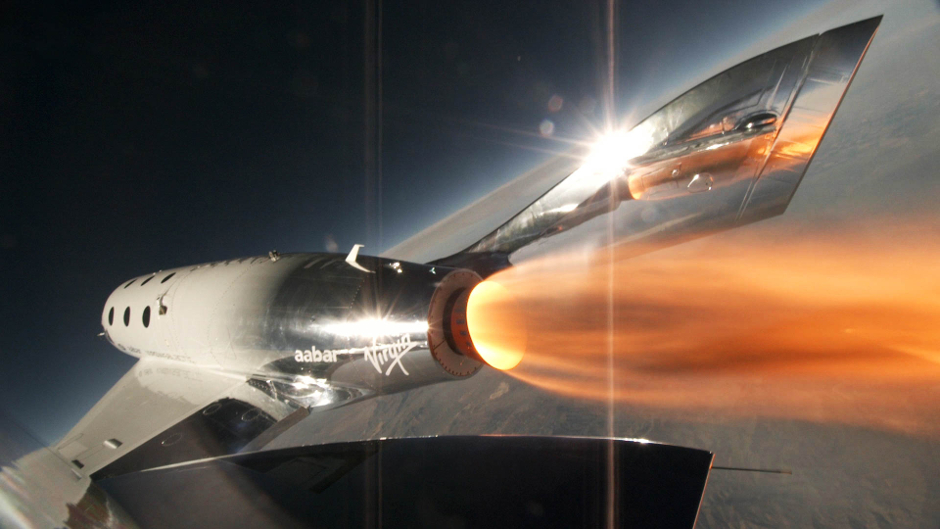
Virgin Galactic successfully launched and landed its Unity spacecraft by rocket power, completing its first powered flight in almost four years. Richard Branson's space company shared a photo of the SpaceShipTwo model spacecraft as it blasted into the air above the Mojave Air and Space Port before going supersonic and landing safely. "VSS Unity completed her first supersonic, rocket-powered flight this morning in Mojave, California. Another great test flight, another step closer to being," Virgin Galactic wrote on Twitter. Unity took off at about 8:02 a.m. as it was propelled to an altitude of 46,500 feet by the WhiteKnightTwo carrier aircraft, VMS Eve. Eve then released Unity from under its wing and the SpaceShipTwo's pilots Mark Stucky and Dave Mackay brought the spacecraft's engines to life and propelled it into an 80 degree climb, accelerating to Mach 1.87 during the 30 seconds of rocket burn. "On rocket shutdown, Unity continued an upwards coast to an apogee of 84,271 feet before readying for the downhill return," Virgin Galactic said.


Once the spacecraft began to descend, the pilots raised its tail booms to a 60 degree angle from the fuselage into the "feathered" configuration, which was adopted after fatal 2014 VSS Enterprise test flight crash.

At 50,000 feet, the tail-booms were lowered again and the Unity glided toward a safe landing on the runway.

"The flight has generated valuable data on flight, motor and vehicle performance which our engineers will be reviewing," Virgin Galactic said. "It also marks a key moment for the test flight program, entering now the exciting phase of powered flight and the expansion to full duration rocket burns."

The newest SpaceShipTwo model was unveiled in February 2016, when the late professor Stephen Hawking gave the ship the name "Unity."

In the future Virgin Galactic's spacecraft will take passengers 68 miles above the Earth's surface for a price of $250,000.

Wednesday, February 14, 2018

NASA's Continued Focus on Returning U.S. Human Spaceflight Launches

NASA's Commercial Crew Program and private industry partners, Boeing and SpaceX, continue to develop the systems that will return human spaceflight to the United States. Both commercial partners are undertaking considerable amounts of testing in 2018 to prove space system designs and the ability to meet NASA's mission and safety requirement for regular crew flights to the International Space Station. "The work Boeing and SpaceX are doing is incredible. They are manufacturing spaceflight hardware, performing really complicated testing and proving their systems to make sure we get it right." said Kathy Lueders, program manager NASA Commercial Crew Program. "Getting it right is the most important thing." Both Boeing and SpaceX plan to fly test missions without crew to the space station prior to test flights with a crew onboard this year. After each company's test flights, NASA will work to certify the systems and begin post-certification crew rotation missions. The current flight schedules for commercial crew systems provide about six months of margin to begin regular, post-certification crew rotation missions to the International Space Station before contracted flights on Soyuz flights end in fall 2019.


As part of the agency's normal contingency planning, NASA is exploring multiple scenarios as the agency protects for potential schedule adjustments to ensure continued U.S. access to the space station.

One option under consideration would extend the duration of upcoming flight tests with crew targeted for the end of 2018 on the Boeing CST-100 Starliner and SpaceX Crew Dragon. The flights could be extended longer than the current two weeks planned for test flights, and likely less than a six-month full-duration mission. The agency also is assessing whether there is a need to add another NASA crew member on the flight tests.

This would not the first time NASA has expanded the scope of test flights. NASA had SpaceX carry cargo on its commercial demonstration flight to the International Space Station in 2012, which was not part of the original agreement. This decision allowed NASA to ensure the crew aboard the space station had the equipment, food and other supplies needed on the station after the end of the agency's Space Shuttle Program.

As with all contingency plans, the options will receive a thorough review by the agency, including safety and engineering reviews. NASA will make a decision on these options within the next few months to begin training crews.

Wednesday, January 10, 2018

China opens 2018 with Long March 2D flight of two SuperView-1 satellites

China’s Long March 2D booster launched into space on Tuesday, January 9, at 11:24 a.m. Beijing time (10:24 p.m. EST and 03:24 GMT on Jan. 8) sending a duo of SuperView-1 satellites into orbit. The mission, which opens Beijing’s busy 2018 launch manifest, lifted off from the Taiyuan Satellite Launch Center (TSLC) located in China’s Shanxi Province. Following a usual pattern for Chinese launches, in particular for those employing the Long March 2D booster, Beijing remained tight-lipped about the details of the mission, its timeline and pre-launch activities. The preparations for the launch commenced in November as the liftoff was originally scheduled for December 25. After liftoff, the rocket began a short vertical climb before turning south across mainland China, toward the South China Sea. During the initial phase of the flight, the rocket was powered by the main stage’s YF-21C engine delivering some 2,962 kilonewtons of thrust. This stage was detached about three minutes after liftoff. Afterward, the second stage’s YF-24C cluster engine was ignited, marking the start of a seven-minute ride to orbit. This phase most likely concluded approximately 10 minutes after liftoff when the satellites were deployed into space. Mission success was declared by the state-run Xinhua press agency, when both SuperView-1 spacecraft were inserted into a Sun-synchronous orbit (SSO) at an altitude of about 310 miles (500 kilometers).


SuperView-1 03 and SuperView-1 04 (also known as GaoJing-1 03 and GaoJing-1 04), are the final two of four satellites of the first generation of the SuperView constellation. They are identical spacecraft, built by the China Academy of Space Technology (CAST). The satellites are based on the CAST3000B platform and are fitted with two deployable solar arrays.

If everything goes as it is currently planned, the pair of newest SuperView-1 spacecraft will be operated by the Beijing Space View Technology Co., Ltd. They will provide imagery with 1.64-foot (0.5-meter) panchromatic resolution and 6.56-foot (2-meter) multispectral (blue, green, red, near-infrared) resolution.

The first pair of SuperView-1 satellites were launched on December 28, 2016, however some problems occurred during the separation of the duo from a Long March 2D booster, that resulted in the spacecraft being placed into a lower-than-intended orbit. The issue was finally corrected in mid-January of 2017.

“The two satellites are working at the normal orbit now. The ground stations have successfully received 1,241 scenes of imagery by January 11, 2017,” Beijing Space View Technology reported in January 2017.

The plan for the SuperView-1 quartet is to have the four satellites phased 90 degrees from each other on the same orbit to collect imagery for clients worldwide. The satellites are designed to work in multiple collection modes including long strip, multiple strips collect, multiple-point targets collect, and stereo imaging. They are expected to deliver highly-detailed imagery for precise map creation, change detection, and in-depth image analysis.

The SuperView-1 spacecraft feature a data collection capability of two terabytes of storage on board and, if in the proper orbit, are able to obtain images covering 270,300 square miles (700,000 square kilometers) across the globe per day.


“The satellites will provide services in a number of fields from environmental monitoring to disaster mitigation,” said Xu Wen, general manager of China Siwei Surveying and Mapping Technology Co. Ltd, a company which controls Beijing Space View Technology.

The full SuperView constellation should consist of 24 Earth-observing satellites that is slated to be orbited by 2022. China hopes that the network will become one of the world’s largest commercial providers of space imagery and geospatial data.

The Long March 2D launcher that has been selected for Tuesday’s flight is a two-stage rocket developed by the Shanghai Academy of Spaceflight Technology. It is mainly used to launch satellites into low-Earth orbit (LEO). The 135 foot (41.15 meters) tall booster can launch payloads of up to 3.5 metric tons to LEO and has an SSO capability of up to 1.3 metric tons. The rocket was launched for the first time on Aug. 9, 1992, from the Jiuquan Satellite Launch Center, orbiting the Fanhui Shei Weixing FSW-2-1 recoverable satellite.

Tuesday’s launch was the 261st flight of the Long March rocket series. The next Chinese mission is currently scheduled to take place on January 11, when a Long March 3C will take to skies with two BeiDou-3 navigation satellites.

Overall, China plans to conduct about 35-40 launches in 2018, including the Chang’e 4 lander – the first spacecraft to attempt a soft landing on the far side of the Moon. The country is also working toward the debut of its new light-lift launcher, Kuaizhou-11, and plans to perform the first orbital launch from a sea platform as well.


Friday, December 8, 2017

Wrapping up 2017 one year out from MU69

New Horizons is in good health and cruising closer each day to its next encounter: a flyby of the Kuiper Belt object (KBO) 2014 MU69 (or "MU69" for short). If you follow our mission, you likely know that flyby will occur on New Year's Eve and New Year's Day 2019, which is just barely over a year from now! As I write this, New Horizons is wrapping up an active period that began when the spacecraft emerged from hibernation mode in September. But soon, on Dec. 21, we'll put the spacecraft back in hibernation, where it will remain until June 4, 2018. After June 4 the spacecraft will stay "awake" until late in 2020, long after the MU69 flyby, when all of the data from that flyby have reached Earth. But before we put New Horizons into hibernation this month, we have some important work ahead. We'll observe five more KBOs with the onboard LORRI telescope/imager to learn about their surface properties, satellite systems and rotation periods. This work is part of a larger set of observations of 25-35 Kuiper Belt objects from 2016 to 2020 on this extended mission. Learning about these KBOs from close range and at angles that we cannot observe from Earth makes will give us key context for the more detailed studies we'll make of MU69 from a thousand times closer than we can study any other KBO. In addition to that LORRI imaging of these objects, we're continuing our nearly round-the-clock observations of the charged particle and dust environment of the Kuiper Belt-both before and while New Horizons hibernates.


Also right ahead is a 2.5-minute engine burn planned for Dec. 9 (yes, a Saturday). This maneuver will both refine our course and optimize our flyby arrival time at MU69, by setting closest approach to 5:33 Universal Time (12:33 a.m. Eastern Standard Time) on Jan. 1, 2019.

Flying by at that time provides better visibility by the antennas of NASA's Deep Space Network, which will attempt to reflect radar waves off the surface of MU69 for New Horizons to receive. If it succeeds, that difficult experiment will help us determine the surface reflectivity and roughness of MU69 at radar wavelengths-something that has been successfully applied to study asteroids, comets, planetary satellites and even some planets, including Pluto, which New Horizons observed the same way in 2015.

Our Pluto observation set a record for the most distant object ever studied with radar -shattering the previous record by over 300 percent! If our radar experiment is successful on the much-smaller MU69 (which is perhaps 30 kilometers [19 miles] in diameter-tiny compared to Pluto's almost 2,400-kilometer [1,480-mile] diameter), then we'll break our own record, something unlikely to be surpassed for decades.

Since hibernating, New Horizons requires less attention from mission control than when we're in active operations. This will allow our mission team to focus fully on planning the detailed sequences that will tell New Horizons how to make every scientific observation of MU69 during its close-range pass in the days surrounding Jan. 1, 2019.

The year ahead will also include many observations of other KBOs, more study of the Sun's heliosphere with our dust and plasma instruments - SDC, PEPSSI, and SWAP, and our Alice ultraviolet spectrometer - as well as all the remaining flyby planning for MU69.

MU69 flyby operations will begin with distant navigation imaging to help us accurately home in on our target; that work will start in late August or September and will continue until literally 48 hours before flyby.

Our navigation teams at KinetX and NASA's Jet Propulsion Lab JPL will use those navigation images to compute the engine burns to further refine our course toward our planned closest approach point just 3,500 kilometers, or about 2,175 miles, from MU69. That's more than three times as close as we flew by Pluto, which should make for spectacular MU69 images and other data!

Additionally, beginning in the final weeks of 2018, we'll search for moons or dust structures around MU69 that could harm New Horizons if we were to collide with them during our 32,000-miles-per-hour flyby. If hazards that threaten the spacecraft are found, we can burn our engines to divert to a farther flyby, with a closest approach of 10,000 kilometers (about 6,200 miles), which should be safer.

Well, that's my update for now. For more mission news, stay tuned to NASA websites, our own project website, and our social media channels, which are listed below so you can bookmark them.

I'll write again early next year. Until then, I hope you have a safe and productive finish to 2017, a happy new year, and that you'll keep on exploring-just as we do!

Saturday, December 2, 2017

NASA successfully fires Voyager 1 thrusters after 37 years

NASA's Voyager 1 spacecraft -- cruising interstellar space billions of miles from Earth -- was back on the right track Friday thanks to thrusters that were fired up for the first time in 37 years. The unmanned spaceship was launched along with its twin, Voyager 2, more than 40 years ago to explore the outer planets of our solar system, traveling further than any human-made object in history. But after decades of operation, the "attitude control thrusters" that turn the spacecraft by firing tiny "puffs" had degraded. The small adjustments are needed to turn Voyager's antenna toward Earth, allowing it to continue sending communications. "At 13 billion miles from Earth, there's no mechanic shop nearby to get a tune-up," NASA said in a news release. Experts at the agency's Jet Propulsion Laboratory in California decided to turn to four backup thrusters that were last used on November 8, 1980. "The Voyager flight team dug up decades-old data and examined the software that was coded in an outdated assembler language, to make sure we could safely test the thrusters," said Chris Jones, chief engineer at JPL. The engineers fired up the thrusters on Tuesday and tested their ability to turn Voyager using 10-millisecond pulses. Then they waited 19 hours, 35 minutes for the test results to arrive at an antenna in Goldstone, California.


Turns out the thrusters worked just fine.

"The Voyager team got more excited each time with each milestone in the thruster test. The mood was one of relief, joy and incredulity after witnessing these well-rested thrusters pick up the baton as if no time had passed at all," said Todd Barber, a JPL propulsion engineer.

Being able to use the backup thrusters means the lifespan of Voyager 1 has been extended by two or three years, added Suzanne Dodd, project manager for Voyager.

NASA plans to switch over to the formerly dormant thrusters in January. They will likely also conduct similar tests on the backup thrusters on Voyager 2.

Scientists still hear from the Voyager spacecraft daily, and expect to get data for about another decade.


Astronomy textbooks were rewritten on a wide scale thanks to the Voyager spacecraft, which zoomed past Jupiter, Saturn, Neptune and Uranus.


The plutonium-powered spaceships will continue until they finally run out of fuel, and will then orbit in the center of the Milky Way galaxy.