Showing posts with label CubeSats. Show all posts

Wednesday, February 13, 2019

Arianespace to launch satellite deployment solution from Open Cosmos

Arianespace and Open Cosmos report that they have signed a contract for the launch of an innovative CubeSat deployment solution. Launched from the Guiana Space Center in French Guiana using a Soyuz rocket, the CubeSat deployment platform is a key to the commercial offering from Open Cosmos. The first mission comprises an array of CubeSats with a total capacity of 12 units (12U). It will weigh about 30 kg. at liftoff, and the CubeSats will be injected into Sun-synchronous orbit at an altitude over 500 km. Open Cosmos delivers effective satellite-based solutions with the goal of enabling companies to use space technologies for tackling global challenge. It specializes in the development and implementation of missions for small, low-cost satellites (up to 50 kg.), with short lead times (typically less than a year). One of the primary advantages of Open Cosmos is that it gives customers access to a wide range of launchers and orbits. The first Open Cosmos payload will be an auxiliary passenger on the COSMO-SkyMed Second Generation (CSG 1) satellite mission, along with the CHEOPS satellite for the European Space Agency ESA as well as the ANGELS and EyeSat's French CNES space agency missions. Launch is scheduled for the last quarter of 2019. Following the contract signature, Rafael Jorda Siquier, Chief Executive Officer of Open Cosmos, said, "Customers always ask us how they can get their payloads into orbit quickly and surely.


"Our partnership with Arianespace to launch a 12U (units) deployment platform will get them into their targeted orbit less than ten months after signing the contract. This mission will use one of the world's most reliable and highest performance launchers, with a proven track record - and that's exactly the kind of agility that the space industry needs right now."

Stephane Israel, Chief Executive Officer of Arianespace, added, "This contract clearly reflects Arianespace's unwavering commitment to new players like Open Cosmos, which drive the dynamic small satellite market. It also reflects our ability to offer available, flexible and competitive solutions for all market segments, thanks to our family of launch vehicles."

Saturday, February 9, 2019

New technology helps address big problems for small satellites

CubeSats have become big players in space exploration. Their small size and relatively low cost have made them popular choices for commercial launches in recent years, but the process to propel such satellites in space comes with a number of problems. Now, Purdue University researchers have developed a technology to address one of those key problems - the uncertainty of the ignition system that initiates the propulsion system of the CubeSats. Current ignition systems are unreliable and can be subject to significant and irreversible damage during the lifespan of the satellite. "We have created a lower energy triggering technology that uses nanosecond-long pulses, that allows the ignition and propulsion systems to function reliably for a very long time," said Alexey Shashurin, an assistant professor of aeronautics and astronautics in Purdue's College of Engineering. "Specifically, we have successfully tested the ignition system for greater than 1.5 million pulses and it remained operational and almost intact after the test. This is a giant leap for extending the lifetime of electric propulsion systems for CubeSats." Their work aligns with Purdue's Giant Leaps celebration, celebrating the university's global advancements in space exploration as part of Purdue's 150th anniversary. This is one of the four themes of the yearlong celebration's Ideas Festival, designed to showcase Purdue as an intellectual center solving real-world issues.


Overall popularity of the CubeSats is heavily driven by the great advancement in miniaturization of electronic components and sensors that allows for new kinds of space missions and measurements using a CubeSat.

"It is exciting to tackle these new challenges presented on spacecraft of a much smaller scale than in previous years," Shashurin said. "The next step for the CubeSats is to have a robust propulsion system for necessary maneuvering and station-keeping duties."

Shashurin and his team worked with the Purdue Office of Technology Commercialization to file a provisional patent on the technology.

The work was published in the Jan. 10 edition of Plasma Research Express. It was also presented during the American Institute of Aeronautics and Astronautics SciTech Forum last month in San Diego.

The team is planning to participate in the National Science Foundation's I-Corps program, which provides support for conducting extensive customer discovery with an ultimate goal to find industrial partners and commercialize the technology.

Saturday, October 6, 2018

NASA Evaluates Commercial Small-Sat Earth Data for Science

NASA has launched a pilot program to evaluate how Earth science data from commercial small-satellite constellations could supplement observations from the agency's fleet of orbiting Earth science missions. On Sept. 28, the agency awarded sole-source contracts to acquire test data sets from three private sector organizations. NASA's Earth Science Division in Washington issued blanket purchase agreements for the "Private Sector Small Constellation Satellite Data Product Pilot" program. Under these agreements, the agency purchases data sets and related products based on observations derived from Earth-orbiting, small-satellite constellations designed and operated by non-governmental entities. "This pilot program is an innovative and efficient way for us to acquire, examine, and evaluate a wide range of private sector Earth observation data," said Michael Freilich, director of NASA's Earth Science Division. "As our very capable NASA research satellite fleet ages and more small satellites are launched by private industry, there are opportunities to leverage the strengths of each into even more complete climate data sets." NASA will provide the test data products to NASA-funded researchers, who will examine whether the data help advance the agency's science and applications development goals.


The pilot program is designed to determine whether these private sector observations and associated products offer a cost-effective means to augment or complement the suite of Earth observations acquired directly by NASA, other U.S. government agencies, and international partners.

he contracts were awarded to:

DigitalGlobe, a Maxar Technologies company headquartered in Westminster, Colorado, has five very high-resolution Earth imaging satellites (GeoEye-1, WorldView-1, WorldView-2, WorldView-3, WorldView-4) capable of collecting 30-centimeter resolution imagery.

Planet, headquartered in San Francisco, has three satellite constellations (SkySat, Dove, RapidEye) with more than 150 satellites supplying imagery and derived products over the entire Earth at medium and high resolution with high repeat frequencies.

SPIRE, headquartered in San Francisco, operates a constellation of over 60 satellites collecting radio occultation soundings, aircraft location information and ship reports. GPS radio occultation measurements can be used to sound the atmosphere for temperature, water vapor, and atmospheric pressure.

These contracts represent the first time that NASA has engaged with commercial small-satellite constellation operators to purchase their data for scientific evaluation. They establish a way for NASA to acquire and examine the data products during the next 12 months. Each contract includes an option for NASA to extend the agreement for an additional four years, for a total value of up to $7 million for each of the three agreements.

To be considered for participation in this pilot program, companies had to demonstrate they were currently operating a small satellite constellation of no fewer than three satellites in non-geostationary orbit and producing consistent global coverage. Companies also were asked to supply a comprehensive catalog of their data, describing areal coverage, data latency, pricing, and other factors.

NASA uses the vantage point of space to understand and explore our home planet, improve lives and safeguard our future. The agency's observations of Earth's complex natural environment are critical to understanding how our planet's natural resources and climate are changing now and could change in the future.

Saturday, September 15, 2018

MarCO makes space for small explorers

Twenty years ago, CubeSats - a class of boxy satellites small enough to fit in a backpack - were used by universities as a teaching aid. Simpler, smaller and cheaper than traditional satellites, they've made space more accessible to private companies and science agencies. This summer, NASA has been flying the first two next-generation CubeSats to deep space. They're currently on their way to Mars, trailing thousands of miles behind the InSight spacecraft. InSight and its CubeSat tag-alongs are already more than halfway to the Red Planet. The mini-mission, called Mars Cube One (MarCO), has already proved this class of spacecraft can survive the deep-space environment. It will next test the use of miniaturized communication technology to relay data when InSight attempts to land in November. Relaying landing data is one of the jobs of NASA's orbiters, which will record InSight's descent; engineers learn more from every landing attempt. MarCO will test whether this technology can ably perform the relay job for future missions. To complete their mission, the MarCOs have miniature high-gain antennas and radios that can communicate with Earth from roughly 93 million miles away. Their propulsion systems are capable of steering towards Mars; each MarCO completed its second steering maneuver in August. They even have color cameras, one of which snapped the first image from a CubeSat of the Earth and the Moon - proof of just how far this technology has literally come.


MarCO is still experimental. It's meant to demonstrate that spacecraft technology can be shrunk into a tiny package and still do something useful in deep space. And while CubeSats will never compete with the larger and more complex spacecraft NASA usually flies, the MarCO spacecraft are pioneering a new class of robotic exploration.

"Our hope is that MarCO could help democratize deep space," said Jakob Van Zyl, director of the Solar System Exploration Directorate at NASA's Jet Propulsion Laboratory in Pasadena, California. "The technology is cheap enough that you could envision countries entering space that weren't players in the past. Even universities could do this."

A Legacy of Pathfinders

JPL initiated and built MarCO, just one of several CubeSat projects the Lab has developed. JPL is a natural place to host CubeSats: The Lab built the first U.S. satellite, Explorer 1, which discovered the Van Allen radiation belts in 1958. Not unlike a CubeSat, it was a small, rudimentary spacecraft. The history of the U.S. space program followed in its wake.

JPL later built a Mars mini-rover called Sojourner that took baby steps in 1997 and proved to be a trial run for NASA's Spirit, Opportunity and Curiosity rovers.

Innovation often begins with pathfinder technology, Van Zyl said. Once engineers prove something can be done, science missions follow.

"When it comes to innovation, MarCO is in the same class as Explorer 1 and Sojourner," Van Zyl said. "The question is: Can we use CubeSats to do more science? Not all science, because they're too limited to carry many instruments. But this technology creates a vehicle for people to do science at a much lower investment to the taxpayer."

NASA has already committed to answering the question. Thomas Zurbuchen, associate administrator of the agency's Science Mission Directorate, is a proponent of CubeSats; last month, he announced NASA will be funding $100 million worth of SmallSat science missions each year.


Preparing for Future CubeSats

MarCO has already laid the groundwork for future exploration with small spacecraft.

"Almost all the features of MarCO are being adapted for use on future spacecraft," said John Baker, the program manager responsible for small spacecraft at JPL. "And many parts started with a commercial partner's product that was modified."

The role of MarCO's commercial partners can't be overstated. Its solar panels, cameras, avionics, propulsion systems and attitude-control systems were all provided by commercial contractors. One advantage of CubeSats is they can use standardized parts and systems, allowing private companies to lower the price of new technology. Lower-cost spacecraft also mean engineers can take more design risks, testing that technology in space.

Van Zyl said that MarCO's main goal was to prove CubeSats can survive the harsh journey to deep space. MarCO's team can check that box off their list.

They're already focused on their next goal: Mars is just a few months and 68 million miles (110 million kilometers) away.

Thursday, August 9, 2018

Arianespace to launch Spire small satellites on Vega SSMS POC flight

The multi-launch contract with Spire - a company providing weather, maritime, and aviation data to public and private customers - will cover a significant number of CubeSats to be launched on Vega as part of the Small Spacecraft Mission Service Proof Of Concept (POC) flight in 2019, as well as options on subsequent Vega flights. With more than 80 satellites placed in orbit during the past four years, Spire has quickly become an important leader in the New Space community. Built in-house by Spire using its LEMUR2 CubeSat platform, the nanosatellites will weigh approximately 5 kg. at launch and are designed to have a nominal service life of two to three years once positioned in a Sun-synchronous orbit at 500 km. Each satellite carries multiple sensors, making them capable of performing data collection for all of Spire's data products. The Vega Proof of Concept (POC) flight is the first of the Small Spacecraft Mission Service (SSMS) - a program initiated by the European Space Agency in 2016, with the contribution of the European Commission. For all the European partners involved, its purpose is to perfectly address the promising microsatellite market for both institutional and commercial needs with a new rideshare concept on the Vega light-lift launcher.


Vega is part of the Arianespace launcher family, alongside the heavy-lift Ariane 5 and the medium-lift Soyuz, all of which are operated from the Guiana Space Center in French Guiana. Avio, based in Colleferro Italy, is Vega's industrial prime contractor.

Following the signature of this contract, which is the launch services company's first with Spire, Arianespace CEO Stephane Israel said: "We are thrilled to have Spire on board the POC flight of Vega's Small Spacecraft Mission Service dispenser, which shows Arianespace's continuous commitment to increased access to space for the growing small satellite market. The Vega launch vehicle offers a flexible solution for this burgeoning segment of the industry."

Monday, December 25, 2017

ESA's butane-powered satellite will be able to change its orbit

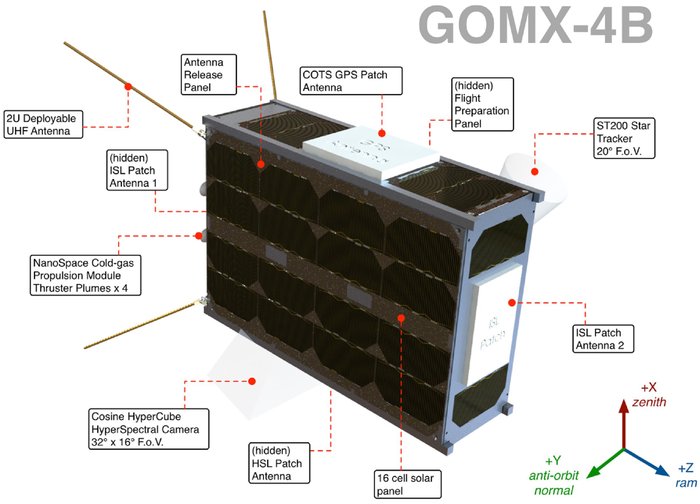
ESA's next miniature satellite will be its first able to change orbit. Thanks to a compact thruster resembling a butane cigarette lighter, the cereal box-sized satellite will fly around its near-twin to test their radio communications. Ready to be launched with its counterpart from China on 2 February, GomX-4B is built from six standard 10 cm CubeSat units. Much quicker to build and cheaper to launch than traditional satellites, ESA is making use of CubeSats for testing new technologies in space. The main goal is to test the radio link at varying distances, routing data from one satellite to the other, then down to the ground. GomX-4A, from the Danish Ministry of Defence, will remain in position while ESA's GomX-4B manoeuvres up to 4500 km away. Supplied by Swedish firm NanoSpace, the thrusters fitted along one side will allow it to adjust its motion by a total of 15 m/s - a speed equivalent to a kicked football. "We have two pressurised fuel tanks linked to two pairs of thrusters," explains Tor-Arne Gronland, head of NanoSpace.


"Rather than burning propellant, these are simpler 'cold-gas' thrusters designed specifically for such a small mission. And simpler means cheaper and smaller.

"The fuel is stored under pressure, then released through a tiny rocket nozzle. Even though it's cold gas, we achieve a substantial velocity change by using liquid butane that turns to gas as it exits.

"Storing it as a liquid, like in a cigarette lighter, allows us to pack as many butane molecules as possible inside the small available volume - its liquid form being some 1000 times denser than its gas."

Each thruster will provide only 1 millinewton - the weight you would feel holding a feather in your hand - but enough to move the 8 kg satellite over time.

The thrusters will typically be fired in pairs although they can also work individually, for a few minutes at a time and up to an hour.

"Compared to a typical half-tonne satellite with 1 N hydrazine thrusters, we are almost a hundred times lighter and a thousand times weaker," adds Tor-Arne.

"All of the elements such as the chamber, nozzle and sensors are fitted into a 1x2 cm chip, just 1 mm thick."

NanoSpace already has flight experience behind its cold-gas thruster, with a smaller version carried on China's TW-1 in 2015.

The company plans to demonstrate a great many different operating methods during the GomX-4B mission: "We'll do different kinds of burns: long, short, pulsing and throttling up and down. It's important to do these things early in the mission then again late on, to show it can survive and perform well in space."

NanoSpace began as a commercial spin-off from Sweden's University of Uppsala, and was acquired last year by Danish company GomSpace, builder of the GomX-4 satellites. The companies are currently working together on a constellation of more than 200 CubeSats for a commercial customer.

NanoSpace is also developing an ESA thruster for flying several satellites in formation, rendezvous and docking, and for controlling the orientation of CubeSats in deep space.