Space News

World space hottest news

Showing posts with label satellite. Show all posts

Sunday, December 17, 2023

China launches large classified optical satellite towards geostationary orbit

China sent the classified Yaogan-41 optical satellite towards the geostationary belt Friday using the country’s largest launch vehicle. The sixth Long March 5 rocket lifted off from the coastal Wenchang Satellite Launch Center at 8:41 a.m. Eastern (1341 UTC) Dec. 15. The China Aerospace Science and Technology Corp. (CASC) announced launch success around an hour later. CASC revealed the payload to be the Yaogan-41 (“remote sensing-41”) satellite. A new, elongated 18.5-meter-long, 5.2-meter-diameter payload fairing shrouded the spacecraft. Previous fairings were 12.3 meters long. CASC revealed that its China Academy of Space Technology (CAST) subsidiary built Yaogan-41 but provided no images nor further details. State news agency Xinhua described the satellite as an optical remote sensing satellite. “The satellite will be used in land survey, crop yield estimation, environmental management, meteorological warning and forecasting, and comprehensive disaster prevention and reduction,” Xinhua stated. Outside observers however assess Yaogan series satellites to be designated for military purposes. The classified nature of the mission suggests Yaogan-41 is for at least partial military use.

The sixth Long March 5 lifts off from Wenchang, Dec. 15, sending Yaogan-41 into GTO. Credit: Ourspace
 
U.S. Space Force space domain awareness cataloged the spacecraft in a 195 by 35,815-kilometer orbit inclined by 19.51 degrees.


The successful launch adds to growing Chinese on-orbit remote sensing capabilities. Should Yaogan-41 take up a position in geostationary orbit, at about 35,786 kilometers above the equator, it will remain in a fixed position relative to the Earth’s surface. This will allow it to conduct continuous observation of the same geographic area.

This vantage point would allow it to constantly view about one-third of the Earth’s surface. Geostationary optical data would be useful for security, meteorology, climate studies and environmental monitoring purposes.

The mission could be a military follow-up to the civilian Gaofen-4 satellite launched in 2015. The Gaofen-4 GEO optical satellite launched on the much smaller Long March 3B and provides 50-meter-resolution images.

CAST produces the DFH-5 large satellite bus for GEO communications and remote sensing. Its size and mass requires the Long March 5—which can carry 14,000 kg to GTO—to launch it. The DFH-5 Shijian-20 satellite has a mass of up to 8,000 kilograms. DFH-5 satellites have a lifetime of up to 15 years.

The Changchun Institute of Optics, Fine Mechanics and Physics (CIOMP) of the Chinese Academy of Sciences (CAS) has produced four-meter-diameter aspheric silicon carbide (SiC) mirrors. SiC mirrors actively serve in space remote sensing.

CIOMP is also involved in developing Xuntian, a Hubble-class space telescope, expected to join the Tiangong space station in orbit in 2025.

In August CASC launched a geosynchronous orbit radar satellite, further adding to its GEO observation capabilities.

The Long March 5 launched for the first time in late 2016. Its second flight in 2017 failed. The rocket was grounded for 900 days as further testing setbacks required a redesign of troublesome turbopumps. The rocket has since successfully launched Shijian-20, China’s first independent interplanetary mission—the Tianwen-1 orbiter and rover mission to Mars—and the 2020 Chang’e-5 lunar sample return mission.

The five-meter-diameter, 874-ton rocket is currently China’s largest. Its 5B low Earth orbit variant constructed the country’s space station. The Long March 5 is also the basis for the under-development Long March 10, which will use upgraded versions of its YF-100 kerosene-liquid engines and three five-meter-diameter cores.

The Yaogan-41 launch followed a day after China sent its experimental reusable spacecraft into orbit for the third time. The spacecraft entered a 333 to 348 kilometer altitude orbit, inclined at 50 degrees.

Friday’s launch was China’s 61st of 2023, with worldwide orbital launches numbering close to 200. Notable Chinese launches include crew and cargo missions to Tiangong, satellite internet test satellites and the first commercial liquid propellant launches.

CASC aimed to launch more than 60 times this year but, with commercial launch providers accounting for 15 launches, appears to be falling someway short of this stated goal. However CASC has not suffered a launch failure since 2020.
Автор: Jackkat на 2:29 PM No comments:
Email ThisBlogThis!Share to XShare to FacebookShare to Pinterest
Ярлыки: CASC, China, Long March 5 rocket, satellite, Yaogan-41

Saturday, May 20, 2023

SpaceX launches OneWeb Gen 2 technology demonstrator

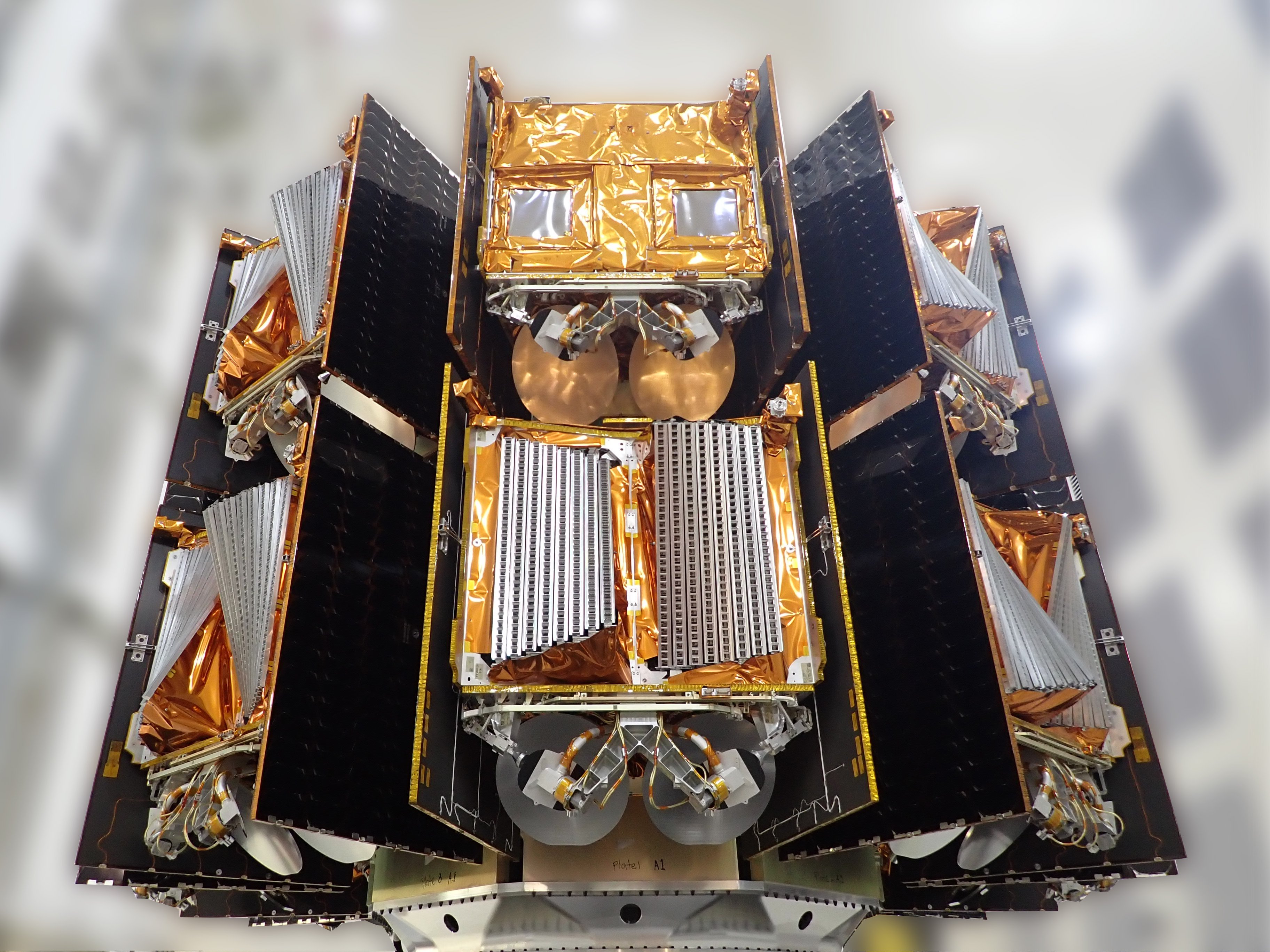
SpaceX launched a technology demonstration satellite for OneWeb’s second-generation broadband constellation May 20, along with spares for the British firm’s current low Earth orbit (LEO) network and another that U.S.-based Iridium Communications operates. A Falcon 9 rocket carrying a total 21 spacecraft lifted off 9:16 a.m. Eastern amid heavy fog at Vandenberg Space Force Base in California on a polar trajectory to the south. All five Iridium spares were deployed an hour later, followed by 16 OneWeb satellites that separated in pairs. The rocket’s first-stage booster successfully landed on a droneship in the Atlantic Ocean for reuse following its eleventh flight. OneWeb and Iridium separately confirmed contact with all their satellites following the mission, which was postponed by a day for reasons SpaceX did not disclose. OneWeb now has 633 first-generation satellites in LEO, although it only needs 588 to provide global coverage, with the rest serving as in-orbit backups. The satellites that pushed OneWeb passed the 588-satellite mark launched March 25 and the company recently said it is on track to launch global commercial services by January. The satellites were built by prime contractor Airbus OneWeb Satellites, a Florida-based joint venture the operator shares with Airbus. Iridium picked Europe’s Thales Alenia Space as prime contractor for its Iridium NEXT connectivity constellation that comprises 66 operational satellites in LEO. SpaceX launched all these satellites between 2017 and 2019, in addition to nine in-orbit spares. The May 20 mission launched five of the six spare satellites Iridium had been keeping in storage for at least four years. Iridium has not detailed any plans to deploy its final ground spare.

JoeySat and a spare OneWeb Gen 1 satellite successfully separated from the Falcon 9 rocket around one hour and 23 minutes after lift-off. Credit: SpaceX webcast


OneWeb’s Gen2

One of the satellites launched for OneWeb, JoeySat, is designed to test capabilities for a second-generation constellation the company has said could start deployments as soon as 2025.

One of several new technologies on JoeySat is the capability to remotely direct beams and signal strength, according to OneWeb, enabling the satellite to increase capacity at higher usage areas in response to spikes in demand.

Israel-based SatixFy built JoeySat’s payload, supported by funds from the European Space Agency and UK Space Agency, for assembly by Airbus OneWeb Satellites.

JoeySat uses the same satellite platform as OneWeb’s 150-kilogram Gen 1 spacecraft.

French geostationary fleet operator Eutelsat, which is seeking regulatory approvals to buy OneWeb, said May 11 that the Gen 2 satellites would be bulkier than Gen 1 and able to provide three to five times more capacity.

The companies also expect only to need a constellation of around 300 Gen 2 satellites, partly because they could leverage Eutelsat’s network in geostationary orbit over high-demand areas.

Eutelsat and OneWeb have not yet picked a manufacturer for the Gen 2 satellites.
Автор: Jackkat на 3:38 PM No comments:
Email ThisBlogThis!Share to XShare to FacebookShare to Pinterest
Ярлыки: JoeySat, LEO network, OneWeb Gen 2, satellite, SpaceX

Sunday, August 30, 2020

SpaceX plans to launch Argentine satellite into polar orbit from Florida

SpaceX plans to launch an Earth observation satellite for Argentina's space agency Sunday evening as the first polar orbit mission from Florida in more than 50 years. A Falcon 9 rocket is scheduled to lift off with the SAOCOM 1B satellite at 7:19 p.m. EDT from Complex 40 at Cape Canaveral Air Force Station. This rocket is to head south over the Atlantic Ocean, while most Florida launches go east. The spacecraft will pass over Cuba, and the first stage booster will fly back for recovery near the Air Force station, likely creating a sonic boom. In the past, launching over communist Cuba would have caused "consternation" due to the Cold War standoff and lingering tension after that, U.S. Space Force Brig. Gen. Douglas Schiess said this week. Since 1969, rockets launched from the United States have lifted off from Vandenberg Air Force Base in California or from Kodiak Island in Alaska. Both of those sites have clear shots to the south over open water. Any debris would not fall into populated areas. Concerns about polar launches from Florida date to 1960, when part of a Thor rocket fell on Cuba, reportedly killing a cow. That resulted in a moratorium and shifted all polar launches away from Florida. The U.S. Space Command announced in 2017 that it again had certified a polar launch trajectory from Florida, but only if the rocket had an automated launch termination capability. SpaceX's Falcon 9 rocket has that. Schiess said the U.S. State Department "notified" Cuba of the pending launch, but he didn't know if Cuba responded. Calls and emails to the department for comment were not returned.


The rocket should be so high into the atmosphere as it crosses over the island nation that any potential debris from a failure would be small and dispersed by the time it reached Earth, the general said.

Argentina's satellite had been scheduled for launch in March, but was postponed due to the coronavirus pandemic, according to the Argentine agency, known as CONAE for the Comision Nacional de Actividades Espaciales (National Commission of Space Activities).

The delay "forced us to stay a long time in Cape Canaveral, away from our families," according to a statement from the agency's executive and technical director, Raul Kulichevsky.

The launch had been set for Friday night, but the delay of another launch - United Launch Alliance's rocket carrying a U.S. spy satellite - bumped the Argentine mission to Sunday.

The first of two SAOCOM satellites was launched in October 2018. According to the mission description for the program, a major focus for the spacecraft is to monitor weather and agriculture.

Data on soil moisture "will help producers know the best time for sowing, fertilizing and irrigation, in crops such as soybeans, corn, wheat and sunflower," the description said.
Автор: Jackkat на 7:23 AM No comments:
Email ThisBlogThis!Share to XShare to FacebookShare to Pinterest
Ярлыки: Argentina, SAOCOM 1B, satellite, SpaceX

Wednesday, July 22, 2020

Airbus signs contract with UK Ministry of Defence for Skynet 6A satellite

Airbus Defence and Space has signed a contract with the UK Ministry of Defence (MOD) to extend and enhance the Skynet fleet. This will involve the development, manufacture, cyber protection, assembly, integration, test and launch, of a military communications satellite, Skynet 6A, planned for launch in 2025. The contract also covers technology development programmes, new secure telemetry, tracking and command systems, launch, in-orbit testing and ground segment updates to the current Skynet 5 system. The value of the contract is more than 500 million pounds. Richard Franklin, Airbus Defence and Space UK Managing Director said: "Airbus is extremely proud to be awarded this critical UK defence contract continuing our long tradition as the UK national milsatcom end-to-end services provider. Satellite manufacturing, linked to support services, is a critical component of the Government-industry UK space strategy and this contract underpins the UK MOD's and industry's lead position in this sector. Building this military satellite will, like Skynet 5, lead to significant export opportunities in the years ahead, growing high value manufacturing jobs and supporting a diverse supply chain in this increasingly important sector. "This contract for 6A demonstrates the strong working partnership we have with UK MOD, built on the success we have jointly achieved on the Skynet 5 system since 2003. Airbus is fully committed to delivering world-class military communications services to our Armed Forces across the globe, and look forward to delivering this step change in capability to the MOD," he continued.


Defence Secretary Ben Wallace said: "A new, more advanced satellite capability will provide continued communications support to the UK deployed forces for many years. British defence must continue to innovate and transform, particularly in cyber and space. Investment in first-class equipment like this new Skynet satellite will keep us safe from the threats we face both now and in the future."

The Skynet 5 programme, managed by Airbus, has provided the UK MOD with a suite of highly robust, reliable and secure military communications services, supporting global operations since 2003. Airbus has been involved in all Skynet phases since 1974 and this phase builds on a strong UK commitment to space manufacturing in the UK. The recent programme commenced by using the legacy Skynet 4 satellites and then augmenting them with a fully refurbished ground network before launching the Skynet 5A, 5B, 5C and 5D satellites between 2007 and 2012.

The Skynet 5 programme has reduced or removed many of the technical and service risks for the MOD, whilst ensuring unrivalled secure satcoms and innovation to UK forces. Through the many years of delivering an exceptionally reliable Skynet service the Airbus teams have managed to significantly extend the lifespan of the Skynet satellites many years beyond their design life, offering significant additional value for money and capability to the UK.

The Skynet 6A satellite will be based on Airbus' Eurostar Neo telecommunications satellite platform. It will utilise more of the radio frequency spectrum available for satellite communications and the latest digital processing to provide both more capacity and greater versatility than Skynet 5 satellites.

The satellite will feature electric orbit raising propulsion as well as electric station keeping systems for maximum cost effectiveness. Complete satellite integration will take place at Airbus facilities in the UK followed by testing using RAL Space testing facilities at Harwell in Oxfordshire supporting the UK Space Agency initiative for sovereign UK end-to-end satellite production and support.

Science Minister Amanda Solloway said: "Space technology plays an important role in supporting our military and keeping us safe, while also boosting the UK's economy and enabling world-leading science and research. "With this major investment in Skynet 6A, the development of the National Satellite Test Facility and the launch of a dedicated innovation programme, we are setting a bold new ambition for the UK in space."

The satellite is due for launch in 2025, and will have a minimum design lifetime of 15 years. Its orbital position will be announced closer to the launch date.
Автор: Jackkat на 1:00 PM No comments:
Email ThisBlogThis!Share to XShare to FacebookShare to Pinterest
Ярлыки: Airbus, Airbus Defence, satellite, Skynet 5 programme, Skynet 6A, Skynet fleet, UK Ministry of Defence

Friday, June 5, 2020

Private investment fuels China commercial space sector growth

In its latest research titled "China Space Industry Report," Euroconsult provides in depth analysis of how commercialization is driving both growth and technology advances in the Chinese space sector, with oversubscribed IPOs and a wave of private investment. China Satcom is now the world's highest valued pure satellite operator with a market cap of US$11 billion as of May 2020, while China Satcom parent company China Aerospace Science and Technology Corporation (CASC) reported record revenues of $37 billion in 2018. With a deep-dive into the structure of the Chinese space industry, the report details the relationships between myriad space organizations and China's complex delineation between commercial and government entities. The Chinese government began to liberalize private investment into the space sector in 2014, and since then more than US$900 million in private funding has been invested. With nearly equal investment from government sources, commercial companies have raised a total of at least US$1.85 billion since 2014. Notably, Euroconsult finds that following a short-term lull in activity corresponding to the COVID-19 pandemic, the Chinese space industry is rebounding strongly, having resumed launches, re-opened manufacturing facilities, and continued to move forward with much-needed reforms. The pandemic has coincided with a drop in funding, with 2020 thus far seeing around RMB 900M of funding raised by Chinese space companies, however this is partly due to 2019 being a historically large year in terms of funding.


"Our overview and analysis of the Chinese space ecosystem provides context and understanding for one of the most opaque markets in the world," said Blaine Curcio, Euroconsult Senior Affiliate Consultant based in Hong Kong.

"The growth of the private sector since 2014 has been astonishing, and there is little to suggest a deceleration in this growth. That being said, the low starting point for the private sector, combined with the sheer size of state-owned incumbents, means that the private sector remains extremely fast-growing but relatively small."

In addition to information on Chinese investment in the space sector, the research provides detailed analysis of five market segments including Earth observation, ground systems, launch services, satellite communications, and satellite manufacturing. It sizes the markets and discusses both government and private companies in each sector, including their business activities and international plans. It also delves into vertical sub-segments such as the national TT&C network, backhaul and trunking demand, and Chinese plans for low-earth orbit (LEO) broadband constellations similar to western concepts such as Starlink.

The report includes an Excel database which organizes hundreds of data points, including funding, supply, demand, and revenue numbers for each of the five market segments. It also provides an up to date analysis of the LEO constellations being developed in China today as well as information on China's NGSO filings with the ITU for Q/V-band, X-band, and S-band spectrum rights.

Key Findings
Euroconsult's analysis shows that from 2014 to 2019 there were 319 launches of Chinese manufactured satellites. Of these, 178 were launched in 2018 and 2019, reflecting the recent expansion of China's manufacturing and launch capabilities.

In the launch sector there have been 46 rounds of private investment in Chinese launch companies since 2014, with total funding raised from both private and government sources of roughly US$1 billion. This investment is targeted at commercial launch companies that are developing more than 20 rockets, many using liquid propellants. Of the launch vehicles being developed, at least seven are expected to have a first launch in 2020 or 2021.

"It's important to understand the government policy decisions that are driving industry trends in China," said Steve Bochinger, Chief Operating Officer, Euroconsult. "When the National Development and Reform Commission added satellite internet as one of its "new infrastructures" to be developed, it triggered a flurry of private investment. While the majority of the Chinese space industry is domestic-focused, there is also an increasing emphasis on internationalization, with this expected to accelerate as China rolls out more global space infrastructure."

China has built out significant space infrastructure over the past 5-10 years, including the BeiDou satellite navigation constellation, the Gaofen Earth observation constellation, and coming LEO broadband constellations. It has a clear strategy for internationalizing this infrastructure to provide turnkey service in regions including Eurasia, Africa, and Latin America.
Автор: Jackkat на 2:52 PM No comments:
Email ThisBlogThis!Share to XShare to FacebookShare to Pinterest
Ярлыки: CASC, China, China Satcom, Chinese space sector, Euroconsult, satellite

Friday, May 29, 2020

Cignal TV selects Hughes JUPITER for satellite internet service in Philippines

Hughes Network Systems has announced that Cignal TV Inc., the Philippines premier direct-to-home (DTH) satellite provider, has selected the Hughes JUPITER System to enable satellite broadband service to its two million subscribers. Under the agreement, Hughes will provide Cignal TV with user terminals and a network management system using the same technology that Hughes employs to power HughesNet, its flagship satellite Internet service with more than 1.5 million subscribers. "To launch satellite Internet, we need a platform that we know will deliver a high-quality experience for our two million customers - this is why we chose the Hughes JUPITER System," said Jane Jimenez Basas, president and chief executive officer of Cignal TV. "In addition to its proven ability to support home Internet, the JUPITER platform gives us the flexibility to consider other satellite services, such as cellular backhaul, community Wi-Fi and enterprise applications." "We look forward to working together with Cignal TV to bring their customers all the benefits of satellite Internet, like social connection, education, healthcare, and access to civil services," said Vaibhav Magow, assistant vice president, Hughes. "This agreement underscores the value of the JUPITER System as the de-facto standard for satellite broadband implementation with leading operators around the world - like Cignal TV - leveraging the performance and capabilities of the platform to achieve their business needs."


The JUPITER System is the next-generation Very Small Aperture Terminal (VSAT) platform from Hughes for broadband services over both high-throughput and conventional satellites.

Employing the DVB-S2X standard for highly efficient use of satellite bandwidth, the JUPITER System powers services on more than 40 satellites around the world, and is the foundation for HughesNet, the satellite Internet service from Hughes available in countries throughout the Americas.

The JUPITER System supports applications such as community Wi-Fi hotspots, cellular backhaul, enterprise networks and in-flight connectivity services, in addition to broadband Internet access.
Автор: Jackkat на 2:25 AM No comments:
Email ThisBlogThis!Share to XShare to FacebookShare to Pinterest
Ярлыки: Cignal TV, DTH, Hughes JUPITER System, satellite, Very Small Aperture Terminal, VSAT

Tuesday, May 12, 2020

China's new ocean-monitoring satellite passes factory tests

China's new ocean-monitoring satellite HY-1D has passed factory tests, paving way for its launch at a suitable time, the Ministry of National Resources said Saturday. It is the country's fourth satellite for monitoring ocean color and an operational satellite for China's civil space infrastructure system, according to the National Satellite Ocean Application Center under the ministry. Satellite HY-1C, launched in 2019, and HY-1D will form China's first civil-use satellite constellation for ocean monitoring to increase its global observation coverage, said a source of the center. Once in orbit, it will provide data on ocean color and water temperature for the resource and environment surveys in China's offshore waters, islands and coastal areas. The data may also be used to facilitate marine disaster prevention and mitigation, sustainable utilization of marine resources, marine ecological early warning and environmental protection, the center source said.


Автор: Jackkat на 1:54 AM No comments:
Email ThisBlogThis!Share to XShare to FacebookShare to Pinterest
Ярлыки: China, HY-1C, satellite

Wednesday, April 29, 2020

Airbus will support France and India to monitor climate change with TRISHNA

The French Space Agency (Centre National d'Etudes Spatiales, CNES) has recently signed a contract with Airbus Defence and Space for the development and manufacture of the thermal infrared instrument for the TRISHNA satellite. TRISHNA (Thermal infraRed Imaging Satellite for High resolution Natural resource Assessment) will be the latest satellite in the joint Franco-Indian satellite fleet dedicated to climate monitoring and operational applications. CNES and ISRO (Indian Space Research Organisation) are partnering on the development of an infrared observation system with high thermal resolution and high revisit capability including a satellite and associated ground segment. TRISHNA observations will enhance our understanding of the water cycle and improve management of the planet's precious water resources, to better define the impacts of climate change, especially at local levels. In the international partnership workshare, ISRO will provide the platform, the visible and short wave infrared instrument and will be the prime contractor for the satellite, while CNES is co-responsible for the mission and will provide the thermal infrared instrument, to be developed by Airbus. The ground segment is shared between both countries. For this mission, Airbus is leveraging the latest innovations and synergies from other programmes (IASI-NG, CO3D...) to offer an affordable high performance instrument, with the aim of encouraging development of a commercial market.


Measuring surface temperatures provides information on hydric stress - a lack of water - and its impact on the vegetative cycle, and this monitoring of water and energy cycles is one of the main objectives of the mission, to be applied particularly in agriculture and hydrology.

"This mission will also serve numerous other applications: surveillance of continental and coastal waters, follow up of urban heat traps, risk monitoring (fire detection and volcanic activity), study of the cryosphere (glaciers, frozen lakes) and radiation budget assessment.

TRISHNA represents a significant step forward, both in terms of resolution and refresh rate, compared with existing missions, improving research opportunities and enabling further development of applications.

While existing missions are limited in terms of resolution (above 1km) and with revisit only every few weeks, TRISHNA will image the Earth every three days, at 50m resolution, observing a wide temperature range, from approx. -20C to +30C, with high precision (0.3C).

Jean-Marc Nasr, Head of Space Systems at Airbus said: "Thanks to ambitious science missions like TRISHNA, our industry has reached a technological maturity that opens up a new era of commercial observation of the Earth and all related applications.

"France's world-leading expertise in the Earth observation export market, combined with the unmatched efficiency and ambition of the Indian Space industry is going to bring thermal infrared imagery to a new level. This will enable breakthrough applications in agriculture, urban and coastal zone management, meteorology, climate science and many commercial applications."
Автор: Jackkat на 4:09 AM No comments:
Email ThisBlogThis!Share to XShare to FacebookShare to Pinterest
Ярлыки: Airbus, CNES, French Space Agency, satellite, TRISHNA

Tuesday, April 28, 2020

NASA CubeSat Will Shine a Laser Light on the Moon's Darkest Craters

As astronauts explore the Moon during the Artemis program, they may need to make use of the resources that already exist on the lunar surface. Take water, for instance: Because it's a heavy and therefore expensive resource to launch from Earth, our future explorers might have to seek out ice to mine. Once excavated, it can be melted and purified for drinking and used for rocket fuel. But how much water is there on the Moon, and where might we find it? This is where NASA's Lunar Flashlight comes in. About the size of a briefcase, the small satellite - also known as a CubeSat - aims to detect naturally occurring surface ice believed to be at the bottom of craters on the Moon that have never seen sunlight. "Although we have a pretty good idea there's ice inside the coldest and darkest craters on the Moon, previous measurements have been a little bit ambiguous," said Barbara Cohen, principal investigator of the mission at NASA's Goddard Space Flight Center in Greenbelt, Maryland. "Scientifically, that's fine, but if we're planning on sending astronauts there to dig up the ice and drink it, we have to be sure it exists." Managed by NASA's Jet Propulsion Laboratory in Southern California, the spacecraft is a technology demonstration: It will seek to achieve several technological firsts, including being the first mission to look for water ice using lasers. It will also be the first planetary spacecraft to use a "green" propellant, a new kind of fuel that is safer to transport and store than the commonly used spacecraft propellant hydrazine.


"A technology demonstration mission like Lunar Flashlight, which is lower cost and fills a specific gap in our knowledge, can help us better prepare for an extended NASA presence on the Moon as well as test key technologies that may be used in future missions," said John Baker, Lunar Flashlight project manager at JPL.

Peering Into the Shadows

Over the course of two months, Lunar Flashlight will swoop low over the Moon's South Pole to shine its lasers into permanently shadowed regions and probe for surface ice. Found near the North and South Poles, these dark craters are thought to be "cold traps" that accumulate molecules of different ices, including water ice. The molecules may have come from comet and asteroid material impacting the lunar surface and from solar wind interactions with the lunar soil.

"The Sun moves around the crater horizon but never actually shines into the crater," said Cohen, whose team includes scientists at the University of California, Los Angeles, John Hopkins Applied Physics Laboratory and the University of Colorado. "Because these craters are so cold, these molecules never receive enough energy to escape, so they become trapped and accumulate over billions of years."

Lunar Flashlight's four-laser reflectometer will use near-infrared wavelengths that are readily absorbed by water to identify any accumulations of ice on the surface. Should the lasers hit bare rock as they shine into the South Pole's permanently shadowed regions, their light will reflect back to the spacecraft, signaling a lack of ice. But if the light is absorbed, it would mean these dark pockets do indeed contain ice. The greater the absorption, the more widespread ice may be at the surface.

While the CubeSat can provide information only about the presence of ice on the surface, and not below it, Lunar Flashlight seeks to fill a critical gap in our understanding of how much water ice these regions possess. "We will also be able to compare the Lunar Flashlight data with the great data that we already have from other Moon-orbiting missions to see if there are correlations in signatures of water ice, thereby giving us a global view of surface ice distribution," added Cohen.

The mission is detailed in a new paper published in the April 2020 issue of IEEE Aerospace and Electronic Systems Magazine.

Lunar Flashlight is funded by the Small Spacecraft Technology program within NASA's Space Technology Mission Directorate. The program is based at NASA's Ames Research Center in California's Silicon Valley. It will be one of 13 secondary payloads aboard the Artemis I mission, the first integrated flight test of NASA's Deep Space Exploration Systems, including the Orion spacecraft and Space Launch System (SLS) rocket launching from the newly upgraded Exploration Ground Systems at Kennedy Space Center in Florida.
Автор: Jackkat на 3:18 PM No comments:
Email ThisBlogThis!Share to XShare to FacebookShare to Pinterest
Ярлыки: Artemis program, CubeSat, Goddard Space Flight Center, Moon, NASA, satellite

Saturday, February 1, 2020

AFRL satellite departing International Space Station

An Air Force Research Laboratory satellite, called the Very Low Frequency Propagation Mapper, or VPM, will be released from the International Space Station Jan. 31. VPM was launched on a SpaceX resupply mission to the International Space Station in Dec. 5, 2019 from Cape Canaveral, Florida. The primary goal for VPM will be to gather important data to better understand the effectiveness of its partner, Demonstration and Experiments Satellite, or DSX, which has been on orbit conducting basic research on the effects of particles in the Van Allen Radiation Belt. VPM has been onboard the ISS waiting for release by NASA astronauts, who will install it onto the Cygnus resupply spacecraft, which will depart and release the satellite, sending it onto the next stage of its mission. "Once the Cygnus resupply vehicle departs the ISS, it will boost to a higher orbit," said Capt. Stephen Tullino, Deputy Program Manager of AFRL's Small Satellite Portfolio. "It will take roughly one day to get into position to deploy, and we will attempt our first listen for DSX's signal, two to four weeks after deployment." The AFRL satellite's overall mission is to collect data on the DSX satellite that the Air Force launched in June 2019. "We want to measure the presence and intensity of very low frequency transmissions from DSX," said Tullino. "Data received from VPM will be analyzed with the information from the DSX Wave Particle Interaction Experiment equipment to obtain an evaluation of two points in the inner magnetosphere."


After being ejected from Cygnus, VPM will initialize, deploy its designated equipment, and prepare to collect and transmit the data that the mission team will analyze over the course of its active lifespan.

"VPM will operate in orbit for one year," Tullino said. "The spacecraft is expected to de-orbit from space somewhere between two to 15 years, after deployment."
Автор: Jackkat на 6:52 AM No comments:
Email ThisBlogThis!Share to XShare to FacebookShare to Pinterest
Ярлыки: Air Force Research Laboratory, DSX satellite, satellite, VPM

Saturday, January 18, 2020

Lockheed Martin Ships Mobile Communications Satellite To Launch Site

Lockheed Martin shipped its third satellite based on the modernized LM 2100 bus to French Guiana for launch aboard an Ariane V rocket. JCSAT-17 will provide flexible mobile communications services to users in Japan and the surrounding region. Arianespace will launch JCSAT-17 from its spaceport in Kourou. JCSAT-17 is the first Mobile Satellite Service (MSS) communications satellite built on the modernized LM 2100, which includes 26 innovations that make the satellite more powerful, flexible and versatile in orbit. A reprogrammable mission processor adds flexibility as mission needs change. Lockheed Martin is currently manufacturing five modernized LM 2100-based satellites for commercial and government customers. "Following two successful launches of LM 2100 commercial communications satellites, Lockheed Martin is proud to deliver JCSAT-17 to SKY Perfect JSAT Corporation (SJC), which will add a tremendous amount of new connectivity for users in Japan," said Guy Beutelschies, Lockheed Martin's Vice President for Communication Satellite Solutions. "This satellite will help grow Japan's advanced economy by adding new options for mobility, bandwidth where it's needed, and reliable connections." The satellite's payload incorporates S-band and C-band transponders with a flexible processor along with 18m mesh reflector, enabling assured communications continuity during high-volume events. The satellite also features robust Ku-band connectivity.


JCSAT-17 is the eighth satellite built by Lockheed Martin for SJC, beginning with NSAT-110, JCSAT-9 through JCSAT-13 and JCSAT-110R.
Автор: Jackkat на 10:02 AM No comments:
Email ThisBlogThis!Share to XShare to FacebookShare to Pinterest
Ярлыки: French Guiana, JCSAT-17, LM 2100 bus, Lockheed Martin, satellite

Tuesday, September 10, 2019

Russian Space Agency to Test Modernized Fregat Upper Stage During Launch of Meteor Satellite in 2020

Russian state space corporation Roscosmos will test the modernized Fregat upper stage in 2020 during the blastoff of the Meteor-M meteorological satellite No. 2-3 from the Vostochny space centre, according to materials on the government procurement website. Earlier it was reported Roscosmos planned to create a modernized Fregat upper stage with a new control system by November 30, 2020, with 672 million rubles ($10.2 million) planned to be spent on this work. In July Russia successfully launched its Soyuz-2.1a carrier with Meridian military communications satellite from Plesetsk cosmodrome, located in Arkhangelsk region in Russia. The Meridian military communications satellite separated from Fregat upper stage and was placed into calculated orbit, the Russian Defence Ministry said.


Автор: Jackkat на 2:45 AM No comments:
Email ThisBlogThis!Share to XShare to FacebookShare to Pinterest
Ярлыки: Fregat upper stage, Meteor-M, Roscosmos, satellite

Friday, September 6, 2019

SpaceX's new ride-sharing launches to boost small-satellite industry

SpaceX's plans for more frequent, regularly scheduled ride-sharing launches will unleash new growth in the small-satellite industry, leading to easier and cheaper rollouts for new communication networks, experts said. SpaceX recently published a schedule of 30 rocket launches for small satellites in 2020 and 2021. Its customers can buy space on the missions for as low as $1 million, a previously unprecedented price to put a satellite into orbit. Reserving an entire launch on the company's Falcon 9 rocket costs $62 million. The small-satellite market is poised to generate $1 billion a year over the next decade, according to Northern Sky Research, which is based in Cambridge, Mass., and specializes in the satellite and space markets. "What SpaceX is doing is great for the satellite industry," Leena Pivovarova, an analyst for Northern Sky, told UPI. "It's definitely going to lead to expansion. It will also make the small-rocket market more competitive," she said. "Things will get a little more difficult for new launch companies trying to enter the market." The new SpaceX schedule for small satellites is in addition to its regular missions to the International Space Station or for large customers like the U.S. military. The first date on the new schedule is in March, when a Falcon 9 rocket is to lift off from Vandenberg Air Force Base in California, but other launches will be in Florida, the company said. One of the first customers for the new program, California-based Momentus, will be launching a satellite specifically designed to move other satellites around once they reach space. That launch is set for late 2020. Momentus said it will provide "last mile" service for other satellites by helping them reach specific orbits. Its satellite shuttle service, or tugboat, is called Vigoride, and also is poised to support more frequent small-satellite deployments.


"We think the cost reduction for SpaceX launches is going to be fantastic, and it will stimulate all kinds of new business in space," said Joel Sercel, the Momentus chief technology officer.

He said the key to success is the regular schedule that businesses can count on.

Plans to launch thousands of new satellites have raised fears of potential problems, though, especially collisions and increased space trash.

SpaceX and the European Space Agency already had a recent close call. The space agency said the United States' collision alert system indicated a European weather satellite was at risk of colliding Monday with a Starlink satellite launched from Florida in May. The risk was 1 in 10,000, which exceeds industry standards, the agency said.

The agency issued a statement saying it had contacted SpaceX, and the space company had indicated it planned to to take no action. Starlink satellites, like many satellites, have the ability to fire thrusters to avoid collisions. Instead, the space agency moved its satellite to avoid the problem.

In a statement afterward, SpaceX acknowledged that it was aware of a problem, but blamed "a bug in our on-call paging system" that prevented a Starlink operator from seeing updates that had raised the probability to the 1 in 10,000 level.

"SpaceX is still investigating the issue and will implement corrective actions. However, had the Starlink operator seen the correspondence, we would have coordinated with ESA to determine best approach," a SpaceX statement said.

On Tuesday, the European agency called for new protocol to communicate and resolve similar problems.

"Today, this negotiation is done through exchanging emails - an archaic process that is no longer viable as increasing numbers of satellites in space mean more space traffic," said Holger Krag, head of space safety at European agency.

Meanwhile, SpaceX is moving forward, noting that dedicated ride-share missions will not be delayed by trouble with another passenger's schedule. "If you are ready to fly during the scheduled launch period, you will fly," the SpaceX announcement said.

Customers who run into delays that prevents them from launching can book another launch with a 10 percent rebooking fee, SpaceX said.

SpaceX's ride-sharing launches and lower cost are partly a result of the company making its rockets reusable, Northern Sky's Pivovarova said.

She said SpaceX simply might launch its own satellites for its Starlink internet network if a scheduled launch doesn't have as many paying customers.

"Personally, I think it may take a while before they can achieve that kind of regular launch rhythm," Pivovarova said. "It could be that they are dropping their prices because they can afford to now, or because they see competition coming up from other rocket companies getting into the business."

Momentus has raised $34 million for its satellite shuttle. The company says its unique new technology uses water plasma as the propellant.

Gwynne Shotwell, the SpaceX president, said Momentus "will offer a strong complement to Falcon 9's capability to reliably and affordably launch payloads for small satellite operators."
Автор: Jackkat на 5:00 AM No comments:
Email ThisBlogThis!Share to XShare to FacebookShare to Pinterest
Ярлыки: European Space Agency, satellite, space, SpaceX

Sunday, August 25, 2019

China's satellite tests pulsar navigation for future deep space exploration

Chinese scientists have conducted experiments on pulsar navigation with an X-ray space telescope, and the technology could be used in future deep space exploration and interplanetary or interstellar travel. The experiments were conducted on the Hard X-ray Modulation Telescope (HXMT), dubbed Insight, which was sent into space on June 15, 2017, to observe black holes, pulsars and gamma-ray bursts, by scientists from the Institute of High Energy Physics of the Chinese Academy of Sciences. The positioning accuracy in the experiments reached 10 km, further verifying the feasibility of autonomous navigation of spacecraft by using pulsars, which lays a foundation for future practical application in deep space exploration, said scientists. An article about the experiments was published in the Astrophysical Journal Supplement on Wednesday. Insight carries several detectors including a high energy X-ray telescope (HE), a medium energy X-ray telescope (ME) and a low energy X-ray telescope (LE). Through more than two years of operation, Insight has observed many black holes, pulsars and gamma-ray bursts. In addition, the in-orbit demonstration of the X-ray pulsar navigation technique has been carried out, said Zheng Shijie, the principal investigator of the pulsar navigation demonstration. More and more space probes are exploring the solar system and "Voyager 1" and "Voyager 2" are going deeper into space. Being far away from Earth, they cannot use the global navigation satellite systems (GNSS). These spacecraft mainly depend instead on radio technologies which have many limitations.


Pulsar navigation, an autonomous navigation technology, is receiving more and more attention as it is less dependent on the support of ground equipment and meets the continuous navigation requirements for deep space exploration, Zheng said.

"X-ray pulsar navigation is a new type of autonomous navigation method," said Zheng, adding that, "It uses the periodic pulse signals from pulsars, the distant celestial objects in the universe, providing navigation and timing services for spacecraft in space."

Pulsars, a kind of rapidly rotating neutron star, are produced in supernova explosions. They are found to be highly magnetized, emitting two beams of electromagnetic radiation. This radiation can be observed only when the beam of emission is pointing toward Earth. It is much the same as how a lighthouse can be seen only when the light is pointed at an observer. To date, scientists have discovered more than 2,000 pulsars. The Milky Way is thought to have around 100 million of them.

They are also called "cosmic-lighthouses" because of their long-term timing stability comparable to atomic clocks on Earth. By detecting the periodic pulse signals of pulsars, a spacecraft can autonomously determine its orbit parameters, said scientists.

The time interval of two adjacent pulses emitted by the pulsar is constant. If a spacecraft moves toward the pulsar, the received pulse interval will be shortened, and vise versa. Thus the observed pulse profile will change as the spacecraft moves in space. The relative arrival times of pulses also indicate the relative position of the spacecraft with respect to the pulsar. Therefore, by analyzing the characteristics of the pulsar signals received by the spacecraft, the three-dimensional position and velocity of the spacecraft can be determined, Zheng explained.

From Aug. 31 to Sept. 5, 2017, Insight observed the Crab pulsar for about five days to test the feasibility of pulsar navigation. The research team had also proposed an algorithm for X-ray pulsar navigation, according to Zhang Shuangnan, lead scientist of the Insight space telescope.

The research team further improved the algorithm and applied it in the processing of the observation data of the three detectors onboard Insight. The satellite's orbit was determined successfully, with the positioning accuracy within 10 km, comparable to that of a similar experiment conducted on the International Space Station, Zhang said.

To test the feasibility and reliability of the algorithm, the research team has carried out theoretical analysis and simulation verification with various types of pulsars. Their results show that the method works for different pulsars.

The reviewer for the Astrophysical Journal commented that "The flight demonstrations from the Insight-HXMT satellite are important contributions to the development of X-ray navigation."

Insight-HXMT is China's first X-ray astronomical satellite with a designed lifespan of four years.

China has also conducted a pulsar navigation test on the Tiangong-2 space lab and launched a pulsar navigation experiment satellite in 2016.
Автор: Jackkat на 5:32 AM No comments:
Email ThisBlogThis!Share to XShare to FacebookShare to Pinterest
Ярлыки: China, Hard X-ray Modulation Telescope, HXMT, pulsar navigation, satellite, space

Wednesday, April 17, 2019

Kepler and Magellan to fly innovative smart radiator device on satellite mission

Kepler Communications ("Kepler"), a Canadian satellite telecommunications provider, and Magellan Aerospace Corporation have signed a Letter of Intention to fly an innovative Smart Radiator Device (SRD) on Kepler's third satellite, scheduled for launch later this year. The unique SRD, designed to significantly improve temperature management on-board future satellites, is being developed by MPB Communications in partnership with Magellan Aerospace. This innovative SRD technology is being developed as part of a technology development program with the goal to improve its technology readiness level by eventually operating in the space environment. Kepler intends to be the first to use this technology as part of their satellite's thermal control hardware suite before the end of 2019. The SRD radiator design has a unique property in which its effectiveness in emitting or retaining heat (its "emissivity") changes with temperature. Heat dissipation increases at elevated temperatures and reduces at lower temperatures. The tunable radiator keeps the spacecraft within tighter temperature bounds and reduces the need for survival heaters when the spacecraft is cold. The SRD's properties are highly desirable for space applications, especially for communication satellites where the payloads tend to rapidly heat up at the time of transmitting signals (up to 80C) and quickly get colder (down to -20C) when dormant.


With the SRD, Kepler will be able to keep the spacecraft in the "Goldilocks Zone": not too hot, not too cold. "We are looking forward to seeing this new technology in action and how it will benefit next-gen satellite platforms moving forward," says Jared Bottoms, Kepler's Lead Systems Engineer.

"Magellan is looking forward to continuing the development of the SRD with MPB, and is excited about the upcoming flight opportunity with Kepler" says Corey Mack, Space Business Unit Leader at Magellan.
Автор: Jackkat на 5:30 AM No comments:
Email ThisBlogThis!Share to XShare to FacebookShare to Pinterest
Ярлыки: Kepler, Kepler Communications, Magellan Aerospace Corporation, satellite, Smart Radiator Device, SRD

Tuesday, March 26, 2019

Vector's GalacticSky GSky-1 satellite ready for launch later this year

Vector, the space access company, has announced its GalacticSky division, which has been in stealth mode since 2016. Led by veterans from VMWare and Citrix, as well as satellite innovators, GalacticSky has achieved a major milestone on its path to launch its first GalacticSky software-defined satellite, GSky-1. GSky-1 successfully completed integration at the University of Southern California's Space Engineering Research Center (SERC) at the Information Sciences Institute (ISI) and will validate GalacticSky's mission to enable innovators to easily and effectively deploy space application technology in space. Developed in its Silicon Valley office, and utilizing Vector's patented software-defined satellite technology, developers will no longer be required to build and pay for their own satellites. Instead, they can create an application and host it on an existing satellite or across an ad-hoc constellation made up of satellites all within the GalacticSky ecosystem. GalacticSky will provide future digital innovators the autonomy to develop and test applications in space. "GalacticSky was created with the goal to bring the promise of space-based technologies to a much larger pool of entrepreneurs who don't need to be space experts to build and deploy their ideas," said Shaun Coleman, co-founder, chief sales and marketing officer at Vector and SVP/GM GalacticSky. "By creating a space-grade cloud computing platform in space, GalacticSky ultimately fulfils Vector's mission of extending access to space and the team at USC is a great partner to support us in our endeavor."


Led by Professor David Barnhart, former DARPA program manager, USC astronautical engineering research professor and director of SERC, the primary mission of this microsatellite is to serve as an on-orbit testbed for GalacticSky and three advanced technology payloads. Following its launch, the satellite will be controlled remotely by Vector and monitored by the SERC research team from a ground antenna at the USC campus and from SERC in Marina del Rey. The primary mission is scheduled to be completed within 90 days once launched, but the satellite will continue to operate and provide system performance data for several years.

"Joining forces with Vector on the GalacticSky satellite mission was an overall great experience for the USC Space Engineering Research Center team," said USC Research Professor David Barnhart, Director of the Space Engineering Research Center (SERC) at USC's Information Sciences Institute (ISI). "Working with industry experts in this environment allows direct transition from theory to practice, within budget and schedule constraints not typically included in normal schedules."

GSky-1 hosts the following advanced technology payloads for NASA and the Air Force Research Laboratory (AFRL) that will provide independent data to characterize the harsh environment and operational performance of GalacticSky:

CrossTrac Precision Timing Board (PTB) - Combines the short-term precision of an atomic clock with the long-term stability of a GPS receiver to provide users with a programmable precision time reference. The test data from PTB ground and flight demonstrations have been purchased by NASA.

Cateni Processor/Sensor Flight Board (PSFB) - Integrates advanced command and data processing components with ethernet interfaces for IP based communications between the vehicle and payloads, two Teledyne radiation dosimeters (one shielded by VSRS and the other exposed to space), and integrated GPS with the groundbreaking MEMs integrated 6-axis MotionTracking device that combines a 3-axis gyroscope, 3-axis accelerometer, and a Digital Motion Processor.

TUI Versatile Structural Radiation Shielding (VSRS) - VSRS is a novel, 3D-printed radiation shielding technology developed by Tethers Unlimited under Air Force Small Business Innovation Research (SBIR) funding to provide a lightweight, customizable, and cost-effective solution to enable commercial off the shelf (COTS) electronics to operate reliably in the space radiation environment.

"There is no substitute for operating in space and to that end our challenge was to get GalacticSky on orbit as soon as possible. Working with USC's SERC team at ISI was a natural fit since they had a mission proven satellite in need of a payload, and GalacticSky needed a satellite to integrate with," said Dr. Darren Garber, president of Vector Government Systems. "The integrated Vector and SERC team successfully delivered GSky-1 on time and on budget within six months. Now GalacticSky is ready to meet our users' needs, and with SERC, we're able to move as fast as our customers."

Through GalacticSky, Vector is adding a smart cloud-based layer to microsatellites, creating a truly software-defined-satellite, allowing satellites to dynamically change their missions on orbit as well as provide innovators a cost-effective way to deploy technology in space without the need to build a satellite.

GalacticSky utilizes modern datacenter computing in space and a virtualization hypervisor powered by Citrix to maximize memory, on-board processing, and network bandwidth. With these features, data can now undergo significant processing and analysis in space thus providing key information to users, saving time, bandwidth, and money. To learn more about Vector's GalacticSky platform
Автор: Jackkat на 12:01 PM No comments:
Email ThisBlogThis!Share to XShare to FacebookShare to Pinterest
Ярлыки: DARPA, GalacticSky, GSky-1, satellite

Wednesday, February 13, 2019

Arianespace to launch satellite deployment solution from Open Cosmos

Arianespace and Open Cosmos report that they have signed a contract for the launch of an innovative CubeSat deployment solution. Launched from the Guiana Space Center in French Guiana using a Soyuz rocket, the CubeSat deployment platform is a key to the commercial offering from Open Cosmos. The first mission comprises an array of CubeSats with a total capacity of 12 units (12U). It will weigh about 30 kg. at liftoff, and the CubeSats will be injected into Sun-synchronous orbit at an altitude over 500 km. Open Cosmos delivers effective satellite-based solutions with the goal of enabling companies to use space technologies for tackling global challenge. It specializes in the development and implementation of missions for small, low-cost satellites (up to 50 kg.), with short lead times (typically less than a year). One of the primary advantages of Open Cosmos is that it gives customers access to a wide range of launchers and orbits. The first Open Cosmos payload will be an auxiliary passenger on the COSMO-SkyMed Second Generation (CSG 1) satellite mission, along with the CHEOPS satellite for the European Space Agency ESA as well as the ANGELS and EyeSat's French CNES space agency missions. Launch is scheduled for the last quarter of 2019. Following the contract signature, Rafael Jorda Siquier, Chief Executive Officer of Open Cosmos, said, "Customers always ask us how they can get their payloads into orbit quickly and surely.


"Our partnership with Arianespace to launch a 12U (units) deployment platform will get them into their targeted orbit less than ten months after signing the contract. This mission will use one of the world's most reliable and highest performance launchers, with a proven track record - and that's exactly the kind of agility that the space industry needs right now."

Stephane Israel, Chief Executive Officer of Arianespace, added, "This contract clearly reflects Arianespace's unwavering commitment to new players like Open Cosmos, which drive the dynamic small satellite market. It also reflects our ability to offer available, flexible and competitive solutions for all market segments, thanks to our family of launch vehicles."
Автор: Jackkat на 1:45 AM No comments:
Email ThisBlogThis!Share to XShare to FacebookShare to Pinterest
Ярлыки: COSMO-SkyMed Second Generation, CSG 1, CubeSats, Open Cosmos, satellite

Tuesday, February 5, 2019

ISRO Set To Launch Communication Satellite GSAT-31 On February 6

The Indian Space Research Organisation is all set to launch its 40th communication satellite GSAT-31 on Wednesday from the spaceport in French Guiana. The satellite with a mission life of 15 years will provide continuity to operational services on some of the in-orbit satellites and augment the Ku-band transponder capacity in Geostationary Orbit, the space agency said. In a statement, the Indian Space Research Organisation (ISRO) said the satellite, weighing about 2,535 kg, is scheduled for launch onboard the Ariane-5 (VA247) from Kourou in French Guiana. "The satellite GSAT-31 is configured on ISRO's enhanced I-2K Bus, utilising the maximum bus capabilities of this type. The satellite derives its heritage from ISROs earlier INSAT/GSAT satellite series. The satellite provides Indian mainland and island coverage," the agency said. ISRO also said the GSAT-31 will be used for supporting VSAT networks, television uplinks, digital satellite news gathering, DTH television services, cellular back haul connectivity and many such applications. The satellite will also provide wide beam coverage to facilitate communication over large oceanic region comprising large part of the Arabian Sea, the Bay of Bengal and the Indian Ocean using wide band transponder, ISRO said.


The agency added that two Ku-band beacon down link signals are transmitted for ground tracking purpose.
Автор: Jackkat на 10:21 AM No comments:
Email ThisBlogThis!Share to XShare to FacebookShare to Pinterest
Ярлыки: Ariane-5, GSAT-31, ISRO, satellite, VA247

Tuesday, January 22, 2019

Airbus wins DARPA contract to develop smallsat bus for Blackjack program

Airbus Defense and Space Inc. has been awarded a contract from the Defense Advanced Research Projects Agency (DARPA) to develop a satellite bus in support of the Blackjack program. DARPA describes the Blackjack program as an architecture demonstration intending to show the military utility of global low-earth orbit constellations and mesh networks of lower size, weight and cost. DARPA wants to buy commercial satellite buses and pair them with military sensors and payloads. The bus drives each satellite by generating power, controlling attitude, providing propulsion, transmitting spacecraft telemetry, and providing general payload accommodation including mounting locations for the military sensors. "Airbus has previously co-invested hundreds of millions of dollars in high-rate manufacturing technology and supply chain logistics to build large constellations of small satellites," said Tim Deaver, Director of US Space Programs at Airbus Defense and Space, Inc. "Airbus is committed to growing manufacturing capability in the US and our government customers can leverage this commercial capability to develop low-earth orbit constellations to complement large existing systems." This contract positions Airbus Defense and Space, Inc., of Herndon, Va., and its strategic joint venture partner, OneWeb Satellites, of Exploration Park, Fl., as the ideal service providers for Blackjack. High production rates and design-to-cost management techniques enable OneWeb Satellites to offer low cost constellation solutions for the U.S. government and current customers. Constellations of inexpensive satellites permit wide scale disaggregated architectures enhancing survivability across many different mission areas.


OneWeb Satellites is pioneering new value propositions in space. They are leading the design and manufacturing of ultra-high performing satellites at high-volumes.

"We have created a game changer with our overall design, supply chain and production system," said Tony Gingiss, CEO, OneWeb Satellites. "Our team is transforming the space industry and we are in the midst of demonstrating we can deliver on our promises."

OneWeb Satellites brings to bear capabilities which dramatically lower the cost and shorten acquisition timelines for customers thanks to a modular design and agile serial production of satellites.

The OneWeb Satellites satellite manufacturing facility in Florida is the latest step in Airbus' continued and long-standing commitment to growth in U.S. manufacturing, job creation and investment.

This facility, which will ultimately support thousands of jobs and follows the opening of our U.S. Manufacturing Facility for A320 aircraft in Mobile, Alabama, from which we delivered our first aircraft in 2016. An A220 assembly line on the same site in Alabama will break ground in January of 2019.

With our extensive network of U.S. suppliers, Airbus is the largest consumer of U.S. aerospace and defense goods in the world - buying more than any other company or even country. Airbus invested $16.5 billion with U.S. companies in 2017, supporting 275,000 American jobs.
Автор: Jackkat на 5:21 AM 2 comments:
Email ThisBlogThis!Share to XShare to FacebookShare to Pinterest
Ярлыки: Airbus Defense, Blackjack program, DARPA, satellite, satellite bus

Friday, November 16, 2018

KazSTSat and VESTA due to lift-off on Spaceflight's SSO-A SmallSat Express Mission

KazSTSat and VESTA, two small satellites designed and manufactured at Surrey Satellite Technology Ltd (SSTL), are due to launch on Spaceflight's SSO-A SmallSat Express Mission on board a SpaceX Falcon 9 launch from Vandenberg Air Force Base later this month. KazSTSat is a small Earth observation satellite jointly developed by SSTL and JV Ghalam LLP, a joint venture between JSC "National Company Kazakhstan Garysh Sapary" (KGS) and Airbus. The satellite has a mass of 105kg and will acquire image data at 18.7 m GSD with a swath width of 275 km. The spacecraft carries several experimental and demonstration units, including a beyond diffraction limit imager, a sun sensor, and a novel OBCARM. KazSTSat will be operated by Ghalam, using a fully virtualized ground segment with S/X-band software defined back-ends deployed at KSAT ground stations in Svalbard and a technology demonstration ground station in Astana. VESTA is a 3U nanosatellite technology demonstration mission that will test a new two-way VHF Data Exchange System (VDES) payload developed by Honeywell for the exactEarth advanced maritime satellite constellation. The 4kg satellite has 3-axis pointing capability, an SEU tolerant on-board computer, VxWorks operating system and also flies a Commercial-Off-The-Shelf (COTS) VHF deployable antenna system developed by Innovative Solutions in Space for the VDES transceiver.


VESTA will be operated in orbit by SSTL, with the payload data being downlinked directly in S-Band to Goonhilly Earth Station.

The development of VESTA was co-funded by the UK Space Agency through its National Space Technology Programme (NSTP) which stimulates the growth and development of the UK space sector through investing in technology development. The project was led by Honeywell.
Автор: Jackkat на 1:43 AM No comments:
Email ThisBlogThis!Share to XShare to FacebookShare to Pinterest
Ярлыки: KazSTSat, OBCARM, satellite, SpaceX Falcon 9, SSO-A, Surrey Satellite Technology Ltd, VESTA, спутник
Older Posts Home
Subscribe to: Posts (Atom)

Popular Posts

  • NASA's emerging microgap cooling to be tested aboard New Shepard
    An emerging technology for removing excessive, potentially damaging heat from small, tightly packed instrument electronics and other spacef...
  • We may have just seen the first comet from another solar system
    The solar system may be hosting a visitor from the stars. A newly discovered comet is screaming away from Earth, and based on its weird orb...
  • Artemis I progresses toward launch
    The flight hardware has been built, the launch facilities are ready, and NASA and its industry partners are checking off final milestones f...
  • One Small Step: Massive Stratolaunch Aircraft Conducts First Taxi Tests
    Scaled Composites' Stratolaunch, the world's widest plane intended to take rockets to the stratosphere for launch, underwent its fi...
  • Russia to deliver US new rocket engines
    The US government is slated to receive one of two batches of Russian-made rocket engines in the second quarter of 2018, according to a lead...
  • Airbus wins DARPA contract to develop smallsat bus for Blackjack program
    Airbus Defense and Space Inc. has been awarded a contract from the Defense Advanced Research Projects Agency (DARPA) to develop a satellite...
  • Airbus selected by ESA for EGNOS V3 program
    Airbus has been selected by the European Space Agency (ESA) as the prime contractor to develop EGNOS V3, the next generation of the Europea...
  • ArianeGroup to start production of the first Ariane 62
    With the successful conclusion of Maturity Gate 6.2, ArianeGroup and its industrial partners are moving into an important new phase in the ...
  • China attracts moon base partners, outlines project timelines
    China says a number of countries have committed to join its International Lunar Research Station moon base initiative. Russia, Pakistan, the...
  • A New Approach for Detecting Planets in the Alpha Centauri System
    Yale astronomers have taken a fresh look at the nearby Alpha Centauri star system and found new ways to narrow the search for habitable pla...

My Blog List

  • Космические новости
    Обнаружен новый тип астрономического объекта — облако, которое не смогло стать галактикой
  • Рыбалка в Украине
    Фидерная ловля леща в мае
  • Самые страшные хищники Земли
    Найдены пауки возрастом 110 млн лет со светящимися глазами
  • Современная техника
    В метро Санкт-Петербурга прогремел мощный взрыв
  • Лучшие места мира
    Алеутский хребет
  • Хоккей в Украине
    В Украине создали новую хоккейную лигу
  • "FORD" cars
    Ford Mondeo vs VW Passat 2015
  • Украинские университеты
    Киевский университет туризма, экономики и права (КУТЭП)
  • Авиакомпании мира
    BA CityFlyer (БиЭй Ситифлаер)
  • Forex Trading
    Software for trading (signals, advisers, robots)
  • Рыбалка в Монголии
    Рыбалка на трофейного хариуса в Монголии
  • My IOFFER
    Kalaideng Royale S PU Leather Skin Case For Iphone 5S
  • Fishing in Canada
    Fishing industry in Canada

About Me

Jackkat
View my complete profile

Blog Archive

  • ▼  2024 (41)
    • ▼  October (1)
      • NASA's exoplanet hunter TESS spots a record-breaki...
    • ►  September (3)
    • ►  August (3)
    • ►  July (2)
    • ►  June (1)
    • ►  April (5)
    • ►  March (8)
    • ►  February (7)
    • ►  January (11)
  • ►  2023 (101)
    • ►  December (6)
    • ►  November (6)
    • ►  October (7)
    • ►  September (2)
    • ►  August (7)
    • ►  July (11)
    • ►  June (8)
    • ►  May (8)
    • ►  April (12)
    • ►  March (14)
    • ►  February (11)
    • ►  January (9)
  • ►  2022 (57)
    • ►  December (13)
    • ►  November (7)
    • ►  October (6)
    • ►  September (6)
    • ►  August (5)
    • ►  July (2)
    • ►  June (3)
    • ►  May (3)
    • ►  April (5)
    • ►  March (1)
    • ►  February (3)
    • ►  January (3)
  • ►  2021 (70)
    • ►  December (4)
    • ►  November (2)
    • ►  October (2)
    • ►  September (3)
    • ►  August (5)
    • ►  July (4)
    • ►  June (5)
    • ►  May (5)
    • ►  April (10)
    • ►  March (8)
    • ►  February (9)
    • ►  January (13)
  • ►  2020 (168)
    • ►  December (4)
    • ►  November (8)
    • ►  October (4)
    • ►  September (8)
    • ►  August (16)
    • ►  July (22)
    • ►  June (28)
    • ►  May (26)
    • ►  April (24)
    • ►  March (13)
    • ►  February (7)
    • ►  January (8)
  • ►  2019 (132)
    • ►  December (8)
    • ►  November (13)
    • ►  October (15)
    • ►  September (16)
    • ►  August (14)
    • ►  July (8)
    • ►  June (3)
    • ►  May (7)
    • ►  April (11)
    • ►  March (16)
    • ►  February (16)
    • ►  January (5)
  • ►  2018 (226)
    • ►  December (1)
    • ►  November (30)
    • ►  October (35)
    • ►  September (28)
    • ►  August (26)
    • ►  July (23)
    • ►  June (16)
    • ►  May (5)
    • ►  April (16)
    • ►  March (14)
    • ►  February (17)
    • ►  January (15)
  • ►  2017 (31)
    • ►  December (22)
    • ►  November (3)
    • ►  October (3)
    • ►  June (2)
    • ►  May (1)
  • ►  2015 (29)
    • ►  July (2)
    • ►  June (17)
    • ►  May (10)

Subscribe To

Posts
Atom
Posts
All Comments
Atom
All Comments

Счетчики

bigmir)net

Total Pageviews

Awesome Inc. theme. Powered by Blogger.