Showing posts with label CNES. Show all posts

Wednesday, December 20, 2023

France to establish NewSpace hubs in Denver and Houston

A delegation from the French Space Agency CNES visited Colorado and Texas last week to expand ties between French and American aerospace companies. The officials, who jokingly refer to themselves as France’s NewSpace Musketeers, plan to establish virtual hubs in Denver and Houston for Connect by CNES, a government initiative to spur space-related innovation. “We want to create jobs in the U.S. and jobs in France,” Francois Alter, CNES deputy chief strategy officer, told SpaceNews. “We want to be the wedding planner to support this growing ecosystem with strong partnerships between U.S. and French companies.” France and the United States have longstanding civil and military space ties, which have deepened in recent years. In addition, France’s vibrant NewSpace sector is growing with an average of one startup established per week. Government support for the NewSpace ecosystem is strong. The national investment plan France 2030 directs 1.5 billion euros ($1.64 billion) towards investment in space technologies over five years.

Connect by CNES leaders pose with a replica of an International Space Station module at the University of Colorado, Boulder. Credit: Connect by CNES

“We have ammunition to make this ecosystem go,” said Emmanuel de Lipkowski, CNES senior advisor and a French Space Command Reserve officer.


Space Symposium France Booth

Connect by CNES was established in 2018 to provide startups with technical expertise, funding, software, incubators, accelerators and introductions to prime contractors and government space agencies. With many French startups maturing, Connect by CNES is looking for international partners, beginning in the United States.

To help French startups establish ties in the U.S., a French delegation met in Denver Dec. 11 and 12 with representatives of Colorado companies, government agencies and academic institutions. The visit paves the way for some 30 to 40 French entrepreneurs to meet with potential partners in April during the National Space Foundation’s 39th Space Symposium in Colorado Springs.

“There is already a lot of collaboration between French and U.S. companies,” Alter said. “We met companies that already have French suppliers, French partners or French customers. Some of them want to make more business in Europe.”

Connect by CNES can help U.S. companies by serving as the “point of entrance to the European ecosystem,” Alter said.

Business France, which has seven offices in the United States, also helps U.S. companies “understand the French market and identify French and European market incentives,” said Nicolas Maubert, CNES representative and space attaché for the French Embassy in Washington.


Speed and Resiliency

Through international partnerships, CNES seeks to improve the resiliency of its space sector.

“We have to make our supply chain much more resilient,” Lipkowski said, citing geopolitical tensions.

The French Air and Space Force and French Space Command “have excellent collaboration with the U.S. military,” Lipowski said. “The collaboration is growing. We are here to make it better and to find better opportunities.”

Partnerships also help space companies keep up with the rapid pace of innovation, Alter said. “In this NewSpace era, you need to move fast. That means that you must find the best suppliers, the best off-the-shelf components and the best equipment.”

Connect by CNES’ Houston hub will be oriented toward human spaceflight and moon programs including Artemis. The Denver hub will focus on military space, cybersecurity, space medicine and educational exchanges.

Wednesday, April 29, 2020

Airbus will support France and India to monitor climate change with TRISHNA

The French Space Agency (Centre National d'Etudes Spatiales, CNES) has recently signed a contract with Airbus Defence and Space for the development and manufacture of the thermal infrared instrument for the TRISHNA satellite. TRISHNA (Thermal infraRed Imaging Satellite for High resolution Natural resource Assessment) will be the latest satellite in the joint Franco-Indian satellite fleet dedicated to climate monitoring and operational applications. CNES and ISRO (Indian Space Research Organisation) are partnering on the development of an infrared observation system with high thermal resolution and high revisit capability including a satellite and associated ground segment. TRISHNA observations will enhance our understanding of the water cycle and improve management of the planet's precious water resources, to better define the impacts of climate change, especially at local levels. In the international partnership workshare, ISRO will provide the platform, the visible and short wave infrared instrument and will be the prime contractor for the satellite, while CNES is co-responsible for the mission and will provide the thermal infrared instrument, to be developed by Airbus. The ground segment is shared between both countries. For this mission, Airbus is leveraging the latest innovations and synergies from other programmes (IASI-NG, CO3D...) to offer an affordable high performance instrument, with the aim of encouraging development of a commercial market.


Measuring surface temperatures provides information on hydric stress - a lack of water - and its impact on the vegetative cycle, and this monitoring of water and energy cycles is one of the main objectives of the mission, to be applied particularly in agriculture and hydrology.

"This mission will also serve numerous other applications: surveillance of continental and coastal waters, follow up of urban heat traps, risk monitoring (fire detection and volcanic activity), study of the cryosphere (glaciers, frozen lakes) and radiation budget assessment.

TRISHNA represents a significant step forward, both in terms of resolution and refresh rate, compared with existing missions, improving research opportunities and enabling further development of applications.

While existing missions are limited in terms of resolution (above 1km) and with revisit only every few weeks, TRISHNA will image the Earth every three days, at 50m resolution, observing a wide temperature range, from approx. -20C to +30C, with high precision (0.3C).

Jean-Marc Nasr, Head of Space Systems at Airbus said: "Thanks to ambitious science missions like TRISHNA, our industry has reached a technological maturity that opens up a new era of commercial observation of the Earth and all related applications.

"France's world-leading expertise in the Earth observation export market, combined with the unmatched efficiency and ambition of the Indian Space industry is going to bring thermal infrared imagery to a new level. This will enable breakthrough applications in agriculture, urban and coastal zone management, meteorology, climate science and many commercial applications."

Tuesday, September 11, 2018

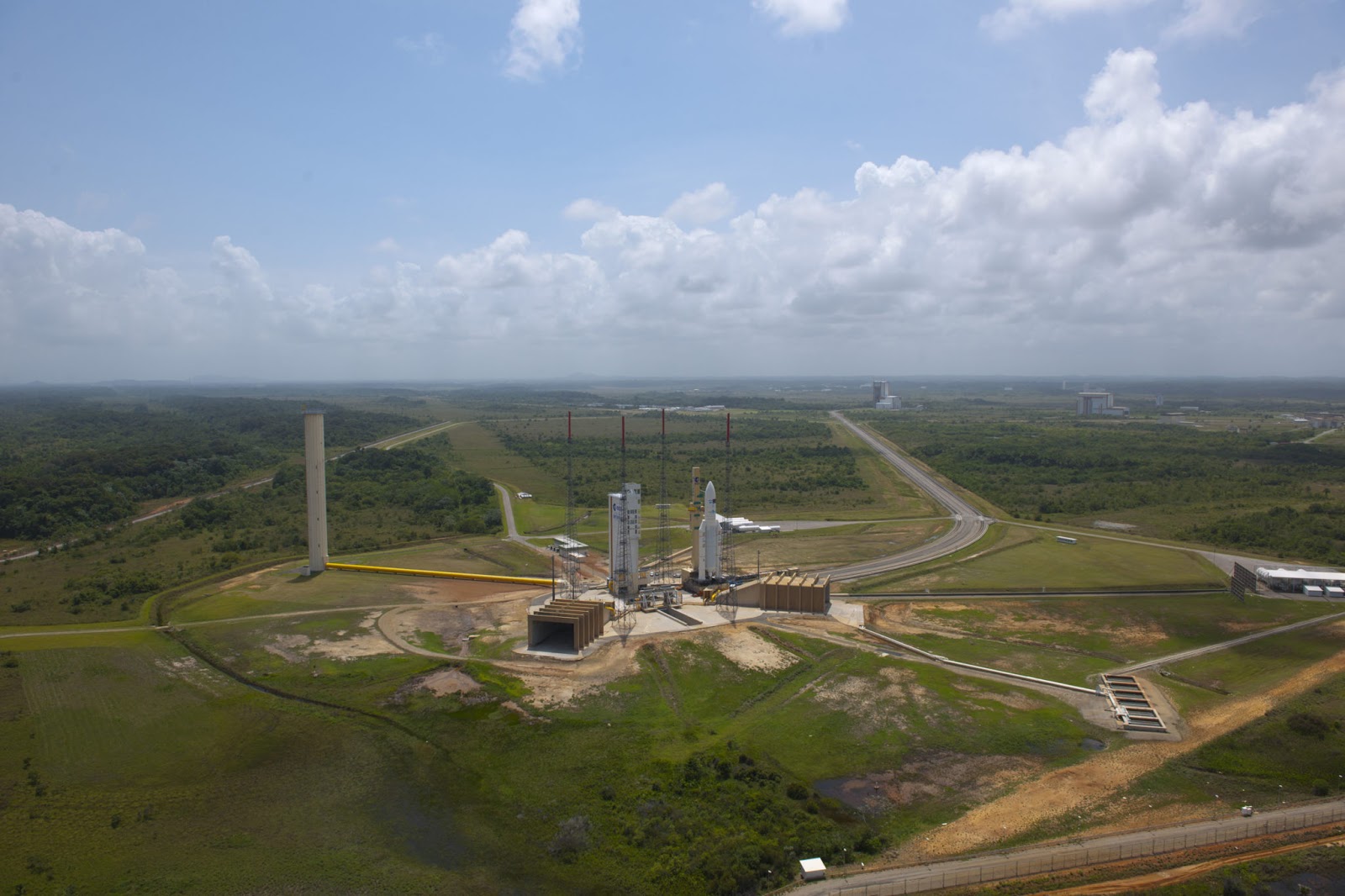
Ariane 6 accelerates as first commercial GEO contracts signed

Arianespace is present at World Satellite Business Week (WSBW) from September 10 to 14 in Paris, confirming the attractiveness of its launcher family with the announcement of two contracts for Ariane 6: the first with Eutelsat as part of a launch services agreement involving five satellites; and the second with France's CNES space agency and the country's DGA defense procurement agency for the CSO-3 satellite. A third contract also was signed recently with the Indian Space Research Organization (ISRO) for Ariane 5 missions to orbit two satellites. Arianespace's backlog is now 59 launches to be carried out during the coming years, including three on Vega C and five on Ariane 6 - the new launchers slated to make their maiden flights in 2019 and 2020, respectively. Stephane Israel, Chief Executive Officer of Arianespace, will participate in the WSBW roundtable entitled: "Accelerating Access to Space" on Tuesday, September 11 at 4:00 p.m. First multi-launch commercial contract with GEO satellites for Ariane 6, along with its third institutional mission. As World Satellite Business Week opened its doors, Arianespace and Eutelsat announced the signature of a multi-year multiple-launch agreement concerning five satellites to be launched through 2027, making Eutelsat the first commercial Ariane 6 customer with geostationary orbit satellite payloads. For institutional missions, after the two launch contracts signed in 2017 for the European Commission and ESA's Galileo constellation, CNES and the DGA have chosen the A62 version of Ariane 6 (with two boosters) to launch their CSO-3 satellite. These orders clearly reflect the competitiveness and versatility of Ariane 6, which will be available in two versions to handle all orbits and multiple payload configurations under the fairing.


Ariane 5 also confirmed its continued attractiveness, as Arianespace signed a contract with India's ISRO space agency for the launch of two geostationary satellites: GSAT-30 and GSAT-31.

In total, and taking into account the signing of a contract with B-SAT during the first half of 2018 to launch BSAT-4b with Ariane 5 - as well as several contracts for the Proof of Concept (POC) flight of the Small Satellite Launch System (SSMS) on Vega - Arianespace's order book value has reached more than euro 4.9 billion. This corresponds to 59 launches: 17 Ariane 5s, five with Ariane 6, 28 with Soyuz and nine with Vega/Vega C.

With nearly one-third of these launches for the European institutions, Arianespace reaffirms its mission to provide Europe with reliable and independent access to space while also confirming its export success.

A contract also is expected to be signed with the South Korean space agency (KARI) on September 20 in Daejeon for a satellite to be lofted by Vega C.

13 satellites orbited by Ariane, Soyuz and Vega since January 2018

Arianespace has carried out five launches since the start of 2018 for both institutional and commercial customers, clearly reflecting the versatility of its launcher family and services. The 13 satellites launched weighed a cumulated total of 25 metric tons and they are performing communications, navigation, science and Earth observation missions. From January to August 2018:

+ Three Ariane 5 launchers orbited four geostationary communications satellites for SES, Yahsat, Avanti Communications and SKY Perfect JSAT/Japanese Ministry of Defense, along with four satellites in the Galileo navigation constellation for the European Commission and ESA,

+ A Soyuz orbited four satellites in SES's O3b constellation, and

+ A Vega launched ESA's Aeolus science satellite, which will support sustainable development.

Six more launches are scheduled during the remaining four months of the year, with two upcoming missions being highly symbolic:

+ The 100th Ariane 5 launch, scheduled for September 25, will loft Horizons 3e for Intelsat and SKY Perfect JSAT, and Azerspace-2/Intelsat 38 for Azercosmos and Intelsat.

+ BepiColombo, a mission to explore the planet Mercury, for ESA in partnership with the Japanese space agency (JAXA), to be launched by an Ariane 5 on October 19.


Ariane 6 and Vega C: getting closer!

Development of the new members of Arianespace's launcher family is proceeding apace, with first missions planned in 2019 for Vega C and 2020 for Ariane 6. A milestone took place on July 16 with a successful first hot firing test of the P120C solid rocket motor, which will equip the strap-on boosters for Ariane 62 and Ariane 64, as well as Vega C's first stage. This followed a series of successful tests of the Vulcain 2.1 main stage engine and Vinci upper stage engine for Ariane 6, along with progress toward Maturity Gate 7 (the critical design review) - which is planned by year-end.

European institutions also have reached major milestones in their commitment to Ariane 6 and Vega C. After the European Commission announced its proposed ambitious space budget for the upcoming decade, an ESA Council meeting in June confirmed funding for the transition period between Ariane 5 and Ariane 6. In addition to the four government contracts already signed for Europe's new launchers (three for Ariane 6 and one for Vega C), the commitment of European governments to all missions identified during the transition phase is a key to the sustainable success of these launchers.

Tuesday, December 19, 2017

ArianeGroup signs contract with ESA for future Prometheus engine

Prometheus is a European demonstrator for a very low cost reusable engine, running on liquid oxygen (LOx) and methane. It is the precursor for future European launcher engines as of 2030. The aim is to be able to build future liquid propellant engines with a unit cost of about 1 million euros, or 10 times less than the cost of producing existing engines such as the Vulcain2. The success of this type of technological challenge demands an entirely new approach and the use of innovative design and production methods and toolsApart from switching from the traditional Ariane propellant (transition from the liquid oxygen and liquid hydrogen combination to a combination of liquid oxygen and methane), the demonstrator will entail major developments, including digitilization of engine control and diagnostics, and manufacturing using 3D printing in a connected factory environment. The 75 million euro contract signed by Daniel Neuenschwander, Director of Space Transportation at the European Space Agency (ESA), and Alain Charmeau, CEO of ArianeGroup, the 50/50 joint-venture set up by the Airbus and Safran groups, covers the design, manufacturing and testing of the first two examples of the Prometheus demonstrator.


The French space agency (CNES) is leading in the early design process, and testing is scheduled on the P5 test bed of the German Aerospace Centre (DLR) in Lampoldshausen, Germany, as of 2020.

"The development of Ariane 6 is ontrack, with a first flight scheduled for 2020. This new Prometheus contract with the European Space Agency is paving the way for the future of European launchers, with the goal of designing and building a reusable engine for one tenth the cost of today's Vulcain2 type engines. I therefore thank ESA and the Member States for their contribution and their confidence in entrusting us with the development of the European technology of tomorrow."

Following the initial phase which was completed in early December, the first Program Review confirmed the consistency of the design choices with engine specifications and in particular with the recurring cost targets. At the same time, subsystems testing has started with the gas generator campaign (one of the parts built using 3D printing) on the DLR's P8 test bed in Lampoldshausen.