Space News

World space hottest news

Showing posts with label ISS. Show all posts

Monday, August 28, 2023

Crew-7 launches to the space station

A Falcon 9 launched a multinational crew to the International Space Station Aug. 26 after a one-day delay to check the spacecraft’s life support system. The SpaceX Falcon 9 lifted off from Launch Complex 39A at the Kennedy Space Center at 3:27 a.m. Eastern on the Crew-7 mission for NASA. The Crew Dragon spacecraft Endurance separated from the Falcon 9’s upper stage a little more than 12 minutes later. Endurance, with its crew of four, is scheduled to dock with the zenith port on the Harmony module of the ISS at 8:39 a.m. Eastern Aug. 27. That will kick off a roughly six-month stay on the station. The launch was scheduled for Aug. 25 but postponed several hours before the scheduled liftoff. NASA said that engineers needed more time to review a component of the Crew Dragon’s life support system, known as ECLSS. NASA did not initially state what that component was but later said it was valves in an air supply system. Steve Stich, NASA commercial crew program manager, said at the post-launch briefing that after discovering corroded valves in the propulsion system of a cargo Dragon in June, SpaceX “out of an abundance of caution” decided to review all valves on the spacecraft, including for life support and propulsion. The review was designed to check the “force margin,” or the ability of the valve to open and close. “It took a little bit more time to get through the ECLSS valves,” he said, which led to the one-day slip. “We said, let’s stand down for 24 hours and make sure we understand it before we go fly.” That review confirmed that the valves were working properly and required no changes.

A Falcon 9 lifts off from the Kennedy Space Center Aug. 26 on the Crew-7 mission to the ISS. Credit: NASA/Joel Kowsky


During the launch countdown, controllers reported a sensor issue that was cleared shortly before liftoff. At the post-launch briefing, officials said that sensors had detected trace amounts of nitrogen tetroxide, or NTO, from the Crew Dragon spacecraft that indicated a possible propellant leak. NTO is one of the two hypergolic propellants used by the spacecraft’s thrusters.

Benji Reed, senior director of the human spaceflight program at SpaceX, said at the post-launch briefing that the levels of NTO detected were about 0.25 parts per million. Three engineers independently calculated what level of leak could cause that reading and all three came to the same conclusion. “The good news was that the number that we came up with was well within the range of what you might normally see.”

That assessment, though, came down to the wire. “We were working the problem and we cleared it within the last two minutes of the count,” he said.

Crew-7 is the first commercial crew flight to carry people from four different agencies. The mission is commanded by NASA astronaut Jasmin Moghbeli on her first flight to space. European Space Agency astronaut Andreas Mogensen is the pilot; he made a 10-day trip to the station on a Soyuz spacecraft in 2015. Satoshi Furukawa of the Japanese space agency JAXA and Roscosmos cosmonaut Konstantin Borisov are mission specialists. Furukawa flew a long-duration mission to the ISS in 2011 while Borisov is on his first trip to space.

That multinational lineup was simply how the crew assignments worked out, said Joel Montalbano, NASA ISS program manager, at a preflight briefing Aug. 21. “The way the timing worked out for this one with our integrated crew agreement that we have with Roscosmos, it was time for these other folks to fly,” he said.

Stich said at that briefing that another milestone for Crew-7 is having a non-NASA astronaut, Mogensen, be a Crew Dragon pilot for the first time. “It’s a very big deal for us,” he said then.

Such multinational crews will not always be the case. The next Crew Dragon mission to the ISS, Crew-8 launching in early 2024, will have three NASA astronauts and one Roscosmos cosmonaut.

The arrival of Crew-7 will allow NASA to begin preparations for the return of the Crew-6 mission, which has been on the station for nearly six months. Montalbano said at the post-launch briefing that the agency was planning a five-day handover between Crew-6 and Crew-7 before Crew-6 departs on the Crew Dragon spacecraft Endeavour. That timing, though, will depend on weather at splashdown locations off the Florida coast, which could be affected by the expected formation of a tropical storm in the Gulf of Mexico in the next several days.
Автор: Jackkat на 2:29 PM No comments:
Email ThisBlogThis!Share to XShare to FacebookShare to Pinterest
Ярлыки: Crew Dragon, Crew-7 mission, Falcon 9, International Space Station, ISS, NASA, NTO, SpaceX

Monday, May 29, 2023

NASA and Boeing say preparations continue for July Starliner test flight

NASA and Boeing said May 26 they are still working towards a July launch of the CST-100 Starliner on a crewed test flight despite “emerging issues” and concerns raised by a safety panel. In a statement issued just before the close of business ahead of a holiday weekend, the two organizations said they completed a “checkpoint review” May 25 of preparations for the Crew Flight Test (CFT) mission, currently scheduled for no earlier than July 21. Two NASA astronauts, Butch Wilmore and Suni Williams, will fly on CFT to the International Space Station on the short test flight, the first crewed flight of the spacecraft. NASA and Boeing said they have now completed 95% of the certification work needed for CFT. They have also addressed all the anomalies from the Orbital Flight Test (OFT) 2 mission, an uncrewed test flight of Starliner to the ISS one year ago. “We are taking a methodical approach to the first crewed flight of Starliner incorporating all of the lessons learned from the various in-depth testing campaigns,” Steve Stich, NASA commercial crew program manager, said in a statement. “In addition to the closeout of ongoing work, the team remains vigilant on tracking new technical issues as we complete certification for crewed flight.” That statement mentioned “emerging issues that need a path to closure” before NASA and Boeing decide to fuel the spacecraft in June for a July launch. Boeing officials said earlier this year they decided to fuel the spacecraft only within 60 days of launch as a measure to mitigate any fuel leaks that could corrode valves, an issue that delayed an August 2021 launch attempt for OFT-2.

Boeing's CST-100 Starliner being prepared for a crew flight test scheduled for no earlier than July 21. Credit: Boeing/John Grant

Among the issues is swapping out a valve in the thermal control system in the spacecraft’s service module, which was reducing flow in one of two redundant loops that cool the vehicle’s avionics. The valve replacement will take about a week, NASA and Boeing said, and should not affect the CFT launch schedule.

Engineers are also evaluating whether tape used on wiring could pose a flammability risk. Although that tape is commonly used on other spacecraft, they are evaluating if it is acceptable for crewed flight. The organizations said that assessment should be done before the decision to fuel the spacecraft.

Another system being reviewed is Starliner’s parachutes. NASA and Boeing said they are reassessing margins in the parachutes, including the “overall efficiency” of joints in that system, to ensure they achieve the required safety factors for a crewed spacecraft.

The statement came a day after a public meeting of NASA’s Aerospace Safety Advisory Panel (ASAP) where the committee’s chair, Patricia Sanders, raised concerns about the ability to complete work, such as parachute certification, in time to meet the planned July 21 launch.

“It is imperative that NASA not succumb to pressure, even unconsciously, to get CFT launched without adequately addressing all the remaining impediments to certification,” she said, recommending that NASA bring in an independent group, such as the NASA Engineering and Safety Center, “to take a deep look at the items on the path to closure.”

The NASA/Boeing statement did not mention the ASAP meeting. However, it did address one issue Sanders raised about the spacecraft’s batteries. The organizations said they had approved the batteries for use on CFT “based on additional testing and analysis” with a proposal to upgrade the batteries on future missions.

Stich, in the statement, said the agency and company had made progress since late March, when they announced the certification work would push the CFT launch from April to July.

“If you look back two months ago at the work we had ahead of us, it’s almost all complete,” he said. “The combined team is resilient and resolute in their goal of flying crew on Starliner as soon as it is safe to do so.”

However, he did not rule out a slip from the current July launch date. “If a schedule adjustment needs to be made in the future, then we will certainly do that as we have done before. We will only fly when we are ready.”
Автор: Jackkat на 10:41 AM No comments:
Email ThisBlogThis!Share to XShare to FacebookShare to Pinterest
Ярлыки: Boeing, Crew Flight Test (CFT) mission, CST-100 Starliner, ISS, NASA, Orbital Flight Test (OFT) 2 mission

Sunday, March 26, 2023

Canada agrees to ISS extension to 2030

The Canadian government formally committed March 24 to an extension of the International Space Station to 2030, joining other Western partners but not Russia. As part of a summit meeting in Ottawa between Canadian Prime Minister Justin Trudeau and President Joe Biden, the two governments confirmed that Canada would participate in the ISS through 2030 as part of a renewed commitment to space exploration that includes contributions to the NASA-led lunar Gateway. “Prime Minister Trudeau agreed to extend Canada’s commitment to the International Space Station (ISS) and support science on the Lunar Gateway,” the Canadian government said in a statement outlining overall cooperation between the two countries. “Our country’s continued participation in ISS and Lunar Gateway cement Canada’s global leadership in robotics in space and on Earth.” The White House announced at the end of 2021 its intent to extend ISS operations through 2030. Since then, the U.S. has been working with its major partners to confirm their participation in the station beyond the previously agreed-to date of 2024. The Japanese government formally agreed to the extension in November 2022, followed shortly thereafter by the European Space Agency at its ministerial meeting. Canada was expected to also agree to an extension, with timing the only issue. “No one would have expected Canada to make a decision before the U.S. or even ESA or Roscosmos,” one Canadian Space Agency official, Christian Lange, said at a January 2022 conference. The White House announcement, he said then, would allow the agency “to propose options and come to a decision in a timely manner” but gave no timeline for doing so.

The International Space Station as seen from a Crew Dragon spacecraft in 2021. Credit: NASA

“The United States strongly welcomed Canada’s decision to support the extension of operation of the International Space Station through 2030,” the White House said at the end of a fact sheet.

With the Canadian announcement, Russia is the only ISS partner that has not agreed to an extension to 2030. Last July, Yuri Borisov, new head of Roscosmos, said that Russia would leave the ISS partnership after 2024. Officials later clarified that meant some time after 2024, not necessarily immediately after 2024.

In February, a Roscosmos council approved a plan to extend Russian operations on the station to 2028. The agency said it would then prepare documents to get formal approval from the Russian government for that extension.

The U.S. and Canada also promoted the impending announcement of the crew of Artemis 2, the first flight of the Orion spacecraft to carry astronauts. The four-person crew will be announced at an event in Houston April 3.

One of the four will be Canadian as part of an agreement NASA and the Canadian Space Agency announced in late 2020 regarding Canada’s contribution to the Gateway. In exchange for providing the Canadarm3 robotic arm for the Gateway, Canada got a seat on Artemis 2 as well as a future, unspecified mission to the Gateway.

Biden mentioned the Artemis 2 announcement in a speech March 24 to the Canadian Parliament. “In just a few days, NASA is going to announce an international team of astronauts who will crew the Artemis 2 mission. The first human voyage to the moon since the Apollo mission ended more than 50 years ago will consist of three Americans and one Canadian,” he noted. “Together we’ll return to the moon.”
Автор: Jackkat на 6:20 AM No comments:
Email ThisBlogThis!Share to XShare to FacebookShare to Pinterest
Ярлыки: Canada, International Space Station, ISS

Wednesday, October 26, 2022

ISS partners weigh options for using commercial space stations

Partner agencies on the International Space Station program say they are in discussions about how they will use, and pay for, commercial space stations that will replace it. Representatives of several countries currently involved in the ISS said during a panel at the American Institute of Aeronautics and Astronautics’ ASCEND conference here Oct. 25 that they are looking at options for how to continue work they currently do on the ISS on the commercial space stations in low Earth orbit (LEO) NASA is helping develop to replace it at the end of the decade. “With the commercialization of LEO, it is really necessary to revisit our principles of doing cooperation,” said Peter Gräf, director of applications and science at the German space agency DLR. Germany is the biggest contributor to ESA’s share of the ISS and actively uses the station for fundamental and applied research. He said discussions among agencies and companies had started on how those arrangements would change with a commercial station. “We need to find ways to work together, certainly in other ways than we did before,” he said. “There are a lot of options available and the main players are in heavy discussions on that.” The ISS today relies extensively on barter arrangements among participating agencies, providing services to cover their share of operations of the station. Such arrangements are unlikely to work for commercial stations, however. “We need to find a new way of cooperating,” said Nicolas Maubert, space counselor at the French Embassy in the U.S. and representative of the French space agency CNES in the U.S., citing the challenges of extending current barter arrangements to commercial stations. “We need to put on the table every option.”

Current international partners on the ISS are looking at how they could use the commercial space stations being developed by American companies that will replace it. Credit: NASA
The simplest approach — direct payments from space agencies to the companies operating commercial stations — could face political obstacles. “The taxpayers in Europe don’t want to pay directly to private American companies,” he said.

He suggested Europe might consider developing its own space station as ESA members debate developing European human spaceflight capabilities. “Having autonomous capabilities is one of the solutions,” he said, one he acknowledged would depend on budgets.

Another option is for companies in other countries to be part of the U.S.-led ventures developing commercial stations. Thales Alenia, for example, is manufacturing modules for Axiom Space and builds components for Northrop Grumman’s Cygnus spacecraft that will be adapted for use on its proposed station.

Japanese companies are also involved in those commercial space station initiatives, said Masami Onoda, director of the Washington office of the Japanese space agency JAXA. “We are very much looking forward to a partnership with commercial outposts.”

First, though, she said the ISS partners needed to finalize plans to extend operations of the station to 2030. “One of the arrangements I hope to see in the coming months is around the ISS. We need to first find out how we’re moving on with the ISS.”

“The bottom line for all is that there is a strong demand for capabilities in low Earth orbit,” Gräf said. “It’s quite clear there will be a human outpost in LEO, no matter what the future will bring.”
Автор: Jackkat на 7:36 AM No comments:
Email ThisBlogThis!Share to XShare to FacebookShare to Pinterest
Ярлыки: ASCEND conference, ESA, International Space Station, ISS, NASA

Friday, June 3, 2022

NASA selects Axiom Space and Collins Aerospace for spacesuit contracts

NASA awarded contracts to Axiom Space and Collins Aerospace to provide spacesuits for International Space Station spacewalks and Artemis moonwalks, although neither the agency nor the winning companies offered many technical or financial details. NASA announced June 1 it selected the two companies for Exploration Extravehicular Activity Services, or xEVAS, contracts to support the development of new spacesuits as well as purchasing spacesuit services. The companies will own the suits they develop and will effectively rent them to NASA for space station and Artemis missions, while also being able to offer the suits to other customers. The goal, NASA officials said at a briefing about the awards, is to have lunar spacesuits ready for the Artemis 3 lunar landing mission, currently scheduled for no earlier than 2025. NASA will also conduct an “orderly transition” from existing, decades-old suits on the ISS to the new suits around the same time. NASA earlier planned to develop suits internally though an effort known as the Exploration Extravehicular Mobility Unit, or xEMU, but shifted gears to a services model with competition, building on the accomplishments of commercial cargo and crew transportation. NASA is making xEMU data and other capabilities available to the companies to support their work. “I really believe that all of that data is helping to reduce the risk and speed that transition process up to the contractor community,” said Lara Kearney, manager of the extravehicular activity and human surface mobility program at NASA’s Johnson Space Center. “We were at a great place to transition just because of how mature the xEMU was at the time.”

A lunar spacesuit being developed by a team led by Collins Aerospace, which, along with Axiom Space, won NASA contracts to develop and provide spacesuits for Artemis missions and the ISS. Credit: Collins Aerospace
Axiom, which is working with a team of companies that includes David Clark Company, KBR and Paragon Space Development Corporation, intended to develop spacesuits to support its commercial space station plans.

“We have a number of customers who already would like to do a spacewalk,” explained Michael Suffredini, president and chief executive of Axiom, said at the briefing. “It’s fantastic to have a partnership where we can benefit from the years of experience that NASA has and all the work they’ve done to advance designs.”

Collins Aerospace, working with ILC Dover and Oceaneering, plans to make use of experience that includes development of the Apollo moonwalking suits and the spacesuits used today on ISS spacewalks.

“The goal is to take the foundations that NASA laid with the xEMU in partnership with industry and evolve that technology, and create a suit that is compatible with the entire spectrum of crew members,” said Dan Burbank, senior technical fellow at Collins.

Both Burbank, a former astronaut, and Suffredini, a former NASA ISS program manager, emphasized their commitment to meeting NASA’s extensive requirements for the suits, including being compatible with astronauts ranging in height from the 5th percentile woman to the 95th percentile man.

However, the companies provided few technical details about their suit designs, and NASA did not even have illustrations of the winning designs to show, electing instead to release an illustration of two moonwalking astronauts wearing suits not necessarily associated with either company. Collins did later release several illustrations of its proposed suit as well as images of that design being testing in a lab.

The total value of the xEVAS contracts is $3.5 billion through 2034, a figure that assumes all task orders are exercised. NASA officials at the briefing declined to break out that total between the two companies, stating that information will instead be in the source selection statement for the procurement, expected to be released publicly in late June. In many other commercial procurements, NASA has released the value of individual awards to companies.

NASA spokesperson Rebecca Wickes later told SpaceNews that the individual contract values will not be published in the source selection statement. Instead, that document will list the percentage difference in the prices compared to other bidders,

“We guaranteed them an amount to make sure we could get them going and they had skin in the game, and we’re going to be careful to protect that,” said Mark Wiese of NASA, who chaired the source selection board for the xEVAS competition. He did not disclose those guaranteed amounts.

“NASA will protect the exact amounts of contract guaranteed minimums and/or individual task order award amounts due to the proprietary nature of the commercial solutions while also protecting the ongoing competitive nature of this contract,” Wickes said.

NASA said in the statement that each company “has invested a significant amount of its own money” into development, but did not disclose those amounts. Burbank said that since he focused on the technical side of spacesuit development, he did not know how much the company had spent. Recent work for the xEVAS contract, he said, “is just the latest version of continual investment in internal R&D.”

Suffredini said that Axiom’s suit development was entirely internally funded. “Now you have to go figure out what that is,” he said.

Both companies said they expected to have spacesuits ready for testing on the ISS and for the Artemis 3 mission by the mid-2020s, but another company plans to test its own spacesuit in orbit before then. As part of the Polaris Program announced in February and funded by billionaire Jared Isaacman, SpaceX is developing a version of its Crew Dragon pressure suit that can be used for spacewalks. That suit will be tested on the Polaris Dawn mission scheduled for later this year.
Автор: Jackkat на 10:23 AM No comments:
Email ThisBlogThis!Share to XShare to FacebookShare to Pinterest
Ярлыки: Artemis moonwalks, Axiom Space, Collins Aerospace, ISS, NASA, spacesuits

Tuesday, April 26, 2022

Crew Dragon splashes down to end Ax-1 private astronaut mission

A Crew Dragon spacecraft returned to Earth April 25, ending a 17-day mission that ferried four private astronauts to and from the International Space Station. The Crew Dragon spacecraft Endeavour splashed down in the Atlantic Ocean off the coast from Jacksonville, Florida, at 1:06 p.m. Eastern after a normal reentry. The spacecraft had undocked from the station 16 hours earlier. Unlike two previous Dragon splashdowns, where one of four main parachutes opened later than the other three, all four parachutes on this spacecraft opened at the same time. NASA and SpaceX had played down any concerns about the delayed parachute opening, saying it may be a normal aerodynamic phenomenon and did not pose a risk to the spacecraft or the people inside. Endeavour returned to Earth four private astronauts on Axiom Space’s Ax-1 mission. Michael López-Alegría, a former NASA astronaut, commanded the mission. One customer, Larry Connor, served as pilot, while two others, Eytan Stibbe and Mark Pathy, were mission specialists. The four launched April 8 and docked with the station less than 24 hours later for what was planned to be an eight-day stay. However, persistent bad weather at splashdown locations in the Atlantic Ocean and Gulf of Mexico kept Dragon in orbit for an extra week. NASA and Axiom Space said their agreement for the mission incorporated the possibility of such delays, so that Axiom Space was not charged extra for the additional time on the station.

The Crew Dragon Endeavour splashes down in the Atlantic Ocean to end the Ax-1 mission. Credit: SpaceX
“Here we are at the conclusion of an incredible mission, and I must say the teams exceeded every expectation,” Amir Blachman, chief business officer of Axiom Space, said on the joint Axiom/SpaceX webcast after splashdown. “We could not be more proud of what has just been accomplished.”

“Overall, this has been an amazing success. The crew performed beyond expectations,” said Derek Hassmann, operations director at Axiom Space, in call with reporters after splashdown. The additional time in orbit, he said, allowed the private astronauts to complete a “handful” of experiments they deferred earlier in the mission as well as perform additional outreach events. “Our Ax-1 crew pitched in on the general care and feeding and upkeep of ISS.”

The crew itself went to Orlando, Florida, after being recovered from the capsule. Hassmann said they will spend a few days there for post-flight medical tests and rest before going home.

The departure and return of Ax-1 allows NASA to proceed with the launch of a new set of professional astronauts to the ISS. The Crew-4 mission is scheduled to launch on another Crew Dragon spacecraft, Freedom, April 27 at 3:52 a.m. Eastern. It will deliver the Crew-4 astronauts of Kjell Lindgren, Bob Hines and Jessica Watson of NASA and Samantha Cristoforetti of the European Space Agency to the ISS.

The tight turnaround — less than 39 hours between splashdown and the scheduled Crew-4 launch — won’t be an issue, said Benji Reed, senior director of human spaceflight programs at SpaceX. Both SpaceX and NASA were reviewing data from the Ax-1 mission throughout the flight, and he indicated no issues with the spacecraft. “Everything is looking great for our launch of Crew-4.”

Approximately five days after the arrival of Crew-4, the Crew-3 astronauts of Raja Chari, Thomas Marshburn and Kayla Barron of NASA and Matthias Maurer of ESA will return to Earth on another Crew Dragon spacecraft, ending a mission that started with their launch to the station in November 2021.

Ax-1 was the first in a series of private astronaut missions to the station planned by Axiom Space before it installed a private module on the station, scheduled for as soon as 2024. Hassmann said the next mission, Ax-2, was tentatively scheduled for early spring of 2023. The company previously announced that former NASA astronaut Peggy Whitson will command Ax-2 with an Axiom customer, John Shoffner, as pilot.

Axiom has not announced who the other two members of the Ax-2 will be. “I believe you will hear something relatively soon” about those other crew members, he said. “Probably in the next few weeks.”
Автор: Jackkat на 6:30 AM No comments:
Email ThisBlogThis!Share to XShare to FacebookShare to Pinterest
Ярлыки: Crew Dragon, ISS, NASA, spacecraft Endeavour, SpaceX

Thursday, February 17, 2022

SpaceLink hires Axiom to support ISS communications demonstration

SpaceLink announced plans Feb. 17 to work with Axiom Space to conduct the first demonstration of its space data relay service on the International Space Station. The Center for the Advancement of Science in Space, manager of the ISS National Laboratory, awarded McLean, Virginia-based SpaceLink a contract to demonstrate data transmission from the Space Station through optical terminals at a rate of 10 gigabits per second. Once that contract was finalized, SpaceLink awarded Axiom a subcontract to support mission integration, launch and operations. Axiom also will serve as SpaceLink’s liaison with NASA, ensuring SpaceLink hardware meets stringent ISS safety requirements. SpaceLink CEO Dave Bettinger called the demonstration, scheduled for 2024, “an excellent validation to show data rates to the ISS that I believe are potentially one or two orders of magnitude higher than what they’ve seen.” OHB System AG is manufacturing four satellites, which it plans to send to medium Earth orbit in 2024, to relay data for government and commercial customers. The planned service is similar to what NASA provides today through the Tracking and Data Relay Satellite constellation in geostationary orbit. “We see it as a an important milestone for us to show NASA and the world that we are going to be able to provide the services in space that commercial, government and international entities will be using in the future,” Bettinger told.

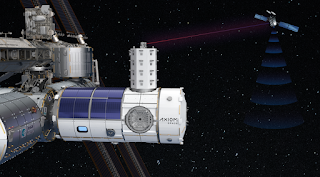
This illustration shows SpaceLink’s optical terminal mounted on the first module of the future Axiom Station. SpaceLink plans to establish a satellite constellation in medium Earth orbit to relay radio frequency and optical data between satellites in low Earth orbit and the ground. Credit: SpaceLink
Axiom won a NASA contract in 2020 to develop a commercial module for the Space Station. Axiom also is planning a series of commercial ISS missions.

“High-speed communication will be a critical component for the future where people live and work in space,” Michael Suffredini, Axiom president and CEO, said in a statement. “Axiom looks forward to collaborating with SpaceLink and supporting its relay network, beginning with this important demonstration on the ISS.”

SpaceLink plans to conduct the data relay demonstration in 2024 after testing in-orbit testing of its communications satellites.

NASA is preparing to hand off to industry the job of providing communications for dozens of spaceflight missions including ISS. Like transportation of crew and cargo to the ISS and cargo delivery to the moon, NASA sees communications in Earth orbit as a job commercial companies can take over.

“NASA has done a great job of going commercial where it makes sense and saved a lot of money on that,” Bettinger said. “We see this as a perfect example. We’re very proud to be a part of the CASIS project.”
Автор: Jackkat на 10:10 AM No comments:
Email ThisBlogThis!Share to XShare to FacebookShare to Pinterest
Ярлыки: Axiom, ISS, SpaceLink

Tuesday, August 10, 2021

DoD experiment flying to International Space Station to collect data for missile-tracking sensors

The infrared imaging payload — called PIRPL (short for prototype infrared payload) — is a 110-pound multispectral camera that will collect data on the low Earth orbit environment. A Northrop Grumman spacecraft scheduled to launch Aug. 10 on a resupply mission to the International Space Station will deliver 8,200 pounds of crew supplies, hardware and science experiments. Among the science payloads on board Cygnus NG-16 is an infrared imaging sensor that will collect data on the low Earth orbit environment. The Pentagon’s Space Development Agency will use the data to develop thermal sensors that can detect hypersonic missiles and other advanced weapons while in flight. Cygnus NG-16 will fly on a Northrop Grumman Antares rocket from the Mid-Atlantic Regional Spaceport at NASA’s Wallops Flight Facility in Virginia. It is scheduled to rendezvous with the ISS on Aug. 12. The infrared imaging payload — called PIRPL (short for prototype infrared payload) — is a 110-pound multispectral camera also made by Northrop Grumman under a $13.8 million contract from the Space Development Agency (SDA) and the Missile Defense Agency. This is SDA’s first experiment in support of its Tracking Layer, a planned constellation of small sensor satellites in low Earth orbit. “Upon arrival at the Space Station, PIRPL will begin collecting infrared data and expanding detection capabilities that will aid in the development of algorithms for the next generation of tracking satellites,” Northrop Grumman said Aug. 9 in a news release.

For the NG-16 mission, the Cygnus spacecraft will launch aboard the Northrop Grumman Antares rocket, carrying approximately 8,200 pounds of supplies, equipment and experiments for the International Space Station. Credit: Northrop Grumman
PIRPL will gather imagery through the entire NG-16 mission expected to last about three months. After Cygnus leaves the space station, PIRPL will be released from the spacecraft and briefly operate in free flying mode so it can collect more data from different angles before it burns up in the atmosphere, an SDA official said during a call with reporters. 

The imagery “will help us understand what Earth infrared backgrounds look like from this type of orbit,” the SDA official said.

Current U.S. military missile-warning satellites have powerful infrared sensors that can detect ballistic missile launches from geosynchronous orbits 22,000 miles above Earth. SDA’s Tracking Layer satellites will be in lower orbits at about 600 miles so the agency needs sample data to develop algorithms that can identify targets amid the clutter.

“One of the objectives is to look at what we can do from LEO orbits which are fairly new for these types of missions,” the official said. “We need to understand what the atmosphere, clouds, earth surface, land and ocean all look like at various times of day and night.”

SDA and the Missile Defense Agency want to “show that we can do those missions at a lower Earth orbit, that we are able to get much closer to the threats,” the agency official said. Another reason for the PIRPL experiment is to test how sensors perform when they’re moving at very fast speeds in low orbits, compared to current staring sensors on geostationary satellites.

“We call that a complex background,” the SDA official said of low Earth orbit. “We need to check whether LEO data can be processed successfully to do the same missions that we do well in high orbit.”
Автор: Jackkat на 7:49 AM No comments:
Email ThisBlogThis!Share to XShare to FacebookShare to Pinterest
Ярлыки: Cygnus NG-16, ISS, multispectral camera, Northrop Grumman, PIRPL, prototype infrared payload

Wednesday, August 4, 2021

Former NASA official joins Nanoracks to lead commercial space station work

Commercial space services company Nanoracks has hired a former NASA official most recently involved with planning for the Artemis program to lead its efforts to develop commercial space stations. Nanoracks announced Aug. 2 it hired Marshall Smith to be its senior vice president of commercial space stations. Smith retired from NASA at the end of July after more than 35 years at the agency, most recently as deputy associate administrator for systems engineering and integration in the Human Exploration and Operations Mission Directorate. In his new role, Smith will oversee the company’s Outpost program, which seeks to convert upper stages of launch vehicles into modules that can be used for in-space manufacturing or habitats, as well as plans to develop free-flyer commercial space stations. Smith will run the company’s new office in Huntsville, Alabama. “I’ve gotten to know Marshall very well over the last several years and have come to appreciate his understanding of how to evolve the NASA legacy into the commercial sector,” Jeffrey Manber, chief executive of Nanoracks, said in a statement. “Put simply, Marshall gets it. He understands that the innovation and cost efficiencies of the private sector are key to furthering American leadership in space.”

As the new its senior vice president of commercial space stations, Marshall Smith will lead work by Nanoracks to develop commercial modules converted from the upper stages of rockets. Credit: Nanoracks
“I was impressed to learn how much Nanoracks has quietly accomplished in advancing the use of in-space platforms and look forward to moving both Nanoracks and the new Huntsville office forward to ensure a vibrant future for commercial space stations and platforms,” Smith said in the statement.

Nanoracks is one of the pioneers in commercial use of the International Space Station, working with NASA to fly payloads to the station and use it as a platform for cubesat launches. Nanoracks developed a commercial airlock, called Bishop, that was installed on the station in December 2020. The company is one of several that has expressed interest in developing commercial space stations as successors to the ISS.

In his last role at NASA, Smith was the senior engineer for the directorate responsible for human spaceflight, converting high-level goals into program objectives and requirements. Before that, he was director for lunar exploration programs, ovseeing development of the lunar Gateway, Human Landing System and other lunar exploration efforts.

Voyage Space Holdings acquired a majority stake in Nanoracks in a deal that closed in May, adding Nanoracks to its portfolio of space companies. Smith said that he will be working closely with Voyager to make the most use of those firms. “There is a need for a vertically integrated NewSpace company with entrepreneurial spirit that will drive the future of our space programs by scaling up successful smaller space companies,” he said in the statement.
Автор: Jackkat на 12:53 PM No comments:
Email ThisBlogThis!Share to XShare to FacebookShare to Pinterest
Ярлыки: commercial space stations, ISS, Marshall Smith, NanoRacks, NASA, Outpost program

Wednesday, January 13, 2021

New solar arrays to power International Space Station Research

As the International Space Station orbits Earth, its four pairs of solar arrays soak up the sun's energy to provide electrical power for the numerous research and science investigations conducted every day, as well as the continued operations of the orbiting platform. The space station is the springboard to NASA's Artemis missions to the Moon, a platform to test advanced technologies for human exploration of deep space and future mission to Mars. NASA also has opened the space station for business and commercial activities, including private astronauts missions. Designed for a 15-year service life, the solar arrays have been operating continuously since the first pair was deployed in December 2000, with additional array pairs delivered in September 2006, June 2007, and March 2009. The first pair of solar arrays has now provided continuous electrical power to the station for more than 20 years as more modules were added and dozens of crews tackled thousands of scientific experiments and continued operations through hundreds of spacewalks, cargo missions, and more. Though they are functioning well, the current solar arrays are showing signs of degradation, as expected. To ensure a sufficient power supply is maintained for NASA's exploration technology demonstrations for Artemis and beyond as well as utilization and commercialization, NASA will be augmenting six of the eight existing power channels of the space station with new solar arrays.


Boeing, NASA's prime contractor for space station operations, its subsidiary Spectrolab, and major supplier Deployable Space Systems (DSS) will provide the new arrays. The combination of the eight original, larger arrays, and the smaller, more efficient new arrays will restore the power generation of each augmented array to approximately the amount generated when the original arrays were first installed, providing a 20% to 30% increase in power for space station research and operations.

The new solar arrays will be a larger version of the Roll-Out Solar Array (ROSA) technology that successfully demonstrated the mechanical capabilities of solar array deployment during its test on the space station in June 2017.

The new solar arrays will be positioned in front of six of the current arrays, and will use the existing sun tracking, power distribution, and channelization. This approach is similar to the one used to upgrade the station's external television cameras to high definition, using the existing power and control mechanisms.

The new arrays will shade slightly over half of the length of the existing arrays and will be connected to the same power system to augment the existing supply. The eight current arrays are currently capable of generating up to 160 kilowatts of power during orbital daytime, about half of which is stored in the station's batteries for use while the station is not in sunlight. Each new solar array will produce more than 20 kilowatts of electricity, eventually totaling 120 kilowatts (120,000 watts) of augmented power during orbital daytime.

In addition, the remaining uncovered solar array pair and partially uncovered original arrays will continue to generate approximately 95 kilowatts of power for a total of up to 215 kilowatts (215,000 watts) of power available to support station operations at completion. For comparison, an active computer and monitor may use up to 270 watts, and a small refrigerator uses about 725 watts.

The solar arrays will be delivered to the International Space Station in pairs in the unpressurized trunk of the SpaceX Dragon cargo spacecraft during three resupply missions starting in 2021, when the second pair of current arrays reaches the 15th year of its design life. The installation of each solar array will require two spacewalks: one to prepare the worksite with a modification kit and another to install the new solar array.

NASA signed a modification to the ISS Vehicle Sustaining Engineering contract with Boeing to provide the six new solar arrays. Doing so provides the International Space Station with enough power to maintain normal operations and ensure adequate power for future opportunities in low-Earth orbit, whether for NASA and its international partners or commercial companies.
Автор: Jackkat на 3:37 AM No comments:
Email ThisBlogThis!Share to XShare to FacebookShare to Pinterest
Ярлыки: International Space Station, ISS, NASA, Roll-Out Solar Array, ROSA, solar arrays

Thursday, September 24, 2020

NASA chief warns Congress about Chinese space station

NASA chief Jim Bridenstine told lawmakers Wednesday it was crucial for the US to maintain a presence in Earth's orbit after the International Space Station is decommissioned so that China does not gain a strategic advantage. The first parts of the ISS were launched in 1998 and it has been continuously lived in since 2000. The station, which serves as a space science lab and is a partnership between the US, Russia, Japan, Europe and Canada, is currently expected to be operated until 2030. "I'll tell you one thing that has me very concerned -- and that is that a day is coming when the International Space Station comes to the end of its useful life," said Bridenstine. "In order to be able to have the United States of America have a presence in low Earth orbit, we have to be prepared for what comes next," he added. To that end, NASA has requested $150 million for the 2021 fiscal year to help develop the commercialization of low Earth orbit, defined as 2,000 km (1,200 miles) or less from the planet's surface. "We want to see a public-private partnership where NASA can deal with commercial space station providers, so that we can keep a permanent uninterrupted human presence in low Earth orbit," said Bridenstine. "I don't think it's in the interest of the nation to build another International Space Station -- I do think it's in the interest of the nation to support commercial industry, where NASA is a customer."


Bridenstine warned the lawmakers this was critical to maintain US space supremacy in the face of a planned Chinese space station that Beijing hopes will be operational by 2022.

The station is named Tiangong, meaning Heavenly Palace, and in June Chinese state media announced it was partnering with 23 entities from 17 countries to carry out scientific experiments on board.

These countries included both developed and developing countries, such as France, Germany and Japan, as well as Kenya and Peru, according to Xinhua news agency.

"China is rapidly building what they call the 'Chinese International Space Station,' and they're rapidly marketing that space station to all of our international partners," said Bridenstine.

"It would be a tragedy, if, after all of his time, and all of this effort, we were to abandon low Earth orbit and cede that territory."

He explained that the microgravity of ISS offered great potential for scientific advances, from innovations in pharmaceuticals to printing 3D human organs to the creation of artificial retinas to treat people with macular degeneration.

Bridenstine said that it was therefore necessary to fund NASA to pay companies to set up a space station, where it would be one of several customers in order to drive down its own costs.

This, he added, was vital to "ultimately not cede that territory to another country that doesn't have our interests at heart."
Автор: Jackkat на 12:19 PM 1 comment:
Email ThisBlogThis!Share to XShare to FacebookShare to Pinterest
Ярлыки: ISS, Jim Bridenstine, NASA

Thursday, June 25, 2020

Thales Alenia Space will provide two key pressurized elements for Axiom commercial space station

Thales Alenia Space, Joint Venture between Thales (67 %) and Leonardo (33 %) announced the signature of an ATP (Authorization To Proceed) with Axiom Space of Houston, Texas to initiate the development of two key pressurized elements dedicated to the world's first commercial space station. In January, NASA selected Axiom's proposal to attach its space station modules to the International Space Station (ISS) starting from the second half of 2024, ultimately creating a new 'Axiom Segment' which will expand the usable and habitable volume of the ISS. When the ISS reaches its retirement date, the Axiom complex will detach and operate as a free-flying commercial space station. The Axiom Segment will be attached to the ISS Node 2 built by Thales Alenia Space. Axiom is offering professional and private astronaut flights to the ISS at a rate of up to two per year, with the first set to launch in October 2021, while it develops the new station elements. Based on its past successful experience building modules for the International Space Station, Thales Alenia Space will be responsible for the design, development, assembly and test of the primary structure and the Micrometeoroid and Debris Protection System for the Axiom Node One (AxN1) and Habitation Module (AxH), the first two Axiom station elements to fly. Axiom will receive these elements at their facility in Houston for integration and outfitting of core systems and certification of flight prior to shipping to the launch facility.


Thales Alenia Space has supplied a significant part of the pressurized elements of the International Space Station, including state-of-the-art components such as Node 2, Node 3, Columbus (pressurized part) - European Laboratory, Multi-Purpose Logistics Module (MPLM), the Permanent Logistic Module (PPM) and Cupola, as well as the ATV and Cygnus cargo modules.
Автор: Jackkat на 6:32 AM No comments:
Email ThisBlogThis!Share to XShare to FacebookShare to Pinterest
Ярлыки: ATP, Axiom, commercial space station, ISS, Thales Alenia Space

Tuesday, June 2, 2020

Starliner to go to ISS without crew in November, crewed flight set for next year

Boeing's Starliner spacecraft will refly its uncrewed test mission to the International Space Station (ISS) in November of this year, while the first crewed flight is planned for April 2021, a space source said. "The second flight of the Starliner spacecraft to the ISS without crew is expected in mid-November 2020, while the first flight with crew - in April 2021", the source said. In April, Boeing announced that it was going to refly its uncrewed orbital flight test after problems during its first flight in December 2019. In December 2019, the Starliner spaceship set off on its first test flight to the International Space Station, but docking was canceled after Starkiner failed to execute an orbit-insertion burn on schedule. Earlier in the day, the SpaceX rocket with NASA astronauts Bob Behnken and Doug Hurley lifted off to the International Space Station (ISS) in a second attempt, after Wednesday's launch was postponed due to bad weather conditions. The Boeing Starliner is a $4.2 billion next-gen crew capsule with a capacity of up to 7 astronauts, a free-flight operating capability of up to 60 hours, and the ability to remain docked in orbit for up to 210 days. It is designed to be launched by Atlas V non-reusable rockets, which use Russian-made RD-180 engines developed by NPO Energomash.


Автор: Jackkat на 9:47 AM No comments:
Email ThisBlogThis!Share to XShare to FacebookShare to Pinterest
Ярлыки: Boeing Starliner, International Space Station, ISS, RD-180, SpaceX rocket

Saturday, April 18, 2020

NASA announces first SpaceX crewed flight for May 27

A SpaceX rocket will send two American astronauts to the International Space Station on May 27, NASA announced on Friday, the first crewed spaceflight from the US in nearly a decade. "On May 27, @NASA will once again launch American astronauts on American rockets from American soil!" Jim Bridenstine, head of the National Aeronautics and Space Administration, said in a tweet. Since July 2011, the United States has relied on Russian Soyuz rockets to send American astronauts to the ISS. The US space agency had been aiming to conduct the crewed mission in May and is sticking with the plan despite the global coronavirus pandemic. Astronauts Robert Behnken and Douglas Hurley will fly to the ISS on a SpaceX Falcon 9 rocket aboard a Crew Dragon spacecraft also built by SpaceX, the company founded by tech entrepreneur Elon Musk. They will lift off at 4:32 pm (2032 GMT) on May 27 from historic launch pad 39A, the same one used for the Apollo and space shuttle missions, at the Kennedy Space Center in Florida, NASA said. Behnken and Hurley have been training for years for the mission, which would move the United States closer to no longer being reliant on Russia for crewed flights. The Crew Dragon capsule is a modified version of SpaceX's Dragon capsule which has been used to send supplies to the ISS since 2012. It will take approximately 24 hours after liftoff for them to dock with the ISS. The length of their stay aboard the ISS has not been determined. One American astronaut and two Russian cosmonauts are currently aboard the ISS.


The May mission will be a milestone for NASA, which has had trouble turning the page on the space shuttle era. Shuttles transported American astronauts into space for three decades but two of them also blew up.

After abandoning the shuttle, NASA turned to private industry to develop its next generation spacecraft and SpaceX and Boeing have been competing on rolling out a crewed capsule.

SpaceX came up with Crew Dragon and Boeing the Starliner but the Starliner suffered a setback in December during a test run.

SpaceX is now poised to become the first private company to send astronauts into space.

In March, Musk's Crew Dragon capsule made a round trip to the ISS, which is in orbit more than 250 miles (400 kilometers) above Earth, with a mannequin on board, before returning to the Atlantic after six days in space.

SpaceX has made the trip 15 times since 2012, but only to refuel the station.
Автор: Jackkat на 7:12 AM No comments:
Email ThisBlogThis!Share to XShare to FacebookShare to Pinterest
Ярлыки: Douglas Hurley, International Space Station, ISS, NASA, Robert Behnken, SpaceX rocket

Monday, December 9, 2019

SpaceX Dragon docks with International Space Station

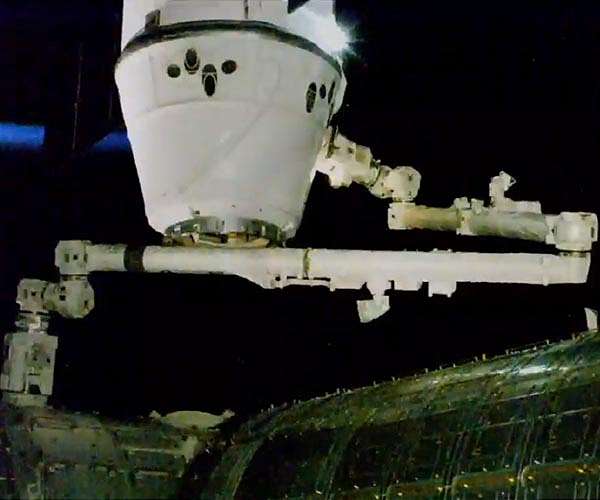
The SpaceX Dragon cargo spacecraft containing 5,700 pounds of cargo arrived at the International Space Station on Sunday morning. The spacecraft, which is SpaceX's 19th delivery to the ISS, was captured by the Canadarm2 robotic arm operated by astronauts Luca Parmitano and Andrew Morgan at 5:05 a.m. At 7:47 a.m., it was installed at the ISS, according to NASA. Aboard were genetically enhanced "mighty mice," 36,000 worms and a new version of the CIMON rocket to interact with astronauts. The worms will reproduce 3 million mice in an incubator and be brought back to Earth in a frozen state, Space.com reported. The mice will help scientists understand how to limit muscle and bone loss in humans in space, CNN reported. Experiments also will study malting barley in microgravity, the spread of fire. Also delivered were a high-tech toolbox to be mounted outside the station and a new hyperspectral Earth imaging system developed by the Japanese government for use in oil exploration among other things. The spacecraft was launched aboard the Falcon 9 rocket Thursday from Cape Canaveral Air Force Station in Florida. The liftoff was delayed from Wednesday because of strong high-altitude winds. The capsule is scheduled to leave the space station and re-enter Earth's atmosphere in January, splashing down in the Pacific Ocean off the coast of Baja California with 3,600 pounds of return cargo. Early Monday morning, a second resupply spacecraft is scheduled to arrive: the Russian Progress 74 that launched Friday morning. NASA TV will provide live coverage of Progress rendezvous and docking at 4:45 a.m.


earlier report
SpaceX launches 19th cargo mission to space station with robot aboard
A SpaceX Falcon 9 rocket launched into a bright Florida sky Thursday from Cape Canaveral Air Force Station on the company's 19th cargo mission to the International Space Station.

The rocket, lifting off at 12:29 p.m., carried 5,700 pounds of supplies, experiments and a new version of the CIMON robot designed to interact with astronauts. The onboard robot is designed to float in the space station's habitat.

SpaceX had postponed a launch attempt Wednesday because of strong high-altitude winds that could knock the Falcon 9 rocket off course, but company officials said the weather was ideal Thursday and the launch came on time.

The first-stage booster of the rocket, which had not been used previously, landed on a barge in the Atlantic Ocean about eight minutes after launch. A live feed showing the barge was interrupted as the booster descended, causing a gasp from the group watching at SpaceX headquarters. The feed was restored a few seconds later and showed the booster standing safely upright.

The Dragon capsule will travel through space for several days as it catches up to the station. On Dec. 8, the capsule will make a slow approach to space station, and astronauts on board will capture it using the station's Canadarm and attach it to an airlock.

After being unpacked and repacked, the capsule is scheduled to leave the space station from the station and re-enter Earth's atmosphere in January, splashing down in the Pacific Ocean off the coast of Baja California with 3,600 pounds of return cargo.

The robot being sent to the space station, CIMON - an acronym for Crew Interactive Mobile Companion - is capable of conversing with astronauts, helping them remember procedures and eventually detecting their mood in case of problems on board. It was built by Airbus with help from IBM and the German Aerospace Center.

The first version of CIMON was tested on the station in November 2018 with mixed results. Video showed German astronaut Alexander Gerst switching on the robot and holding a five-minute conversation with it. CIMON appeared to malfunction, floating down toward the deck of the station despite Gerst's attempt to pull it back.

But the robot did answer questions and play a song that was billed as Gerst's favorite in the video, The Man Machine, by German band Kraftwerk. Finally CIMON told Gerst to "Be nice to me," prompting snickers from the crew.

At one point in the conversation, the robot responded with comments about dancing when Gerst told it to "cancel" the music it was playing.

"The first CIMON was sent back to Earth and will go to a museum," said Till Eisenberg, a project manager for Airbus. "The new version has better microphones and software life that can last up to three years in space."

The goal, Eisenberg said, is to have CIMON support the crew's mental health and mood with conversation. It also could be equipped with sensors, such as those that would detect carbon monoxide if astronauts appear groggy.

Other items on the rocket included a high-tech toolbox, designed to be mounted outside the station, and a new hyperspectral Earth imaging system that was developed by the Japanese government for use in oil exploration among other things.

The toolbox will hold two leak detectors, and help reduce preparation time in space because they no longer will be brought through airlocks. The leak detectors are equipped with mass spectrometers that can find small leaks from the space station, NASA said.

The tool stowage assembly was developed at NASA's Goddard Space Flight Center in Greenbelt, Md., in partnership with NASA's Johnson Space Center in Houston.

The Dragon capsule that carried the cargo previously flew on SpaceX's CRS-6 and CRS-11 missions.
Автор: Jackkat на 12:24 PM No comments:
Email ThisBlogThis!Share to XShare to FacebookShare to Pinterest
Ярлыки: Canadarm2, cargo, CIMON rocket, docking, Dragon, ISS, NASA, spacecraft

Monday, November 25, 2019

Boeing CST-100 Starliner takes next step for orbital flight test

The Boeing CST-100 Starliner spacecraft that will launch to the International Space Station on the company's uncrewed Orbital Flight Test for NASA's Commercial Crew Program (CCP) has taken a significant step toward launch. Starliner rolled out of Boeing's Commercial Crew and Cargo Processing Facility at NASA's Kennedy Space Center in Florida on Nov. 21, making the trek on a transport vehicle to Space Launch Complex 41 at Cape Canaveral Air Force Station. "This is critical to our future as a nation," said Kennedy's center director Bob Cabana. "We've got to get astronauts flying on U.S rockets from U.S. soil, and this is just a huge step forward." Cabana was joined by CCP and Boeing leaders in a gathering of employees and families to watch Starliner roll out of the factory. "For the team that has built the first American spacecraft designed to land on land, and to get it rolling out, is absolutely incredible," said John Mulholland, Vice President and Program Manager of Boeing Commercial Crew Programs. "Something this complex takes a huge team." "Look at that amazing sight and what your success looks like," said Kathy Lueders, NASA's Commercial Crew Program Manager. "We're not done yet. We've got to step into the mission carefully, fly this vehicle up to the space station, and bring it home safely." At the pad, Starliner was hoisted up at the Vertical Integration Facility and secured atop a United Launch Alliance Atlas V rocket for the flight test to the space station. The Atlas V rocket that will carry Starliner comprises a booster stage and dual-engine Centaur upper stage, as well as a pair of solid rocket boosters.


NASA astronauts Mike Fincke and Nicole Mann and Boeing astronaut Chris Ferguson were on hand to witness the rollout milestone ahead of the uncrewed flight test.

"This is the dawn of a new era," said Ferguson. "For all of you youngsters out there who came out here early to watch, I'm glad you were a part of this. This is really important because this is your future, too."

"We're looking forward to the day when we're launching people on a regular basis," said Fincke. "As graduates of military test pilot schools, we are really excited to see how Starliner's going to behave; we know it's going to be awesome, and we're going to get all kinds of really great test data from it."

The uncrewed flight test, targeted to launch Dec. 17, will provide valuable data on the end-to-end performance of the Atlas V rocket, Starliner spacecraft and ground systems, as well as in-orbit, docking and landing operations. The data will be used as part of NASA's process of certifying Boeing's crew transportation system for carrying astronauts to and from the space station.

"It comes down to trust," said Mann. "I'm talking about trust in the individuals-our fellow Americans-who are building this spacecraft and making this possible. You walk around the factory and there is this amazing attention to detail, and it gives you this great level of confidence," said Mann.

NASA is working in partnership with Boeing and SpaceX to launch astronauts on American rockets and spacecraft from American soil for the first time since 2011. Safe, reliable and cost-effective human transportation to and from the space station will allow for additional research time and increase the opportunity for discovery aboard humanity's testbed for exploration.
Автор: Jackkat на 8:18 AM No comments:
Email ThisBlogThis!Share to XShare to FacebookShare to Pinterest
Ярлыки: Atlas V rocket, Boeing, Commercial Crew Program, CST-100 Starliner spacecraft, ISS, NASA, space

Sunday, October 13, 2019

NASA and SpaceX hope for manned mission to ISS in early 2020

SpaceX could launch US astronauts to the International Space Station as early as next year if tests on the company's long-delayed Crew Dragon capsule prove conclusive, NASA Administrator Jim Bridenstine said Thursday. Bridenstine made the announcement as he toured the California headquarters of billionaire Elon Musk's SpaceX, a major contractor for NASA. The visit came as Bridenstine and Musk have been engaged in a public spat over the much-delayed building of the Crew Dragon spacecraft. The capsule would provide the transportation for astronauts to the space station for the first time since America's space shuttle program ended in 2011. Musk, who appeared at a news conference alongside Bridenstine and the two astronauts who are set to fly on board the spacecraft, said he hoped to have the capsule delivered to NASA by the end of the year. He stressed, however, that safety was paramount and the launch would be delayed without hesitation if any problems arise. "If everything goes according to plan, it would be in the first quarter of next year," Bridenstine said of the launch. "But remember -- and this is the important thing that we have to get right on messaging -- there are still things that we can learn or could learn that could be challenging that we have to resolve. "I'm not saying that's going to happen, I don't know. That's why we test."


Some of the technical challenges SpaceX is working on include concerns about the parachutes and the propulsion system.

"It's a pretty arduous engineering job to get the parachutes right," Musk said.

"Parachutes, they look easy but they are definitely not easy," he added. "We want to get at least something on the order of 10 successful tests in a row before launching astronauts."

Since retiring its space shuttle program, NASA has had to rely on Russia to ferry astronauts to and from the space station at a cost of $85 million a seat. It is now counting on SpaceX and Boeing to carry out that task.

SpaceX was founded in 2002 by Musk to help reduce space transportation costs -- and with an ultimate goal of helping colonize Mars.

The first manned flight to the space station was due to take place last year but SpaceX suffered a major setback in April when its Crew Dragon spacecraft exploded during testing, prompting delays and renewed tests.

"You know, honestly, if there's a test program and nothing happens in that test program, I would say that test program is insufficiently rigorous," Musk said Thursday.

"Space is hard," he added.
Автор: Jackkat на 8:31 AM No comments:
Email ThisBlogThis!Share to XShare to FacebookShare to Pinterest
Ярлыки: Crew Dragon capsule, Elon Musk, ISS, NASA, SpaceX

Saturday, October 12, 2019

Luca powers up for a spacewalk

European Space Agency (ESA) astronaut Luca Parmitano is preparing to step out into space for his first spacewalk of the Beyond mission. Scheduled for 25 October, he will work with NASA astronaut Jessica Meir to replace nickel hydrogen batteries with newer lithium ion batteries and install battery adapter plates on the Space Station's Port-6 truss structure. This is a process fellow ESA astronaut Thomas Pesquet knows well, having replaced batteries on another power channel during his Proxima mission. We asked him to tell us more about the task and how the crew will prepare. Known to the crew as an EVA (Extravehicular Activity), each spacewalk is planned up to a year in advance. On Station, preparation begins around two weeks ahead, with a set of procedures called the "Road to EVA". "Preparing for a spacewalk will make up 2-3 hours of your schedule every day during this time," Thomas explains. "The crew often carry out prep in their personal time as well."


The big day
Live coverage of Luca and Jessica's spacewalk starts on NASA TV at 10:30 GMT (12:30 CEST), but the crew will begin their preparation around 6:00. And there is to be no showering, shaving, or applying deodorant for at least a day in advance, as any remnants of these products could mix with the pure oxygen inside the suit and pose a fire risk

Astronauts wear a liquid cooling garment underneath their spacesuit. This is connected to the water system that keeps them cool, or warm, by circulating water around their body. They also don a medical monitor and put a dosimeter in their pocket to measure radiation before entering the hatch.

Thomas describes the process inside the airlock as "like scuba diving in reverse", as astronauts breathe in a controlled way to rid their blood of nitrogen and adjust to lower pressure.

A third crew member, known as the Intravehicular (IV) crew member, is also isolated in the airlock, before it goes to vacuum. This person helps the astronauts with their oxygen masks and into their spacesuits, while making sure everything is checked, tethered and ready for a safe and successful sortie.

It is a role Luca will play in the two spacewalks before his, on 15 and 21 October.

Out in space

Before exiting the airlock, Thomas says, extreme focus is the overriding feeling.

"Everybody's watching, so many people have been involved in the preparation, and the risks are so much higher when you're outside the Space Station," he explains. "The only thing you can't really prepare for are the day/night cycles.

"During the night, you only have your helmet light, so you can't really see anything except what you're working on. And because you're working in all body orientations, it's easy to get disoriented. But you know you can always follow your tether back towards the hatch."

After exiting the airlock, Thomas says one astronaut will prepare the worksite while the other breaks torque on the pre-positioned adapter plates. Each astronaut will then work to install the adapter plates, needed to replace two older batteries with one new one.

The spacewalk on 25 October is the one of five scheduled for October. Even more are expected in November as Luca ventures out again with the complex task of repairing and enhancing dark matter hunter AMS-02 - a structure never designed to be maintained in orbit.
Автор: Jackkat на 8:31 AM No comments:
Email ThisBlogThis!Share to XShare to FacebookShare to Pinterest
Ярлыки: ESA, European Space Agency, ISS, Luca Parmitano, space walk

Tuesday, April 23, 2019

SpaceX to launch cargo resupply mission despite Crew Dragon mishap

The "anomaly" experienced by SpaceX's Crew Dragon over the weekend won't affect the company's planned space station resupply mission. According to NASA officials, SpaceX's Falcon 9 rocket is still scheduled to launch the company's Dragon cargo spacecraft on April 30. "The NASA and SpaceX teams are still assessing the anomaly that occurred, but I can tell you we are still tracking, as of today, for Tuesday, April 30, and that launch will be at 4:22 a.m. Eastern time," NASA public affairs officer Joshua Finch told reporters during a teleconference on Monday, according to Space.com. The resupply mission was originally scheduled to blast-off on April 26, but last week, NASA announced a delay. "April 30 is the most viable date for both NASA and SpaceX due to station and orbital mechanics constraints," the space agency noted in an update. On Saturday, a cloud of smoke rising from test facilities at Cape Canaveral could be seen from miles away. Reports confirmed the smoke was the result of an explosive accident involving SpaceX's Crew Dragon. Both SpaceX and NASA acknowledged the failure. SpaceX referred to the accident an "anomaly" during the final of a series of engine test fires. "Ensuring that our systems meet rigorous safety standards and detecting anomalies like this prior to flight are the main reasons why we test," SpaceX told UPI in released statement. "Our teams are investigating and working closely with our NASA partners."


An unverified video of the accident, first published by Business Insider, shows what appears to the Crew Dragon spacecraft being destroyed by a fiery explosion.

Though SpaceX has yet to confirm the authenticity of the video, the company did report that the anomaly was quickly contained and that no one was injured.

"The NASA and SpaceX teams are assessing the anomaly that occurred today during a part of the Dragon Super Draco Static Fire Test at SpaceX Landing Zone 1 in Florida," NASA Administrator Jim Bridenstine tweeted on Saturday. "This is why we test. We will learn, make the necessary adjustments and safely move forward with our Commercial Crew Program."

The exploded spacecraft was the same vessel that completed the first commercial crew program test flight earlier this year. The Crew Dragon capsule was supposed to conduct another test flight this summer. The latest accident could jeopardize NASA's plans to launch American astronauts from the United States.

Currently, the space agency and its astronauts rely on Russian rockets and crew capsules to ferry Americans to and from ISS -- an agreement with Roscosmos that ends in early 2020.
Автор: Jackkat на 7:21 AM No comments:
Email ThisBlogThis!Share to XShare to FacebookShare to Pinterest
Ярлыки: Crew Dragon, ISS, NASA, SpaceX

Monday, April 15, 2019

UAE Names First Astronaut to Fly to ISS on Board Russian Soyuz Vehicle

The United Arab Emirates' Mohammed Bin Rashid Space Centre (MBRSC) said that Hazzaa AlMansoori will be the country's first astronaut to fly to the International Space Station (ISS) on board the Russian Soyuz MS-15 spacecraft. "@MBRSpaceCentre announces that it has selected Hazzaa AlMansoori as the prime astronaut and Sultan AlNeyadi as the backup astronaut for the International Space Station (ISS) mission. The Emirati astronaut Hazzaa AlMansoori will fly for an eight-day space mission to ISS aboard a Soyuz-MS 15 spacecraft on 25 September 2019", the center wrote on Twitter late on Friday. The flight of the UAE mission to the ISS was initially scheduled for this April. However, it was postponed due to the aborted launch of the Soyuz MS-10 spacecraft last October. Roscosmos and the MBRSC concluded a deal to fly the first UAE astronaut to the ISS last June. Last September, the two astronauts from the Middle Eastern country began training for their mission. Meanwhile, Sergey Krikalev, director of manned spaceflight at Russian State Space Corporation Roscosmos has told Sputnik that the UAE is planning to buy a Soyuz spacecraft and launch services from Russia to send two domestic astronauts to orbit in one mission.


According to Krikalev, if UAE signs a contract with Roscosmos, an additional Soyuz spacecraft will be manufactured, as it cannot be part of the Russian manned program for delivering Russian cosmonauts to the International Space Station.
Автор: Jackkat на 10:21 AM No comments:
Email ThisBlogThis!Share to XShare to FacebookShare to Pinterest
Ярлыки: ISS, Mohammed Bin Rashid Space Centre, Soyuz, Soyuz MS-15, UAE
Older Posts Home
Subscribe to: Posts (Atom)

Popular Posts

  • NASA's emerging microgap cooling to be tested aboard New Shepard
    An emerging technology for removing excessive, potentially damaging heat from small, tightly packed instrument electronics and other spacef...
  • We may have just seen the first comet from another solar system
    The solar system may be hosting a visitor from the stars. A newly discovered comet is screaming away from Earth, and based on its weird orb...
  • Artemis I progresses toward launch
    The flight hardware has been built, the launch facilities are ready, and NASA and its industry partners are checking off final milestones f...
  • One Small Step: Massive Stratolaunch Aircraft Conducts First Taxi Tests
    Scaled Composites' Stratolaunch, the world's widest plane intended to take rockets to the stratosphere for launch, underwent its fi...
  • Russia to deliver US new rocket engines
    The US government is slated to receive one of two batches of Russian-made rocket engines in the second quarter of 2018, according to a lead...
  • Airbus wins DARPA contract to develop smallsat bus for Blackjack program
    Airbus Defense and Space Inc. has been awarded a contract from the Defense Advanced Research Projects Agency (DARPA) to develop a satellite...
  • Airbus selected by ESA for EGNOS V3 program
    Airbus has been selected by the European Space Agency (ESA) as the prime contractor to develop EGNOS V3, the next generation of the Europea...
  • ArianeGroup to start production of the first Ariane 62
    With the successful conclusion of Maturity Gate 6.2, ArianeGroup and its industrial partners are moving into an important new phase in the ...
  • China attracts moon base partners, outlines project timelines
    China says a number of countries have committed to join its International Lunar Research Station moon base initiative. Russia, Pakistan, the...
  • A New Approach for Detecting Planets in the Alpha Centauri System
    Yale astronomers have taken a fresh look at the nearby Alpha Centauri star system and found new ways to narrow the search for habitable pla...

My Blog List

  • Космические новости
    Обнаружен новый тип астрономического объекта — облако, которое не смогло стать галактикой
  • Рыбалка в Украине
    Фидерная ловля леща в мае
  • Самые страшные хищники Земли
    Найдены пауки возрастом 110 млн лет со светящимися глазами
  • Современная техника
    В метро Санкт-Петербурга прогремел мощный взрыв
  • Лучшие места мира
    Алеутский хребет
  • Хоккей в Украине
    В Украине создали новую хоккейную лигу
  • "FORD" cars
    Ford Mondeo vs VW Passat 2015
  • Украинские университеты
    Киевский университет туризма, экономики и права (КУТЭП)
  • Авиакомпании мира
    BA CityFlyer (БиЭй Ситифлаер)
  • Forex Trading
    Software for trading (signals, advisers, robots)
  • Рыбалка в Монголии
    Рыбалка на трофейного хариуса в Монголии
  • My IOFFER
    Kalaideng Royale S PU Leather Skin Case For Iphone 5S
  • Fishing in Canada
    Fishing industry in Canada

About Me

Jackkat
View my complete profile

Blog Archive

  • ▼  2024 (41)
    • ▼  October (1)
      • NASA's exoplanet hunter TESS spots a record-breaki...
    • ►  September (3)
    • ►  August (3)
    • ►  July (2)
    • ►  June (1)
    • ►  April (5)
    • ►  March (8)
    • ►  February (7)
    • ►  January (11)
  • ►  2023 (101)
    • ►  December (6)
    • ►  November (6)
    • ►  October (7)
    • ►  September (2)
    • ►  August (7)
    • ►  July (11)
    • ►  June (8)
    • ►  May (8)
    • ►  April (12)
    • ►  March (14)
    • ►  February (11)
    • ►  January (9)
  • ►  2022 (57)
    • ►  December (13)
    • ►  November (7)
    • ►  October (6)
    • ►  September (6)
    • ►  August (5)
    • ►  July (2)
    • ►  June (3)
    • ►  May (3)
    • ►  April (5)
    • ►  March (1)
    • ►  February (3)
    • ►  January (3)
  • ►  2021 (70)
    • ►  December (4)
    • ►  November (2)
    • ►  October (2)
    • ►  September (3)
    • ►  August (5)
    • ►  July (4)
    • ►  June (5)
    • ►  May (5)
    • ►  April (10)
    • ►  March (8)
    • ►  February (9)
    • ►  January (13)
  • ►  2020 (168)
    • ►  December (4)
    • ►  November (8)
    • ►  October (4)
    • ►  September (8)
    • ►  August (16)
    • ►  July (22)
    • ►  June (28)
    • ►  May (26)
    • ►  April (24)
    • ►  March (13)
    • ►  February (7)
    • ►  January (8)
  • ►  2019 (132)
    • ►  December (8)
    • ►  November (13)
    • ►  October (15)
    • ►  September (16)
    • ►  August (14)
    • ►  July (8)
    • ►  June (3)
    • ►  May (7)
    • ►  April (11)
    • ►  March (16)
    • ►  February (16)
    • ►  January (5)
  • ►  2018 (226)
    • ►  December (1)
    • ►  November (30)
    • ►  October (35)
    • ►  September (28)
    • ►  August (26)
    • ►  July (23)
    • ►  June (16)
    • ►  May (5)
    • ►  April (16)
    • ►  March (14)
    • ►  February (17)
    • ►  January (15)
  • ►  2017 (31)
    • ►  December (22)
    • ►  November (3)
    • ►  October (3)
    • ►  June (2)
    • ►  May (1)
  • ►  2015 (29)
    • ►  July (2)
    • ►  June (17)
    • ►  May (10)

Subscribe To

Posts
Atom
Posts
All Comments
Atom
All Comments

Счетчики

bigmir)net

Total Pageviews

Awesome Inc. theme. Powered by Blogger.