Space News

World space hottest news

Showing posts with label Virgin Galactic. Show all posts

Wednesday, November 8, 2023

Virgin Galactic to halt Unity suborbital flights by mid-2024

Virgin Galactic will reduce the frequency of flights of its current suborbital vehicle and stop them entirely by mid-2024 as it concentrates resources on the next generation of vehicles. In a Nov. 8 earnings call, company executives said flights of VSS Unity, which completed its fifth commercial suborbital mission Nov. 2, would move to a quarterly frequency starting with its next mission, Galactic 06 in January. That would be followed by Galactic 07 early in the second quarter. There could be a third mission, Galactic 08, around the middle of the year, but Michael Colglazier, Virgin Galactic’s chief executive, said the company had not decided yet whether to fly that mission before moving personnel and other resources to work on its Delta-class of vehicles. Virgin Galactic announced Nov. 7 it would be laying off staff and reducing other expenses to concentrate resources on the Delta class, which Colglazier said was key to the company’s future. The company said in a Securities and Exchange Commission filing that it would be cutting 185 jobs, or about 18% of its current workforce. That announcement did not provide any indications about the future of Unity, but Colglazier suggested in the earnings call that the company had learned what it needed about spaceflight operations and the experience of its customers over the five commercial flights it carried out between June and November. “Unity’s flight objectives are to demonstrate our system, showcase our astronaut experience and provide learnings for our Delta program,” he said. “The total costs to support Unity’s flights surpass the relatively modest monthly revenues.”

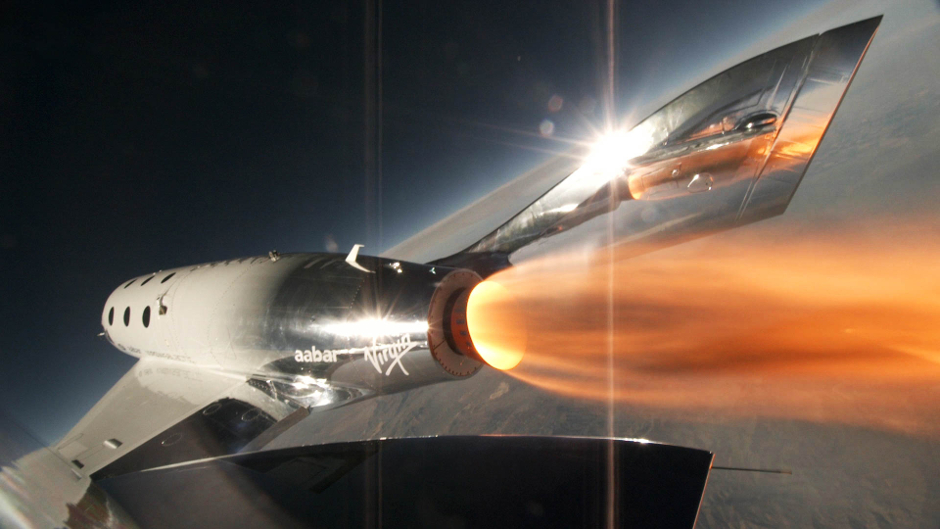
Virgin Galactic’s SpaceShipTwo suborbital spaceplane, VSS Unity, on the Unity 25 test flight May 25. Credit: Virgin Galactic

“The big move we’re making here is pivoting the resources that have been put into the Unity flights and redirecting them over to get the Delta ships done with the cash we have on hand,” he said later in the call.

Colglazier said that for the remaining flights, Virgin Galactic will concentrate on higher revenue opportunities. That includes research, which offers more revenue per seat than private astronauts. He said some seats might be sold to private astronauts who are willing to pay a “premium price” of up to $1 million each, versus the current price of $450,000.

Once Unity flights end, he said company staff who work on the vehicles at Spaceport America in New Mexico will go to a new factory near Phoenix the company expects to complete in the second quarter of 2024 to help with the assembly of the first Delta-class vehicles. Doing so, he said, will help with company resources and give personnel experience with the spaceplanes before test flights begin in 2025.

Those layoffs and other cost-cutting measures, along with a sale of stock in an “at-the-market” deal in the third quarter, should give the company enough funding to complete development of the first two Delta vehicles and begin commercial flights in 2026, the company concluded. Virgin Galactic ended the quarter with $1.1 billion of cash and equivalents on hand.

He said the company projected that the Delta-class vehicles will be able to fly twice a week, versus the monthly cadence of Unity flights. With the Delta vehicles able to carry six customers versus four on Unity, each Delta vehicle will be able to produce 12 times as much revenue per month as Unity.

That is key, executives said, in enabling the company to achieve a positive cash flow in 2026, with the increased revenues from Delta flights and a reduction in expenses from the end of the vehicles’ development.

“We project we have sufficient capital to build the revenue-generating assets necessary to achieve positive free cash flow,” said Doug Ahrens, the chief financial officer of Virgin Galactic. He added there is still $113 million available in its at-the-market stock offering it can sell for additional funding.

Virgin Galactic reported $1.7 million in revenue in the third quarter from its spaceflight as well as “membership fees” from customers, and projects $3 million in revenue in the fourth quarter. The company had a net loss of $105 million in the third quarter.
Автор: Jackkat на 6:33 PM No comments:
Email ThisBlogThis!Share to XShare to FacebookShare to Pinterest
Ярлыки: Virgin Galactic, VSS Unity

Tuesday, June 23, 2020

Virgin Galactic signs agreement with NASA

Virgin Galactic announced Monday an agreement with NASA allowing it to develop a private astronaut readiness program for trips to the International Space Station. NASA said it hopes the agreement will encourage more commercial participation in low Earth orbit. Under the agreement, Virgin Galactic will develop the program similar to one it has to prepare space tourists for its own flights. The company said it could buy seats on flights to the space station, were private citizens could travel to the space station along with assisting scientific research. Some 603 "space tourists" have made reservations to fly on Virgin Galactic from $200,000 to $250,000 per person. "We are excited to partner with NASA on this private orbital spaceflight program, which will not only allow us to use our spaceflight platform but also offer our space training infrastructure to NASA and other agencies," George Whitesides, chief executive officer of Virgin Galactic said in a statement. "Based on the unsurpassed levels of spaceflight customer commitments we have secured to date, we are proud to share that insight in helping to grow another market for the new space economy. We want to bring the planetary perspective to many thousands of people, Whitesides said. NASA Administrator Jim Bridenstine suggested an agreement was close on Friday, saying on Twitter it would issue a request for information.


"NASA is developing the process to fly astronauts on commercial suborbital spacecraft," Bridenstine said. "Whether it's suborbital, orbital or deep space, NASA will utilize our nation's innovative commercial capabilities. RFI will be released next week."
Автор: Jackkat на 4:23 AM No comments:
Email ThisBlogThis!Share to XShare to FacebookShare to Pinterest
Ярлыки: NASA, Virgin Galactic

Friday, July 13, 2018

First space tourist flights could come in 2019

The two companies leading the pack in the pursuit of space tourism say they are just months away from their first out-of-this-world passenger flights -- though neither has set a firm date. Virgin Galactic, founded by British billionaire Richard Branson, and Blue Origin, by Amazon creator Jeff Bezos, are racing to be the first to finish their tests -- with both companies using radically different technology. Neither Virgin nor Blue Origin's passengers will find themselves orbiting the Earth: instead, their weightless experience will last just minutes. It's an offering far different from the first space tourists, who paid tens of millions of dollars to travel to the International Space Station (ISS) in the 2000s. Having paid for a much cheaper ticket -- costing $250,000 with Virgin, as yet unknown with Blue Origin -- the new round of space tourists will be propelled dozens of miles into the atmosphere, before coming back down to Earth. By comparison, the ISS is in orbit 250 miles (400 kilometers) from our planet. The goal is to approach or pass through the imaginary line marking where space begins -- either the Karman line, at 100 kilometers or 62 miles, or the 50-mile boundary recognized by the US Air Force.


At this altitude, the sky looks dark and the curvature of the earth can be seen clearly.

- Virgin Galactic -

With Virgin Galactic, six passengers and two pilots are boarded onto SpaceShipTwo VSS Unity, which resembles a private jet.

The VSS Unity will be attached to a carrier spacecraft -- the WhiteKnightTwo -- from which it will then detach at around 49,000 feet (15,000 meters.) Once released, the spaceship will fire up its rocket, and head for the sky.

Then, the passengers will float in zero-gravity for several minutes, before coming back to Earth.

The descent is slowed down by a "feathering" system that sees the spacecraft's tail pivot, as if arching, before returning to normal and gliding to land at Virgin's "spaceport" in the New Mexico desert.

In total, the mission lasts between 90 minutes and two hours. During a May 29 test in California's Mojave desert, the spaceship reached an altitude of 21 miles, heading for space.

In October 2014, the Virgin spaceship broke down in flight due to a piloting error, killing one of two pilots on board. The tests later resumed with a new craft.

The company has now also reached a deal to open a second "spaceport" at Italy's Tarente-Grottaglie airport, in the south of the country.

Branson in May told BBC Radio 4 that he hoped to himself be one of the first passengers in the next 12 months. About 650 people make up the rest of the waiting list, Virgin told AFP.

- Blue Origin -

Blue Origin, meanwhile, has developed a system closer to the traditional rocket: the New Shepard.

On this journey, six passengers take their place in a "capsule" fixed to the top of a 60-foot-long rocket. After launching, it detaches and continues its trajectory several miles toward the sky. During an April 29 test, the capsule made it 66 miles.

After a few minutes of weightlessness, during which passengers can take in the view through large windows, the capsule gradually falls back to earth with three large parachutes and retrorockets used to slow the spacecraft.

From take-off to landing, the flight took 10 minutes during the latest test.

Until now, tests have only been carried out using dummies at Blue Origin's West Texas site.

But one of its directors, Rob Meyerson, said in June the first human tests would come "soon."

Meanwhile, another company official, Yu Matsutomi, said during a conference Wednesday that the first tests with passengers would take place "at the end of this year," according to Space News.

- What's next? -

SpaceX and Boeing are developing their own capsules to transport NASA astronauts, most likely in 2020, after delays -- a significant investment that the companies will likely make up for by offering private passenger flights.

"If you're looking to go to space, you'll have quadruple the menu of options that you ever had before," Phil Larson, assistant dean at the University of Colorado, Boulder's College of Engineering and Applied Science, told AFP.

Longer term, the Russian firm that manufactures Soyuz rockets is studying the possibility of taking tourists back to the ISS. And a US start-up called Orion Span announced earlier this year it hopes to place a luxury space hotel into orbit within a few years -- but the project is still in its early stages.
Автор: Jackkat на 5:24 AM No comments:
Email ThisBlogThis!Share to XShare to FacebookShare to Pinterest
Ярлыки: Blue Origin, International Space Station, Richard Branson, space tourism, Virgin Galactic

Friday, April 6, 2018

Virgin Galactic completes first rocket-powered Unity space craft launch

Virgin Galactic successfully launched and landed its Unity spacecraft by rocket power, completing its first powered flight in almost four years. Richard Branson's space company shared a photo of the SpaceShipTwo model spacecraft as it blasted into the air above the Mojave Air and Space Port before going supersonic and landing safely. "VSS Unity completed her first supersonic, rocket-powered flight this morning in Mojave, California. Another great test flight, another step closer to being," Virgin Galactic wrote on Twitter. Unity took off at about 8:02 a.m. as it was propelled to an altitude of 46,500 feet by the WhiteKnightTwo carrier aircraft, VMS Eve. Eve then released Unity from under its wing and the SpaceShipTwo's pilots Mark Stucky and Dave Mackay brought the spacecraft's engines to life and propelled it into an 80 degree climb, accelerating to Mach 1.87 during the 30 seconds of rocket burn. "On rocket shutdown, Unity continued an upwards coast to an apogee of 84,271 feet before readying for the downhill return," Virgin Galactic said.


Once the spacecraft began to descend, the pilots raised its tail booms to a 60 degree angle from the fuselage into the "feathered" configuration, which was adopted after fatal 2014 VSS Enterprise test flight crash.

At 50,000 feet, the tail-booms were lowered again and the Unity glided toward a safe landing on the runway.

"The flight has generated valuable data on flight, motor and vehicle performance which our engineers will be reviewing," Virgin Galactic said. "It also marks a key moment for the test flight program, entering now the exciting phase of powered flight and the expansion to full duration rocket burns."

The newest SpaceShipTwo model was unveiled in February 2016, when the late professor Stephen Hawking gave the ship the name "Unity."

In the future Virgin Galactic's spacecraft will take passengers 68 miles above the Earth's surface for a price of $250,000.
Автор: Jackkat на 12:44 PM No comments:
Email ThisBlogThis!Share to XShare to FacebookShare to Pinterest
Ярлыки: Richard Branson, spacecraft, Virgin Galactic, VSS Unity

Sunday, February 18, 2018

Launch Reservation with Open Cosmos

Vector, a nanosatellite launch company comprised of new-space and enterprise software industry veterans from SpaceX, Virgin Galactic, McDonnell Douglas, Boeing, Sea Launch and VMware and Open Cosmos, a space mission provider, has announced an agreement to reserve five orbital launches between 2019 and 2023 on the Vector-R launch vehicle. The announcement comes in advance of Vector's first orbital launch in July. "This agreement with Open Cosmos continues our ongoing efforts to partner with a broad network of customers, and signals the start of a new frontier for Vector as we prepare for our first orbital mission this summer," said Jim Cantrell, CEO and co-founder of Vector. "Open Cosmos' mission to provide simple and affordable access to space is one that very closely aligns with Vector's, and we look forward to having them along our journey as we continue breaking down the barriers to access space faced by many."


Based in the United Kingdom, Open Cosmos provides end-to-end mission services enabling its clients to focus on in-orbit data. This one-stop-shop to orbit allows companies to have dedicated nanosatellite missions for remote sensing payloads, IoT/telecommunication services, scientific research, or space technology in-orbit demonstrations.

Open Cosmos manufactures its satellites in-house, procures launch services from partners like Vector, and operates qbee fleets using its own satellite operations system while leveraging existing ground segment infrastructure.

"This agreement secures our ability to provide dedicated, affordable launch options to our customers," said Rafel Jorda-Siquier, CEO and founder of Open Cosmos.

"Following the qbee nanosatellite deployment in LEO early April 2017, we've been building a strong commercial pipeline of customers looking to get their payload to orbit and start generating revenues fast and under budget. Vector's launch cadence and aggressive prices allows us to provide increased affordable schedule certainty to our time-to-market sensitive customers."

Vector will begin construction on its state-of-the-art rocket factory in Pima County, Ariz. later this year, designed to produce up to 100 launch vehicles per year to start. Throughout 2018, Vector will be testing major elements of its Vector-R launch vehicle leading up to the July orbital launch.
Автор: Jackkat на 12:43 PM No comments:
Email ThisBlogThis!Share to XShare to FacebookShare to Pinterest
Ярлыки: Boeing, McDonnell Douglas, Open Cosmos, rocket, Sea Launch, space, SpaceX, Vector-R, Virgin Galactic, VMware
Older Posts Home
Subscribe to: Posts (Atom)

Popular Posts

  • NASA's emerging microgap cooling to be tested aboard New Shepard
    An emerging technology for removing excessive, potentially damaging heat from small, tightly packed instrument electronics and other spacef...
  • We may have just seen the first comet from another solar system
    The solar system may be hosting a visitor from the stars. A newly discovered comet is screaming away from Earth, and based on its weird orb...
  • Artemis I progresses toward launch
    The flight hardware has been built, the launch facilities are ready, and NASA and its industry partners are checking off final milestones f...
  • One Small Step: Massive Stratolaunch Aircraft Conducts First Taxi Tests
    Scaled Composites' Stratolaunch, the world's widest plane intended to take rockets to the stratosphere for launch, underwent its fi...
  • Russia to deliver US new rocket engines
    The US government is slated to receive one of two batches of Russian-made rocket engines in the second quarter of 2018, according to a lead...
  • Airbus wins DARPA contract to develop smallsat bus for Blackjack program
    Airbus Defense and Space Inc. has been awarded a contract from the Defense Advanced Research Projects Agency (DARPA) to develop a satellite...
  • Airbus selected by ESA for EGNOS V3 program
    Airbus has been selected by the European Space Agency (ESA) as the prime contractor to develop EGNOS V3, the next generation of the Europea...
  • ArianeGroup to start production of the first Ariane 62
    With the successful conclusion of Maturity Gate 6.2, ArianeGroup and its industrial partners are moving into an important new phase in the ...
  • China attracts moon base partners, outlines project timelines
    China says a number of countries have committed to join its International Lunar Research Station moon base initiative. Russia, Pakistan, the...
  • A New Approach for Detecting Planets in the Alpha Centauri System
    Yale astronomers have taken a fresh look at the nearby Alpha Centauri star system and found new ways to narrow the search for habitable pla...

My Blog List

  • Космические новости
    Обнаружен новый тип астрономического объекта — облако, которое не смогло стать галактикой
  • Рыбалка в Украине
    Фидерная ловля леща в мае
  • Самые страшные хищники Земли
    Найдены пауки возрастом 110 млн лет со светящимися глазами
  • Современная техника
    В метро Санкт-Петербурга прогремел мощный взрыв
  • Лучшие места мира
    Алеутский хребет
  • Хоккей в Украине
    В Украине создали новую хоккейную лигу
  • "FORD" cars
    Ford Mondeo vs VW Passat 2015
  • Украинские университеты
    Киевский университет туризма, экономики и права (КУТЭП)
  • Авиакомпании мира
    BA CityFlyer (БиЭй Ситифлаер)
  • Forex Trading
    Software for trading (signals, advisers, robots)
  • Рыбалка в Монголии
    Рыбалка на трофейного хариуса в Монголии
  • My IOFFER
    Kalaideng Royale S PU Leather Skin Case For Iphone 5S
  • Fishing in Canada
    Fishing industry in Canada

About Me

Jackkat
View my complete profile

Blog Archive

  • ▼  2024 (41)
    • ▼  October (1)
      • NASA's exoplanet hunter TESS spots a record-breaki...
    • ►  September (3)
    • ►  August (3)
    • ►  July (2)
    • ►  June (1)
    • ►  April (5)
    • ►  March (8)
    • ►  February (7)
    • ►  January (11)
  • ►  2023 (101)
    • ►  December (6)
    • ►  November (6)
    • ►  October (7)
    • ►  September (2)
    • ►  August (7)
    • ►  July (11)
    • ►  June (8)
    • ►  May (8)
    • ►  April (12)
    • ►  March (14)
    • ►  February (11)
    • ►  January (9)
  • ►  2022 (57)
    • ►  December (13)
    • ►  November (7)
    • ►  October (6)
    • ►  September (6)
    • ►  August (5)
    • ►  July (2)
    • ►  June (3)
    • ►  May (3)
    • ►  April (5)
    • ►  March (1)
    • ►  February (3)
    • ►  January (3)
  • ►  2021 (70)
    • ►  December (4)
    • ►  November (2)
    • ►  October (2)
    • ►  September (3)
    • ►  August (5)
    • ►  July (4)
    • ►  June (5)
    • ►  May (5)
    • ►  April (10)
    • ►  March (8)
    • ►  February (9)
    • ►  January (13)
  • ►  2020 (168)
    • ►  December (4)
    • ►  November (8)
    • ►  October (4)
    • ►  September (8)
    • ►  August (16)
    • ►  July (22)
    • ►  June (28)
    • ►  May (26)
    • ►  April (24)
    • ►  March (13)
    • ►  February (7)
    • ►  January (8)
  • ►  2019 (132)
    • ►  December (8)
    • ►  November (13)
    • ►  October (15)
    • ►  September (16)
    • ►  August (14)
    • ►  July (8)
    • ►  June (3)
    • ►  May (7)
    • ►  April (11)
    • ►  March (16)
    • ►  February (16)
    • ►  January (5)
  • ►  2018 (226)
    • ►  December (1)
    • ►  November (30)
    • ►  October (35)
    • ►  September (28)
    • ►  August (26)
    • ►  July (23)
    • ►  June (16)
    • ►  May (5)
    • ►  April (16)
    • ►  March (14)
    • ►  February (17)
    • ►  January (15)
  • ►  2017 (31)
    • ►  December (22)
    • ►  November (3)
    • ►  October (3)
    • ►  June (2)
    • ►  May (1)
  • ►  2015 (29)
    • ►  July (2)
    • ►  June (17)
    • ►  May (10)

Subscribe To

Posts
Atom
Posts
All Comments
Atom
All Comments

Счетчики

bigmir)net

Total Pageviews

Awesome Inc. theme. Powered by Blogger.