Monday, April 9, 2018

Giant solar tornadoes put researchers in a spin

Despite their appearance solar tornadoes are not rotating after all, according to a European team of scientists. A new analysis of these gigantic structures, each one several times the size of the Earth, indicates that they may have been misnamed because scientists have so far only been able to observe them using 2-dimensional images. Dr Nicolas Labrosse will present the work, carried out by researchers at the University of Glasgow, Paris Observatory, University of Toulouse, and Czech Academy of Sciences, at the European Week of Astronomy and Space Science (EWASS) in Liverpool on Friday 6 April. Solar tornadoes were first observed in the early 20th century, and the term was re-popularised a few years ago when scientists looked at movies obtained by the AIA instrument on the NASA Solar Dynamics Observatory (SDO). These show hot plasma in extreme ultraviolet light apparently rotating to form a giant structure taking the shape of a tornado (as we know them on Earth). Now, using the Doppler effect to add a third dimension to their data, the scientists have been able to measure the speed of the moving plasma, as well as its direction, temperature and density. Using several years' worth of observations, they were able to build up a more complete picture of the magnetic field structure that supports the plasma, in structures known as prominences.


Dr Nicolas Labrosse, lead scientist in the study, explains: "We found that despite how prominences and tornadoes appear in images, the magnetic field is not vertical, and the plasma mostly moves horizontally along magnetic field lines. However we see tornado-like shapes in the images because of projection effects, where the line of sight information is compressed onto the plane of the sky."

Dr Arturo Lopez Ariste, another member of the team, adds: "The overall effect is similar to the trail of an aeroplane in our skies: the aeroplane travels horizontally at a fixed height, but we see that the trail starts above our heads and ends up on the horizon. This doesn't mean that it has crashed!"

Giant solar tornadoes - formally called tornado prominences - have been observed on the Sun for around a hundred years. They are so called because of their striking shape and apparent resemblance to tornadoes on Earth, but that is where the comparison ends.

Whereas terrestrial tornadoes are formed from intense winds and are very mobile, solar tornadoes are instead magnetized gas. They seem to be rooted somewhere further down the solar surface, and so stay fixed in place.

"They are associated with the legs of solar prominences - these are beautiful concentrations of cool plasma in the very hot solar corona that can easily be seen as pink structures during total solar eclipses," adds Labrosse.

"Perhaps for once the reality is less complicated than what we see!" comments Dr Brigitte Schmieder, another scientist involved in the work.

She continues: "Solar tornadoes sound scary but in fact they normally have no noticeable consequences for us. However, when a tornado prominence erupts, it can cause what's known as space weather, potentially damaging power, satellite and communication networks on Earth."

Sunday, April 8, 2018

Deep Space Industries to provide Comet satellite propulsion for BlackSky, LeoStella

Deep Space Industries (DSI) has signed a contract to provide its Comet water-based satellite propulsion systems for the BlackSky Earth observation constellation of smallsats. DSI will provide an initial block of 20 water thrusters for the BlackSky satellites which are scheduled to start launching later this year. This announcement comes on the heels of Spaceflight Industries' recent $150 million funding and the development of LeoStella LLC, a joint venture between Spaceflight Industries and Thales Alenia Space. LeoStella is developing a Seattle-based facility to manufacture the low-cost, high-performance BlackSky satellites and is tasked with building the next 20 spacecraft with the Comet propulsion technology between now and 2020. These smallsats are part of an ultimate constellation of 60 satellites that provide high revisit rate Earth imagery and when combined with other space and terrestrial based sensors, will enable delivery of innovative global monitoring solutions and geospatial activity-based intelligence services. "The launch-safe propulsion features of the Comet system are well aligned with BlackSky's performance needs to enable affordable and flexible satellite systems," said Nick Merski, vice president of space operations, Spaceflight Industries. "We're looking forward to working with the DSI team on this and future projects."


"Customers like LeoStella are exactly why we developed the Comet propulsion system," said William Miller, chief executive officer of Deep Space Industries.

Comet is the first propulsion system in Deep Space Industries' line of green propulsion solutions designed for small satellites. While other propulsion systems use either high-pressure or toxic propellants, DSI propulsion systems are designed to be low-pressure, non-toxic, and therefore launch-safe, while still offering suitable performance for small satellites.

Comet is ride-share compatible, easy to work with, and customizable for many mission types and size. Furthermore, and in the context of DSI's longer-term goals, all its propulsion systems use propellants that can be sourced from space resources.

Friday, April 6, 2018

Virgin Galactic completes first rocket-powered Unity space craft launch

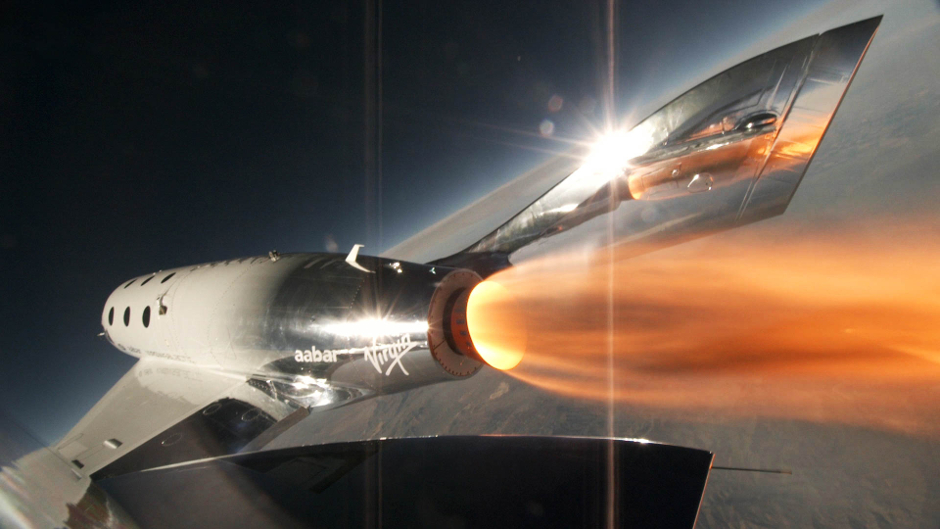
Virgin Galactic successfully launched and landed its Unity spacecraft by rocket power, completing its first powered flight in almost four years. Richard Branson's space company shared a photo of the SpaceShipTwo model spacecraft as it blasted into the air above the Mojave Air and Space Port before going supersonic and landing safely. "VSS Unity completed her first supersonic, rocket-powered flight this morning in Mojave, California. Another great test flight, another step closer to being," Virgin Galactic wrote on Twitter. Unity took off at about 8:02 a.m. as it was propelled to an altitude of 46,500 feet by the WhiteKnightTwo carrier aircraft, VMS Eve. Eve then released Unity from under its wing and the SpaceShipTwo's pilots Mark Stucky and Dave Mackay brought the spacecraft's engines to life and propelled it into an 80 degree climb, accelerating to Mach 1.87 during the 30 seconds of rocket burn. "On rocket shutdown, Unity continued an upwards coast to an apogee of 84,271 feet before readying for the downhill return," Virgin Galactic said.


Once the spacecraft began to descend, the pilots raised its tail booms to a 60 degree angle from the fuselage into the "feathered" configuration, which was adopted after fatal 2014 VSS Enterprise test flight crash.

At 50,000 feet, the tail-booms were lowered again and the Unity glided toward a safe landing on the runway.

"The flight has generated valuable data on flight, motor and vehicle performance which our engineers will be reviewing," Virgin Galactic said. "It also marks a key moment for the test flight program, entering now the exciting phase of powered flight and the expansion to full duration rocket burns."

The newest SpaceShipTwo model was unveiled in February 2016, when the late professor Stephen Hawking gave the ship the name "Unity."

In the future Virgin Galactic's spacecraft will take passengers 68 miles above the Earth's surface for a price of $250,000.

Wednesday, April 4, 2018

Here, There and Everywhere: Across the Universe with the Beatles

The Beatles are one of the greatest cultural phenomena to come from the 20th Century, yet many people are unaware of their impact on science. In 'Here, There and Everywhere', inspired by the book 'La scienza dei Beatles' ('The science of the Beatles'), Viviana Ambrosi shows how the Fab Four can bring the study of celestial objects and the exploration of the universe closer to a large public audience. This is set out in a presentation on 3rd April at the European Week of Astronomy and Space Science in Liverpool. The Beatles formed at the start of the space race, and have always inspired scientists, whether they knew it or not. The Beatles' record company (EMI) used money from the sale of the White Album to fund scientific research. Some of which went towards Godfrey Hounsfield's research into X-rays, which led to the invention of the CT scanner, for which he shared a Nobel Prize.


'Across the Universe' was transmitted into deep space in 2008, and numerous songs have been played as the wakeup call for astronauts on the International Space Station, including a live musical wake up by Paul McCartney in 2005.

There are five asteroids named: Beatles, Lennon, McCartney, Harrison, and Starr. There is also a crater on Mercury named 'Lennon', and when a diamond star (a white dwarf covered in crystallised carbon) was discovered in 2004, it was nicknamed 'Lucy' after 'Lucy in the Sky with Diamonds'.

This was also the inspiration for 'Lucy', the fossil that rewrote the story of humanity, and this in turn has inspired NASA to name their first mission to Jupiter's Trojan asteroids 'Lucy'.

This mission is due to launch in 2021 and will take 12 years to complete its journey. It is safe to say that the Beatles will be an inspiration for many years to come.

Tuesday, April 3, 2018

Is there life adrift in the clouds of Venus?

In the search for extraterrestrial life, scientists have turned over all sorts of rocks. Mars, for example, has geological features that suggest it once had - and still has - subsurface liquid water, an almost sure prerequisite for life. Scientists have also eyed Saturn's moons Titan and Enceladus as well as Jupiter's moons Europa, Ganymede and Callisto as possible havens for life in the oceans under their icy crusts. Now, however, scientists are dusting off an old idea that promises a new vista in the hunt for life beyond Earth: the clouds of Venus. In a paper published online in the journal Astrobiology, an international team of researchers led by planetary scientist Sanjay Limaye of the University of Wisconsin-Madison's Space Science and Engineering Center lays out a case for the atmosphere of Venus as a possible niche for extraterrestrial microbial life. "Venus has had plenty of time to evolve life on its own," explains Limaye, noting that some models suggest Venus once had a habitable climate with liquid water on its surface for as long as 2 billion years. "That's much longer than is believed to have occurred on Mars."


On Earth, terrestrial microorganisms - mostly bacteria - are capable of being swept into the atmosphere, where they have been found alive at altitudes as high as 41 kilometers (25 miles) by scientists using specially equipped balloons, according to study co-author David J. Smith of NASA's Ames Research Center.

There is also a growing catalog of microbes known to inhabit incredibly harsh environments on our planet, including the hot springs of Yellowstone, deep ocean hydrothermal vents, the toxic sludge of polluted areas, and in acidic lakes worldwide.

"On Earth, we know that life can thrive in very acidic conditions, can feed on carbon dioxide, and produce sulfuric acid," says Rakesh Mogul, a professor of biological chemistry at California State Polytechnic University, Pomona, and a co-author on the new paper. He notes that the cloudy, highly reflective and acidic atmosphere of Venus is composed mostly of carbon dioxide and water droplets containing sulfuric acid.

The habitability of Venus' clouds was first raised in 1967 by noted biophysicist Harold Morowitz and famed astronomer Carl Sagan. Decades later, the planetary scientists David Grinspoon, Mark Bullock and their colleagues expanded on the idea.

Supporting the notion that Venus' atmosphere could be a plausible niche for life, a series of space probes to the planet launched between 1962 and 1978 showed that the temperature and pressure conditions in the lower and middle portions of the Venusian atmosphere - altitudes between 40 and 60 kilometers (25-27 miles) - would not preclude microbial life. The surface conditions on the planet, however, are known to be inhospitable, with temperatures soaring above 450 degrees Celsius (860 degrees Fahrenheit).

Limaye, who conducts his research as a NASA participating scientist in the Japan Aerospace Exploration Agency's Akatsuki mission to Venus, was eager to revisit the idea of exploring the planet's atmosphere after a chance meeting at a teachers' workshop with paper co-author Grzegorz Slowik of Poland's University of Zielona Gora. Slowik made him aware of bacteria on Earth with light-absorbing properties similar to those of unidentified particles that make up unexplained dark patches observed in the clouds of Venus. Spectroscopic observations, particularly in the ultraviolet, show that the dark patches are composed of concentrated sulfuric acid and other unknown light-absorbing particles.

Those dark patches have been a mystery since they were first observed by ground-based telescopes nearly a century ago, says Limaye. They were studied in more detail by subsequent probes to the planet.

"Venus shows some episodic dark, sulfuric rich patches, with contrasts up to 30-40 percent in the ultraviolet, and muted in longer wavelengths. These patches persist for days, changing their shape and contrasts continuously and appear to be scale dependent," says Limaye.

"Venus has had plenty of time to evolve life on its own," explains Limaye, noting that some models suggest Venus once had a habitable climate with liquid water on its surface for as long as 2 billion years. "That's much longer than is believed to have occurred on Mars."

The particles that make up the dark patches have almost the same dimensions as some bacteria on Earth, although the instruments that have sampled Venus' atmosphere to date are incapable of distinguishing between materials of an organic or inorganic nature.

The patches could be something akin to the algae blooms that occur routinely in the lakes and oceans of Earth, according to Limaye and Mogul - only these would need to be sustained in the Venusian atmosphere.

Limaye, who has spent his career studying planetary atmospheres, was further inspired to revisit the idea of microbial life in the clouds of Venus by a visit to Tso Kar, a high-altitude salt lake in northern India where he observed the powdery residue of sulfur-fixing bacteria concentrated on decaying grass at the edge of the lake being wafted into the atmosphere.

Limaye notes, however, that a part of the equation that isn't known is when Venus' liquid water evaporated - extensive lava flows in the last billion years likely have either destroyed or covered up the planet's earlier terrestrial history.

In the hunt for extraterrestrial life, planetary atmospheres other than Earth's remain largely unexplored.

One possibility for sampling the clouds of Venus, says Limaye, is on the drawing board: VAMP, or Venus Atmospheric Maneuverable Platform, a craft that flies like a plane but floats like a blimp and could stay aloft in the planet's cloud layer for up to a year gathering data and samples.

Such a platform could include instruments like Raman Lidar, meteorological and chemical sensors, and spectrometers, says Limaye. It could also carry a type of microscope capable of identifying living microorganisms.

"To really know, we need to go there and sample the clouds," says Mogul. "Venus could be an exciting new chapter in astrobiology exploration."

The Wisconsin scientist and his colleagues remain hopeful that such a chapter can be opened as there are ongoing discussions about possible NASA participation in Russia's Roscosmos Venera-D mission, now slated for the late 2020s. Current plans for Venera-D might include an orbiter, a lander and a NASA-contributed surface station and maneuverable aerial platform.