SpaceLink announced plans Feb. 17 to work with Axiom Space to conduct the first demonstration of its space data relay service on the International Space Station. The Center for the Advancement of Science in Space, manager of the ISS National Laboratory, awarded McLean, Virginia-based SpaceLink a contract to demonstrate data transmission from the Space Station through optical terminals at a rate of 10 gigabits per second. Once that contract was finalized, SpaceLink awarded Axiom a subcontract to support mission integration, launch and operations. Axiom also will serve as SpaceLink’s liaison with NASA, ensuring SpaceLink hardware meets stringent ISS safety requirements. SpaceLink CEO Dave Bettinger called the demonstration, scheduled for 2024, “an excellent validation to show data rates to the ISS that I believe are potentially one or two orders of magnitude higher than what they’ve seen.” OHB System AG is manufacturing four satellites, which it plans to send to medium Earth orbit in 2024, to relay data for government and commercial customers. The planned service is similar to what NASA provides today through the Tracking and Data Relay Satellite constellation in geostationary orbit. “We see it as a an important milestone for us to show NASA and the world that we are going to be able to provide the services in space that commercial, government and international entities will be using in the future,” Bettinger told.
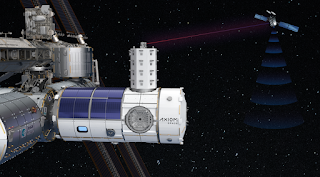
This illustration shows SpaceLink’s optical terminal mounted on the first module of the future Axiom Station. SpaceLink plans to establish a satellite constellation in medium Earth orbit to relay radio frequency and optical data between satellites in low Earth orbit and the ground. Credit: SpaceLinkAxiom won a NASA contract in 2020 to develop a commercial module for the Space Station. Axiom also is planning a series of commercial ISS missions.
“High-speed communication will be a critical component for the future where people live and work in space,” Michael Suffredini, Axiom president and CEO, said in a statement. “Axiom looks forward to collaborating with SpaceLink and supporting its relay network, beginning with this important demonstration on the ISS.”
SpaceLink plans to conduct the data relay demonstration in 2024 after testing in-orbit testing of its communications satellites.
NASA is preparing to hand off to industry the job of providing communications for dozens of spaceflight missions including ISS. Like transportation of crew and cargo to the ISS and cargo delivery to the moon, NASA sees communications in Earth orbit as a job commercial companies can take over.
“NASA has done a great job of going commercial where it makes sense and saved a lot of money on that,” Bettinger said. “We see this as a perfect example. We’re very proud to be a part of the CASIS project.”
Launcher has purchased slots on three more SpaceX rideshare missions for its Orbiter tug as it continues development of a small launch vehicle. Launcher announced Feb. 7 it signed a multi-launch contract with SpaceX for three additional missions of its Orbiter tug. Those tugs will fly on Falcon 9 rideshare missions in January, April and October of 2023. Launcher’s first Orbiter tug will launch on SpaceX’s Transporter-6 rideshare mission in October 2022 under a contract announced last June when the company revealed its plans to develop Orbiter. The vehicle is designed to deploy cubesats and other smallsats in their desired orbits as well as host payloads for missions lasting up to two years. “We have chosen SpaceX to be our provider in 2023 and beyond, due to their incredible reliability, performance, industry-leading price, and mission flexibility, which allows us to provide the lowest-cost Orbiter mission services to our customers,” Max Haot, chief executive of Launcher, said in a statement. Launcher offers launch and orbit transfer services for smallsats for between $8,000 and $25,000 per kilogram, depending on mission requirements. It also will sell a dedicated Orbiter mission for $400,000 plus SpaceX flight costs.
Orbiter, an orbital transfer vehicle being developed by Launcher, will be able to carry up to 90U of cubesats or other smallsats, and fly on both Launcher Light and SpaceX's Falcon 9. Credit: Launcher
The company development of Orbiter is on track for its first mission this fall. The company recently announced a series of tests of the vehicle’s main engine, a thruster that uses ethane and nitrous oxide as propellants, including one test where the engine was fired for two and a half minutes.
Orbiter is one of several vehicles designed to provide “last mile” in-space transportation services for smallsats launched on rideshare missions like SpaceX, moving satellites from an initial transfer orbit provided by the rideshare launch to their final orbits. D-Orbit, Momentus and Spaceflight are among the other companies that are developing or have flown similar vehicles.
Launcher developed Orbiter not just for rideshare missions on larger vehicles but also for its own Launcher Light small launch vehicle in development. Haot told SpaceNews that the company was making “great progress” in testing of the E-2 engine that powers the vehicle’s first stage and that the first launch of the vehicle is scheduled for March 2024.
ABL Space Systems says a test incident that destroyed the upper stage of its RS1 rocket last week will delay that vehicle’s first flight by three months as it identifies and corrects the failure’s root cause. ABL was in the middle of a test campaign for the RS1 upper stage built for its first launch when an anomaly destroyed the stage during a Jan. 19 static firing at the Mojave Air and Space Port in California. The accident created a dramatic plume of black smoke and prompted a response from local firefighters, but there were no injuries reported and no damage outside of the location where the stage was being tested. Harry O’Hanley, chief executive of ABL, told SpaceNews that the stage’s E2 Vacuum engine suffered a “hard start” in the hot gas circuit of its turbopump. A hard start is when the flow of propellants and ignition fluid in an engine doesn’t allow for a gradual increase in energy, but instead an explosive rise. Hard starts can damage or destroy rocket engines. In the case of this test, O’Hanley said, the hard start caused “a substantial fire on the aft end of the vehicle, resulting in a complete failure about 20 seconds later.” No personnel were near the test stand at the time of the incident, and there no significant damage to three adjacent test cells at the site. Since the accident, engineers have been examining data to work through the fault tree to determine the root cause. “It appears that the failure was a result of multiple risk factors combining in an improbable way,” he said, although the company declined to comment on those risk factors while the investigation is still in progress. “This explains why we haven’t observed the failure after over 80 starts and 3,000 seconds of hot fire testing of the flight-design E2 engine over the past six months.”
A nominal static-fire test of ABL Space System's RS1 upper stage on Jan. 7. A similar test Jan. 19 resulted in a "hard start" of the engine that destroyed the stage. Credit: ABL Space Systems
Dan Piemont, president of ABL, said the company did see some small hard starts during earlier testing of the engine that caused minor damage. “Those were each traced to a simple cause, fairly typical engine R&D events,” he said. “The failure last week was larger and more complex.”
The company is work on what O’Hanley described as “manufacturing and operational improvements” to the E2 engine to reduce the chance that fuel could leak into the turbopump and cause a hard start. “We’re also implementing some simple changes to reduce the probability of an off-nominal startup.”
The incident took place in the seventh in a series of hot-fire tests of the stage in Mojave. The overall test campaign started in December with a series of fill-and-drain, cold flow and ignition tests, followed by the hot-fire tests. Piemont said that, at the time of the anomaly, at least five more tests were planned before the company completed the test campaign.
That upper stage was being tested ahead of the first RS1 launch from Kodiak Island, Alaska. “After some final engine design changes were identified last summer, we set an aggressive schedule to try to launch by the end of 2021,” Piemont said. “Our schedule slipped a bit in past few months, but our programs were converging towards a launch from Kodiak in February.”
After the incident, he said the company expects a three-month delay in that first launch. The upper stage being built for the second RS1 launch will now be used for the first launch. The lower stage is complete and currently in storage in Kodiak, while the interstage between the first and second stages is being shipped to Kodiak. The payload fairing has completed acceptance testing and will soon be shipped to the launch site.
“Our strategy in developing RS1 is to rapidly test, iterate and sometimes fail. An engine hard start was a known risk in this campaign,” O’Hanley said. “This strategy has been highly successful in helping us to uncover unknown unknowns and has been the underpinning of our rapid progress over the past three years.”
Blue Origin is buying Honeybee Robotics, a company that develops robotic systems for space and other extreme environments. Honeybee Robotics announced Jan. 25 that its parent company, Ensign-Bickford Industries, was selling it to Blue Origin. Terms of the deal, expected to close in mid-February, were not disclosed. Honeybee Robotics is best known in the space industry for developing robotics systems, notably drills and other mechanisms, for use on space missions. That has included drills and sample collection systems flown on several Mars missions as well as others under development for missions to the moon and NASA’s Dragonfly mission to Saturn’s moon Titan. “Joining Blue Origin is a major step forward for us,” said Kiel Davis, president of Honeybee Robotics, in a statement. “With Blue Origin we look forward to further expanding our capacity to meet the most exciting challenges in next-generation space transportation, space mobility, space destinations, and planetary science and exploration.” “We’re beyond excited to welcome Honeybee Robotics to our team,” Brent Sherwood, senior vice president of advanced development programs at Blue Origin, said in the statement. “We value the company’s brand, talent, unique expertise, and product lines. And we know that together we will make bold things possible.”
Honeybee Robotics has provided components for several NASA missions, such as the sampling system on Phoenix Mars lander's robotic arm. Credit: NASA/JPL-Caltech
Honeybee was founded in New York City in 1983 and started working on NASA projects in 1986. The company now has locations in Colorado and Southern California and, in addition to space, works in terrestrial mining and energy markets as well as defense and other industrial applications. Ensign-Bickford acquired Honeybee in 2017 and, in 2019, combined it with Avior Controls, a manufacturer of space-rated mechanisms.
Blue Origin said it will retain Honeybee as a separate entity and with “no notable changes” to its products or customers. It did not disclose its long-term plans for the company or its technologies, although Blue Origin and its founder, Jeff Bezos, have long discussed using space resources to enable the expansion of humanity into space.
“Over time, the combined capabilities of Honeybee and Blue Origin will create new opportunities, efficiencies, and innovations as they work together to develop space to benefit Earth,” the companies said.
NASA’s safety advisers are calling on the agency to reexamine how it manages human spaceflight programs to reflect the changing relationship with industry and to better run its core exploration effort. The central theme of the annual report of the Aerospace Safety Advisory Panel (ASAP), released Jan. 11, was a need to reexamine the roles and responsibilities of NASA as human spaceflight programs are increasingly managed by industry rather than NASA itself, as was the case for most of the agency’s history. “If these trends continue, which seems likely, the Panel believes it is crucial for NASA to strategically evaluate the path ahead and determine the future shape of the organization,” the report states. “Once the Agency has clarified a vision and strategy, it should then make the decisions, and take the necessary actions, to enable it to accomplish the required transformation.” The panel argued that this was time to address those issues as the agency was at an “inflection point” given both growing commercial capabilities and roles and the agency’s own long-term plans for human missions to the moon and Mars that need to fit within limited budgets. “Consequently, the Agency will need to operate differently—from strategic planning and how it approaches program management, to workforce development, facility maintenance, acquisition strategies, contract types, and partnerships,” it wrote. That transition is within the mandate of ASAP because of the implications such changes have on human spaceflight safety, the panel argued in the report. “The Panel believes that NASA’s vision for the future, and a clear definition of how it will evaluate and make decisions related to risk (in addition to how it will manage and execute programs), are extremely important factors in ensuring human space flight safety.”
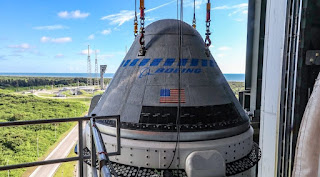
Among the issues raised in the Aerospace Safety Advisory Panel report was a difference in opinion between NASA and Boeing on the risk posed vt stuck propulsion valves in the CST-100 Starliner that the panel said was evidence the two organizations "do not share a common understanding of how to assess and characterize risk." Credit: Boeing/John Grant
The shift to commercial crew transportation has created some specific issues in the last year mentioned in the report. The panel cited a “concerning dissonance” between NASA and SpaceX during preparations for the Crew-1 landing last May. The two organizations “differed in their understanding of the level of risk to be incurred” regarding a nighttime landing of the Crew Dragon spacecraft, with NASA initially preferring a daytime landing as the lowest risk option. SpaceX argued that a nighttime landing was acceptable and offered better sea state conditions than the proposed daytime landing. The report stated that “last-minute communications had been necessary to ensure NASA approved the plans for the night landing.”
There was also a difference of opinion between NASA and Boeing involving the risk of stuck propulsion valves on the company’s CST-100 Starliner that delayed an uncrewed test flight last summer. Boeing evaluated the risk as low, the panel said, while NASA considered it moderate during a flight readiness review. That review, the panel concluded, “revealed NASA and Boeing do not share a common understanding of how to assess and characterize risk.”
The language of the report suggested the issue came up in the flight readiness review held several days before the scheduled launch, while the problem itself was reported only after the launch was scrubbed a few hours before the scheduled liftoff. However, a company spokesman said that the problem was discovered after the flight readiness review, and also played down the difference in opinions highlighted in the ASAP report.
“It is not uncommon to have differences in the risk scoring on the magnitude of various technical issues being addressed at the review. This is because we use different rubrics, or scoring systems, for our risk assessments,” Boeing said in a statement. “Using different assessments can be healthy for the program as it allows management to better understand the total level of risk as the scoring systems look through different lenses to ultimately drive down risk and increase crew safety.”
The panel also took issue with the “disaggregated” way NASA’s exploration efforts are organized. That structure treats the Space Launch System, Orion spacecraft and Exploration Ground Systems as separate programs, which the panel attributes to the uncertain direction of the agency’s exploration programs after the cancellation of the Constellation program more than a decade ago.
“In essence, it appears that the cancellation of the Constellation program has led to a cautious stance among NASA leaders driven by the assumption that having an Apollo-like program now is a problematic political optic, and like Constellation, a possible target for cancellation by a future Administration,” the panel wrote. “In effect, NASA has accepted the disaggregated program structure as normal, and is now propagating this structure as a preferred business and risk management model, even though it is essentially an untried approach for an integrated systems engineering effort of this magnitude and complexity.”
Among the panel’s recommendations was to create an integrated Artemis program led by a single manager “endowed with authority, responsibility, and accountability” along with a bottoms-up approach to systems engineering and integration as well as risk management. NASA sometimes refers to an “Artemis program” today, the panel noted, but without the formal program architecture that risks “confusing both employees and contractors about who is ultimately responsible and accountable.”
The panel recommended NASA establish a “board of directors” consisting of senior NASA Headquarters officials as well as its center directors. The members would examine agency issues outside of their perspectives as heads of programs or centers. It also recommended a strategic vision for the future of space exploration and operations that would look out at least 20 years, including roles for commercial and international partners and its workforce requirements.
“NASA is no longer the sole driver or customer for human space flight capabilities and related technology, nor is it the sole organization creating demand,” the panel stated. “Consequently, it is imperative for NASA leaders to establish a clear vision of the future and an understanding of the Agency’s purpose to anchor its decisions today and tomorrow.”