Monday, May 29, 2023

NASA and Boeing say preparations continue for July Starliner test flight

NASA and Boeing said May 26 they are still working towards a July launch of the CST-100 Starliner on a crewed test flight despite “emerging issues” and concerns raised by a safety panel. In a statement issued just before the close of business ahead of a holiday weekend, the two organizations said they completed a “checkpoint review” May 25 of preparations for the Crew Flight Test (CFT) mission, currently scheduled for no earlier than July 21. Two NASA astronauts, Butch Wilmore and Suni Williams, will fly on CFT to the International Space Station on the short test flight, the first crewed flight of the spacecraft. NASA and Boeing said they have now completed 95% of the certification work needed for CFT. They have also addressed all the anomalies from the Orbital Flight Test (OFT) 2 mission, an uncrewed test flight of Starliner to the ISS one year ago. “We are taking a methodical approach to the first crewed flight of Starliner incorporating all of the lessons learned from the various in-depth testing campaigns,” Steve Stich, NASA commercial crew program manager, said in a statement. “In addition to the closeout of ongoing work, the team remains vigilant on tracking new technical issues as we complete certification for crewed flight.” That statement mentioned “emerging issues that need a path to closure” before NASA and Boeing decide to fuel the spacecraft in June for a July launch. Boeing officials said earlier this year they decided to fuel the spacecraft only within 60 days of launch as a measure to mitigate any fuel leaks that could corrode valves, an issue that delayed an August 2021 launch attempt for OFT-2.

Boeing's CST-100 Starliner being prepared for a crew flight test scheduled for no earlier than July 21. Credit: Boeing/John Grant

Among the issues is swapping out a valve in the thermal control system in the spacecraft’s service module, which was reducing flow in one of two redundant loops that cool the vehicle’s avionics. The valve replacement will take about a week, NASA and Boeing said, and should not affect the CFT launch schedule.

Engineers are also evaluating whether tape used on wiring could pose a flammability risk. Although that tape is commonly used on other spacecraft, they are evaluating if it is acceptable for crewed flight. The organizations said that assessment should be done before the decision to fuel the spacecraft.

Another system being reviewed is Starliner’s parachutes. NASA and Boeing said they are reassessing margins in the parachutes, including the “overall efficiency” of joints in that system, to ensure they achieve the required safety factors for a crewed spacecraft.

The statement came a day after a public meeting of NASA’s Aerospace Safety Advisory Panel (ASAP) where the committee’s chair, Patricia Sanders, raised concerns about the ability to complete work, such as parachute certification, in time to meet the planned July 21 launch.

“It is imperative that NASA not succumb to pressure, even unconsciously, to get CFT launched without adequately addressing all the remaining impediments to certification,” she said, recommending that NASA bring in an independent group, such as the NASA Engineering and Safety Center, “to take a deep look at the items on the path to closure.”

The NASA/Boeing statement did not mention the ASAP meeting. However, it did address one issue Sanders raised about the spacecraft’s batteries. The organizations said they had approved the batteries for use on CFT “based on additional testing and analysis” with a proposal to upgrade the batteries on future missions.

Stich, in the statement, said the agency and company had made progress since late March, when they announced the certification work would push the CFT launch from April to July.

“If you look back two months ago at the work we had ahead of us, it’s almost all complete,” he said. “The combined team is resilient and resolute in their goal of flying crew on Starliner as soon as it is safe to do so.”

However, he did not rule out a slip from the current July launch date. “If a schedule adjustment needs to be made in the future, then we will certainly do that as we have done before. We will only fly when we are ready.”

Friday, May 26, 2023

Space Development Agency to launch 13 satellites in late June

The Space Development Agency is preparing to launch at least 13 satellites in late June, the agency’s director Derek Tournear said May 26. This will be SDA’s second launch of Tranche 0 satellites for its proliferated low Earth orbit constellation. Tranche 0 is a 28-satellite demonstration constellation. The first 10 spacecraft — eight communications satellites made by York Space and two missile-detection satellites made by SpaceX — launched April 2 on a SpaceX Falcon 9. SDA initially planned to launch all 18 remaining in June but made some late changes to the manifest, Tournear said in an interview with SpaceNews. The upcoming mission — scheduled to fly on a SpaceX Falcon 9 rocket in late June from Vandenberg Space Force Base, California — is now projected to launch 11 communications satellites (10 made by Lockheed Martin and one made by York Space) and two missile-tracking satellites made by SpaceX. There were two Tranche 0 York satellites on the manifest but one is likely to be kept on the ground so SDA can use it for software tests, said Tournear. Four L3Harris Tranche 0 satellites were scheduled to launch but were taken off the manifest due to production delays, he said. The four satellites will fly to orbit on a separate mission planned by the Missile Defense Agency. MDA is preparing to launch two prototypes — one made by L3Harris and the other by Northrop Grumman — for its Hypersonic and Ballistic Tracking Space Sensor (HBTSS). SDA and MDA are collaborating closely on missile tracking and missile defense architectures, said Tournear. The agencies agreed to deploy L3Harris’ wide field-of-view satellites made for SDA in the same orbit as the HBTSS medium field-of-view missile defense satellites.


This will help both agencies figure out how they will integrate future sensor networks, said Tournear.

The new plan turned out to be a “win win,” he said. “Once MDA agreed that we could put our L3Harris satellites on their launch, it became a very easy choice.”

MDA has not yet announced a launch date for the HBTSS mission.

SDA’s first 10 satellites in good health

Of the 10 satellites launched April 2, both SpaceX tracking satellites have reached the intended orbit about 1,000 kilometers above Earth.

“We will be able to get tracking data very shortly,” said Tournear. “We have to make sure we have the payloads and the software in place to be able to do the tracking mission.”

The eight York satellites haven’t performed their orbit raising yet because SDA needs extra time to test the Link 16 payloads onboard those satellites, he said.

Link 16 is a data exchange and radio communications network widely used by the U.S. military and NATO allies.

Once the York satellites complete their orbit raising, SDA will test the inter-satellite laser communications links, which requires more separation between the satellites.

“Our plan is to have everything tested, checked out and ready to do initial mission demonstrations in late June. early July,” said Tournear.

The Tranche 0 satellites are what SDA calls a “warfighter immersion tranche” that will give military users an opportunity to experiment with the technology and better understand the capabilities of LEO satellites for missile tracking and for data relay.

Following the Tranche 0 deployment, SDA plans to launch dozens more satellites on a monthly cadence starting with Tranche 1 in late 2024.

The Tracking Layer is envisioned as a global network of sensors that will provide a defense shield against Russian and Chinese ballistic and hypersonic missiles. The data collected by missile-tracking satellites will be sent via optical links to the Transport Layer. That would ensure that if a missile threat is detected, its location and trajectory data can be transmitted securely through space and downlinked to military command centers.

SpaceX’s final Tracking Layer satellites

Tournear said the four tracking satellites made by SpaceX for Tranche 0 are likely to be the company’s last. SpaceX did not bid for the Tracking Layer Tranche 1 contract, which was won by L3Harris and Northrop Grumman.

To meet SDA’s required satellite orbit at 1,000 kilometers, SpaceX built the four satellites using a customized bus, not the one the company mass-produces for its Starlink internet constellation, Tournear said.

To track hypersonic missiles in all phases of flight, DoD determined that satellites 1,000 kilometers above Earth will be better positioned to see these targets.

SpaceX informed SDA it did not bid for Tranche 1 because the requirements could not be met with the Starlink bus, said Tournear, However, “we’re working with them to see how they can participate in the future.”

SDA is seeking input from LEO internet companies like SpaceX, Amazon and others on how they might provide a low-Earth orbit “backhaul” capability to support military data transport.

“We are looking for how commercial providers could augment the overall Defense Department space data transport layer and have a seamless integration with the SDA data transport layer,” said Tournear. “So there’s certainly activities like that that are going on.”

SDA’s vision is to deploy “translator satellites” that would allow SDA spacecraft to talk to commercial remote-sensing and communications providers.

“We are looking for ideas from companies on how they could tie their company’s offerings into the transport layer,” he said, “so that we can have multiple different pathways to get low latency, tactical data link, and also be able to augment or back that up with commercial systems.”

Monday, May 22, 2023

China launches new science probes, SAR sat and replacement Beidou satellite

China conducted a pair of launches last week to replenish its Beidou navigation system and send science and radar tech test satellites into orbit. A Long March 2C rocket lifted off at 4 a.m. Eastern May 21 from the Jiuquan Satellite Launch Center in the Gobi Desert. Aboard were the Macau Science Satellite 1A and 1B, designed to study the Earth’s magnetic field, and the Luojia-2 (01), a Ka-band synthetic aperture radar (SAR) test satellite for Wuhan University. Macau Science Satellite 1A carries payloads for measuring the Earth’s magnetic field while 1B features high-energy particle detectors and solar X-ray instruments. The pair will provide complementary observations to those made by ESA’s Swarm satellites and the Sino-Italian seismo-electromagnetic satellite, Zhangheng-1. The satellites will also monitor the South Atlantic Anomaly (SAA), a weak spot in Earth’s magnetic field which impacts the operations of spacecraft. The platform for satellite 1A was developed by DFH Satellite under the China Academy of Space Technology (CAST), the main satellite-making arm of China’s main space contractor, CASC, while 1B was developed by Northwestern Polytechnical University. The payloads were developed by the Macau University of Science and Technology (MUST). Luojia-2 (01) is testing multi-angle and video radar imaging, with a highest resolution of 0.5 meters in spotlight imaging mode. It will also test signal enhancement and integration of remote sensing imaging, meteorological detection and water conservancy applications, according to Chinese media reports. It continues a surge in SAR developments in China.

A Long March 2C rocket ignites at Jiuquan Satellite Launch Center, May 21, 2023, carrying science and SAR satellites to orbit. Credit: OurSpace

The 353-kilogram Luojia-2 was developed by Wuhan University. The first satellite, Luojia-1, launched in June 2018 and had a mass of 20 kilograms.

The launch of the satellites was facilitated by the China Great Wall Industry Corp. (CGWIC), another CASC subsidiary, which is authorized to provide commercial launch services, as well as satellites and engage in international space cooperation.

Prior to this, a Long March 3B lifted off from Xichang Satellite Launch Center in southwest China at 10:49 p.m. Eastern, May 16. Aboard was the 56th satellite for China’s Beidou navigation and positioning system, and is headed for geostationary orbit.

It is the first backup satellite for the Beidou system, which was completed in 2020. The new satellite is part of an overall aim to improve the system’s availability, stability, short message communication capacity and positioning precision.

The launches were China’s 19th and 20th of 2023 so far. CASC plans more than 60 launches this year, while commercial actors could add more than 20 orbital missions, according to announced plans.

A Long March 2F rocket was rolled out at Jiuquan May 22 ahead of launch of the Shenzhou-16 crewed mission. That launch to the Tiangong space station could take place as soon as May 27. China earlier this month sent the Tianzhou-6 cargo spacecraft to Tiangong to provide supplies, propellant, science experiments and equipment to Tiangong.

Commercial company Landspace also recently delivered its second Zhuque-2 methalox to Jiuquan.

Saturday, May 20, 2023

SpaceX launches OneWeb Gen 2 technology demonstrator

SpaceX launched a technology demonstration satellite for OneWeb’s second-generation broadband constellation May 20, along with spares for the British firm’s current low Earth orbit (LEO) network and another that U.S.-based Iridium Communications operates. A Falcon 9 rocket carrying a total 21 spacecraft lifted off 9:16 a.m. Eastern amid heavy fog at Vandenberg Space Force Base in California on a polar trajectory to the south. All five Iridium spares were deployed an hour later, followed by 16 OneWeb satellites that separated in pairs. The rocket’s first-stage booster successfully landed on a droneship in the Atlantic Ocean for reuse following its eleventh flight. OneWeb and Iridium separately confirmed contact with all their satellites following the mission, which was postponed by a day for reasons SpaceX did not disclose. OneWeb now has 633 first-generation satellites in LEO, although it only needs 588 to provide global coverage, with the rest serving as in-orbit backups. The satellites that pushed OneWeb passed the 588-satellite mark launched March 25 and the company recently said it is on track to launch global commercial services by January. The satellites were built by prime contractor Airbus OneWeb Satellites, a Florida-based joint venture the operator shares with Airbus. Iridium picked Europe’s Thales Alenia Space as prime contractor for its Iridium NEXT connectivity constellation that comprises 66 operational satellites in LEO. SpaceX launched all these satellites between 2017 and 2019, in addition to nine in-orbit spares. The May 20 mission launched five of the six spare satellites Iridium had been keeping in storage for at least four years. Iridium has not detailed any plans to deploy its final ground spare.

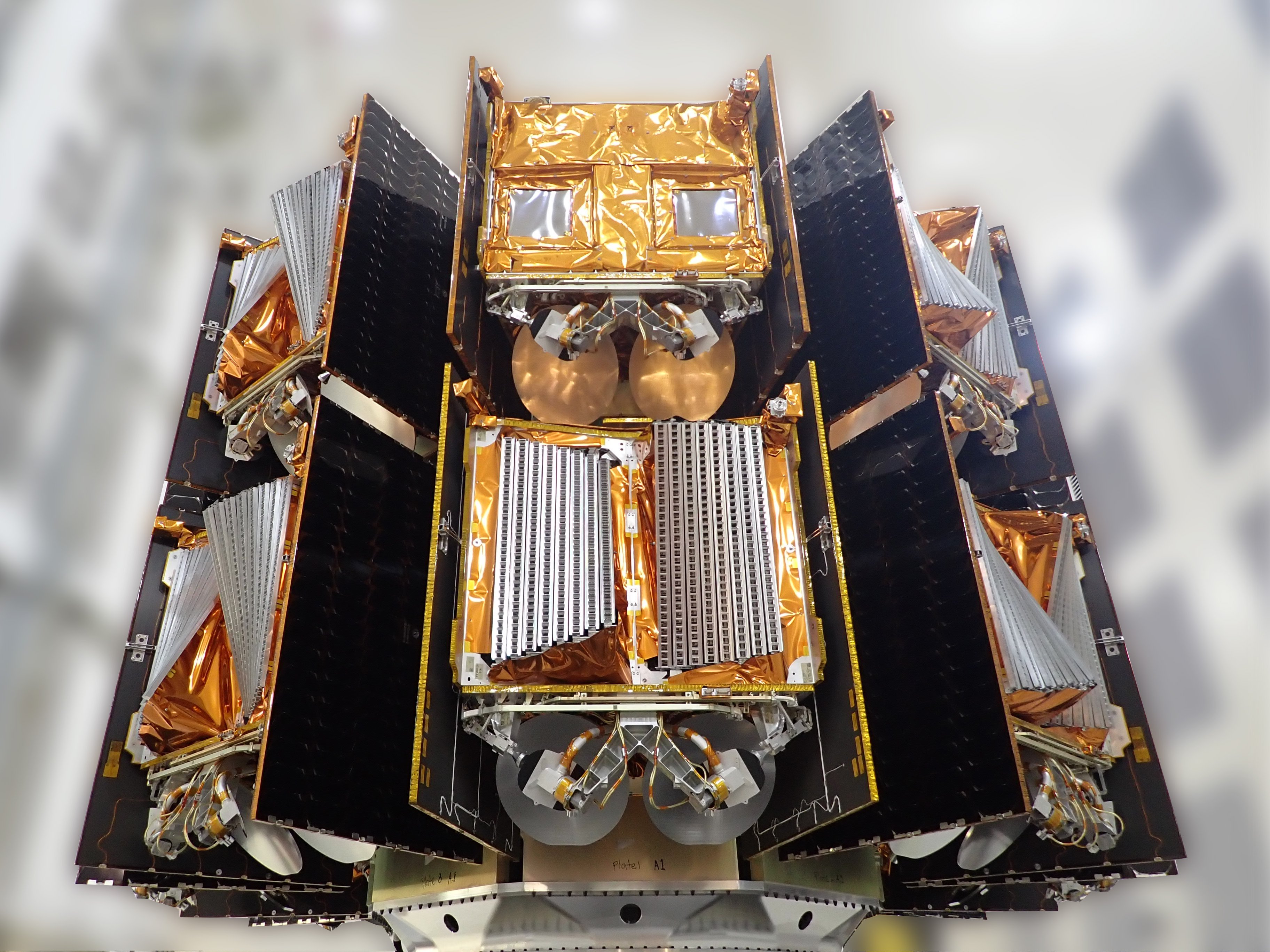
JoeySat and a spare OneWeb Gen 1 satellite successfully separated from the Falcon 9 rocket around one hour and 23 minutes after lift-off. Credit: SpaceX webcast


OneWeb’s Gen2

One of the satellites launched for OneWeb, JoeySat, is designed to test capabilities for a second-generation constellation the company has said could start deployments as soon as 2025.

One of several new technologies on JoeySat is the capability to remotely direct beams and signal strength, according to OneWeb, enabling the satellite to increase capacity at higher usage areas in response to spikes in demand.

Israel-based SatixFy built JoeySat’s payload, supported by funds from the European Space Agency and UK Space Agency, for assembly by Airbus OneWeb Satellites.

JoeySat uses the same satellite platform as OneWeb’s 150-kilogram Gen 1 spacecraft.

French geostationary fleet operator Eutelsat, which is seeking regulatory approvals to buy OneWeb, said May 11 that the Gen 2 satellites would be bulkier than Gen 1 and able to provide three to five times more capacity.

The companies also expect only to need a constellation of around 300 Gen 2 satellites, partly because they could leverage Eutelsat’s network in geostationary orbit over high-demand areas.

Eutelsat and OneWeb have not yet picked a manufacturer for the Gen 2 satellites.

Tuesday, May 16, 2023

Italy awards $256 million contract for 2026 in-orbit servicing mission

Italy’s space agency has awarded local companies 235 million euros ($256 million) in pandemic relief funds for an in-orbit servicing demo in 2026, the group’s leader Thales Alenia Space announced May 15. Thales Alenia Space, a joint venture between Thales of France and Leonardo of Italy, said the group is contracted to design, develop, and qualify a spacecraft capable of performing a range of autonomous robotic operations on satellites in low Earth orbit. The company did not disclose details about the 2026 mission, but said the servicer would have a dexterous robotic arm and test capabilities that include refueling, component repair or replacement, orbital transfer, and atmospheric reentry. The servicer will be launched with a target satellite, Thales Alenia Space spokesperson Cinzia Marcanio said, and both will be fitted with an interface for a refueling mission. Marcanio said the servicer would also be designed to serve larger satellites that it would capture with its robotic arm. Leonardo is providing the robotic arm, developed with SAB Aerospace, the Italian National Institute for Nuclear Physics, and the Italian Institute of Technology. Spaceflight services company Telespazio and rocket builder Avio are also part of the consortium, along with D-Orbit, the space tug specialist that completed its first commercial mission in late 2020. Massimo Comparini, senior executive vice president of observation, exploration, and navigation at Thales Alenia Space, said the mission would highlight how established players could combine their skills and experience with more agile emerging space companies.

The servicer will be based on ION, D-Orbit's in-space transportation platform, illustrated here deploying satellites. Credit: D-Orbit

“By working together they will generate synergies that ensure the future viability of the space sector,” Comparini said, “while also developing all-Italian technologies to support the growth of the country’s space industry.”

Telespazio is responsible for the mission’s ground segment, with support from Altec, a joint venture between Thales Alenia Space and Italy’s space agency.

Avio is in charge of orbital support and developing propulsion for the servicer, which would be based on D-Orbit’s ION (In Orbit Now) orbital transfer vehicle.

D-Orbit is also managing the development of a refueling system that could transfer fluid from the servicer to the target satellite.

The Italian government has allotted about 2 billion euros ($2.2bn) in total for its space industry under the country’s National Plan for Recovery and Resilience to boost its post-pandemic economy.

A 1.1 billion euro chunk of these funds has been earmarked for developing an Earth observation constellation called IRIDE, or International Report for Innovative Defense of Earth.